
Laser Hair Therapy vs Mesotherapy: Which Treatment Is Better for Hair Growth?
Neither treatment is universally better. Laser hair therapy stimulates existing hair follicles with light energy, while mesotherapy delivers active substances into the scalp through microinjections.
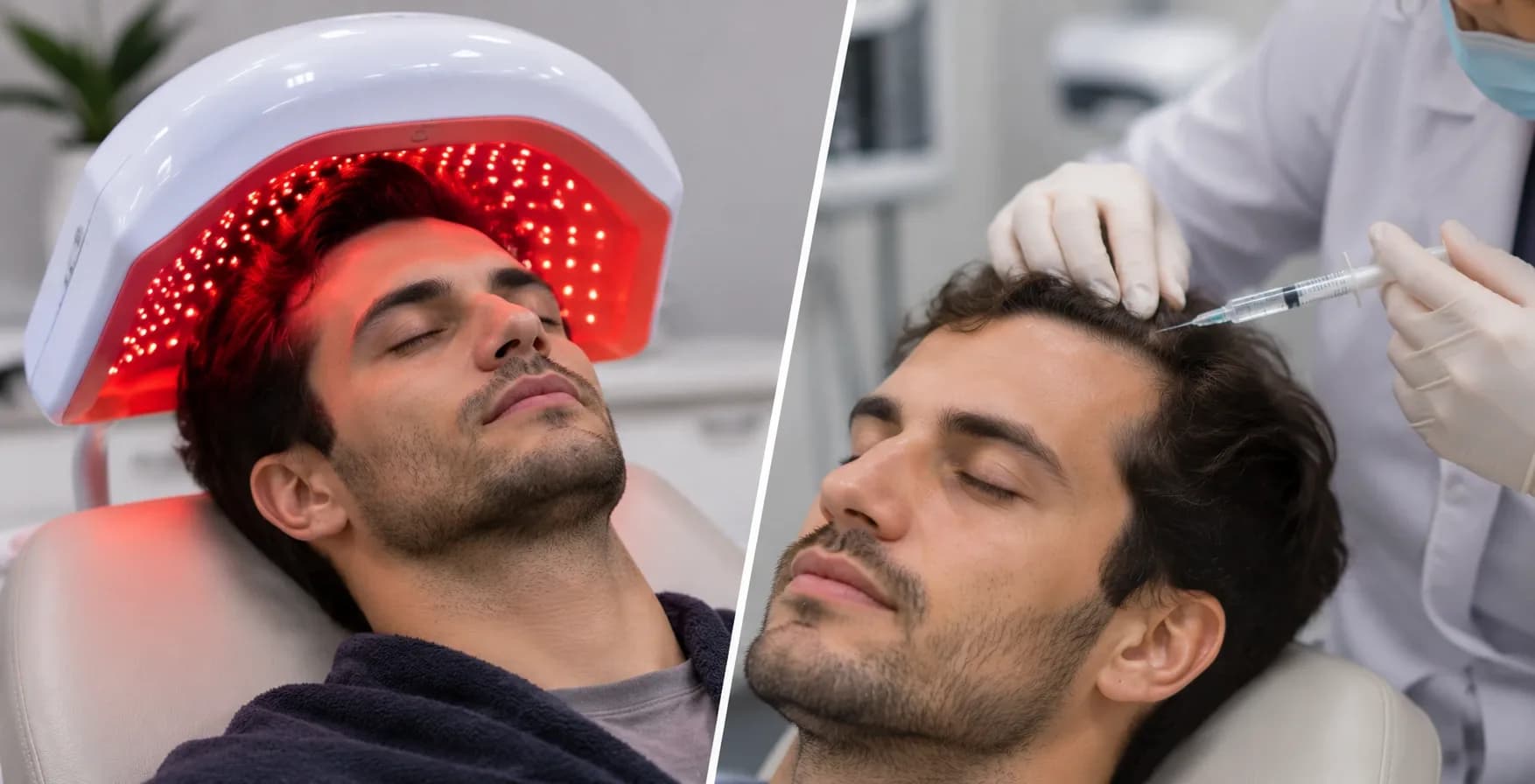
Neither treatment is universally better. Laser hair therapy stimulates existing hair follicles with light energy, while mesotherapy delivers active substances into the scalp through microinjections. The right choice depends on your diagnosis, the activity level of your follicles, and your tolerance for injections.
Interest in non-surgical hair restoration has grown rapidly over the last decade. Patients increasingly look for options that do not involve surgery, long recovery periods, or permanent commitments. Two treatments dominate this conversation: laser hair therapy and hair mesotherapy. Both aim to support hair health and slow the progression of thinning, but they work through entirely different biological mechanisms. Laser hair therapy, also called low-level laser therapy (LLLT) or photobiomodulation, applies red or near-infrared light to the scalp. Mesotherapy, by contrast, injects customized solutions of vitamins, peptides, or medications into the superficial scalp layers. Understanding this distinction matters, because identifying the underlying cause of hair loss remains the single most important step before choosing either treatment.
What Is Laser Hair Therapy and How Does It Work?
Laser hair therapy is a non-invasive treatment that uses specific wavelengths of red light to stimulate cellular activity inside hair follicles, a process known as photobiomodulation.
Low-level laser therapy delivers light at wavelengths typically between 630 and 670 nanometers to the scalp. Unlike surgical lasers, LLLT does not cut, burn, or damage tissue. Instead, cells in the hair follicle absorb the light energy, which may increase cellular metabolism and support follicular function. Researchers propose that this stimulation can improve hair density and increase the thickness of existing hair shafts in patients whose follicles remain active (Avci et al.). Clinical devices for laser hair growth treatment come in several forms, including laser caps, helmets, and handheld combs, which patients use either in clinics or at home.
How Does Low-Level Laser Therapy Stimulate Hair Follicles?
LLLT appears to stimulate follicles by increasing cellular energy production, which may extend the active growth phase of hair and improve local scalp conditions.
The leading hypothesis centers on mitochondria. When follicular cells absorb red light, a protein called cytochrome c oxidase may increase the production of adenosine triphosphate, the molecule that powers cellular activity (Avci et al.). More cellular energy could shift follicles from the resting telogen phase into the growth anagen phase and prolong that growth period. Photobiomodulation may also improve scalp blood circulation and reduce low-grade inflammation around follicles, both of which influence hair thinning. Scientists consider the hair density improvements measured in clinical trials as established findings, while the exact molecular pathways remain proposed mechanisms under continued study (Lanzafame et al.).
What Types of Laser Devices Are Used for Hair Restoration?
Patients can choose between in-office laser systems, wearable laser caps and helmets, and handheld laser combs, with real laser diodes generally outperforming simple LED devices.
LLLT devices fall into three practical categories. First, clinical systems in medical offices deliver controlled energy under professional supervision. Second, wearable caps and helmets contain dozens of laser diodes and allow hands-free home treatment. Third, handheld laser combs and brushes require the user to move the device across the scalp manually. An important distinction separates true laser diodes from light-emitting diodes (LEDs). Lasers produce coherent light at a precise wavelength, which allows consistent energy delivery to follicles, while LEDs emit broader, non-coherent light. When evaluating any device, patients should examine the wavelength, the number of laser diodes, the energy dose per session, and the recommended treatment duration, because these specifications determine whether the device can deliver a therapeutic dose.
What Is Hair Mesotherapy and What Does the Treatment Involve?
Hair mesotherapy is a minimally invasive treatment in which a practitioner injects a customized solution of vitamins, minerals, peptides, or medications into the superficial layers of the scalp through multiple small injections.
During a mesotherapy session, the practitioner uses fine needles or an injection gun to deposit small amounts of a selected solution into the dermis, the skin layer where hair follicle roots sit. This delivery method bypasses the skin barrier, which blocks most topically applied substances. Common ingredients include B vitamins, zinc, amino acids, peptides, and plant-derived extracts, though formulations vary widely between practitioners and protocols. Patients should understand that mesotherapy is not a single standardized formula. The composition of the injected solution depends on the diagnosis, the practitioner's judgment, and local regulations, which makes treatment quality highly dependent on the provider.
How Do Mesotherapy Injections Support Hair Growth?
Mesotherapy supports hair growth by placing active ingredients directly around hair follicles, where nutritional or pharmacological components may improve follicular function and scalp condition.
The scalp microinjections deliver substances to the follicular environment at concentrations that oral supplements cannot achieve locally. Selected nutrients may correct local deficiencies that limit follicular activity, while pharmacological agents such as minoxidil can directly stimulate the follicle where legally permitted (Kadry et al.). This mechanism differs fundamentally from platelet-rich plasma (PRP) therapy. PRP uses concentrated platelets drawn from the patient's own blood to release growth factors, whereas mesotherapy uses externally prepared solutions. Patients should not treat the two injectable procedures as interchangeable.
Which Ingredients Are Commonly Used in Hair Mesotherapy?
Typical mesotherapy formulations combine vitamins, minerals, amino acids, and peptides, and some protocols add medications such as minoxidil or plant-derived extracts.
Vitamins like biotin and pantothenic acid and minerals like zinc participate in normal hair follicle metabolism, and correcting their deficiency may support hair production. Amino acids and peptides serve as building blocks for keratin, the structural protein of the hair shaft. Where regulations allow, practitioners may include minoxidil or other pharmacological substances for patients with androgenetic alopecia. Plant-derived extracts and other supportive ingredients appear in many commercial cocktails. The exact composition matters for both effectiveness and safety, because every injected ingredient carries a potential for allergic or adverse reactions. Patients should always request a full ingredient list before treatment (Kaliyadan et al.).
Laser Hair Therapy vs Mesotherapy: What Are the Main Differences?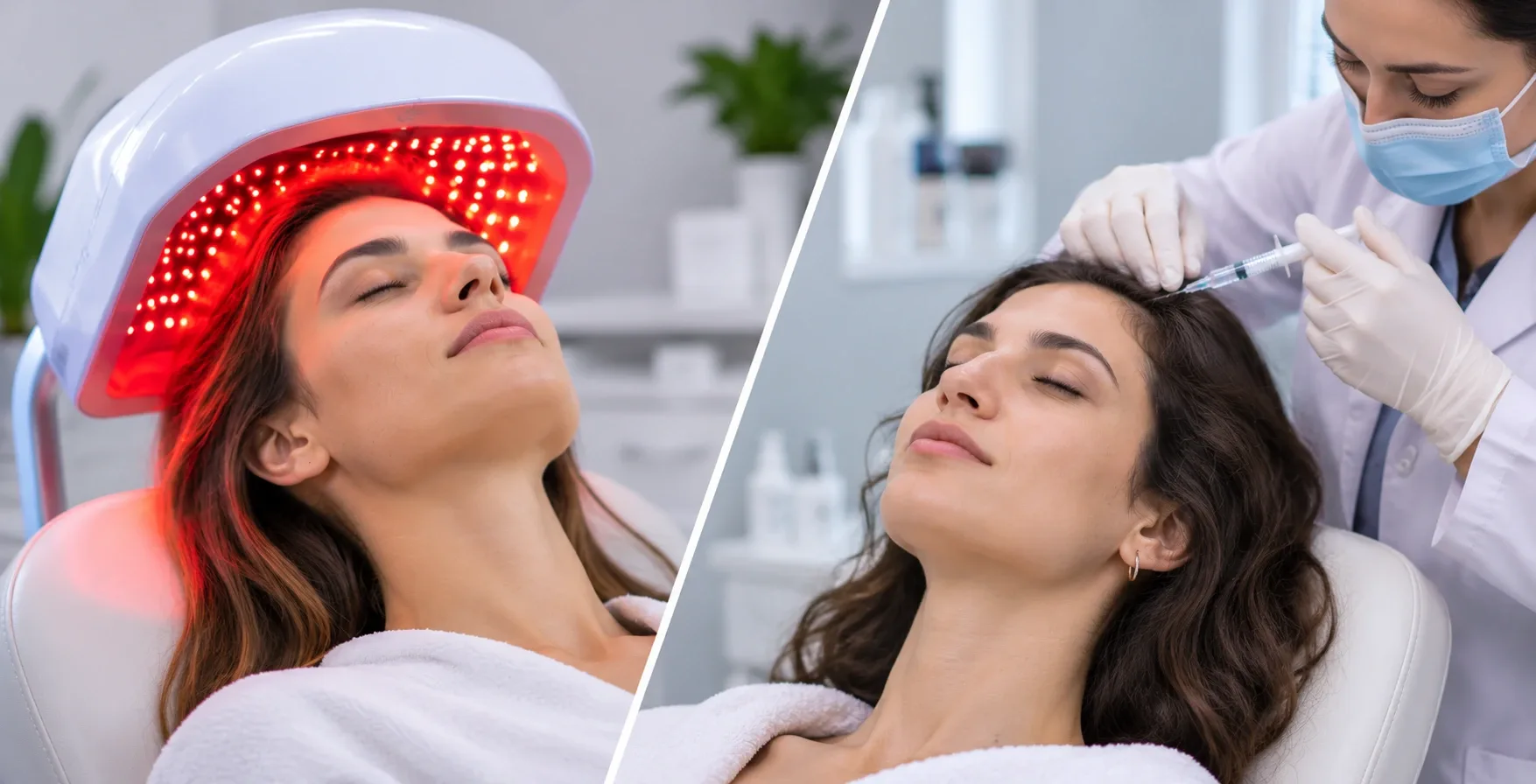
The two treatments differ in mechanism, invasiveness, frequency, and evidence base. Laser therapy uses light to stimulate follicles, while mesotherapy injects substances into the scalp.
Laser hair therapy stimulates follicular activity through photobiomodulation without breaking the skin. Mesotherapy introduces selected substances directly into scalp tissue through needles. These differences shape everything else: recovery time, treatment accessibility, comfort, and maintenance demands. The following table summarizes the core comparison.
Feature | Laser Hair Therapy | Hair Mesotherapy |
Mechanism | Photobiomodulation with red light | Microinjections of active substances |
Invasiveness | Non-invasive, no needles | Minimally invasive, multiple injections |
Setting | Home devices or clinics | Clinical setting only |
Typical frequency | Several sessions weekly, ongoing | Initial series plus maintenance sessions |
Discomfort | Minimal, possible warmth | Injection-related pain, bruising |
Evidence base | Several randomized controlled trials | Limited, heterogeneous studies |
Recovery | None | Short, local reactions possible |
Neither treatment guarantees regrowth in every patient. Both work best on weakened but still functioning follicles, and both require realistic expectations.
How Do Their Treatment Mechanisms Differ?
Laser therapy changes how follicular cells produce and use energy, while mesotherapy changes the chemical environment around the follicle.
Photobiomodulation acts on the cell from the inside by influencing mitochondrial activity and cellular signaling. Mesotherapy acts from the outside by adding substances the follicle may lack or respond to, such as nutrients or growth-supporting medications. Laser treatment therefore targets cellular function, and mesotherapy targets local supply and pharmacological stimulation. Because they affect different biological pathways, the two approaches are not competitors at the mechanistic level, which also explains why practitioners sometimes combine them.
Which Treatment Is More Invasive?
Mesotherapy is more invasive because it requires multiple scalp injections, while laser therapy never penetrates the skin.
Laser hair therapy involves no needles, no skin penetration, and no wound. Mesotherapy delivers dozens of small injections per session, which can cause temporary discomfort, tenderness, and minor bleeding. Injection sites may remain sensitive for a day or two, and some patients develop small bruises. Laser therapy produces no such reactions under correct use. Both treatments allow patients to resume normal daily activities immediately, but patients who fear needles or have sensitive scalps usually tolerate laser therapy more easily.
How Do Treatment Frequency and Duration Compare?
Laser therapy demands frequent, consistent sessions over many months, while mesotherapy follows an initial series of clinic visits with individualized maintenance intervals.
Most laser device protocols require use three to four times per week for 15 to 30 minutes per session, continued indefinitely to maintain results. Compliance strongly influences outcomes, because skipped sessions reduce the cumulative light dose (Jimenez et al.). Mesotherapy usually involves four to ten sessions spaced one to four weeks apart, followed by maintenance appointments every few months. The exact schedule depends on the patient's diagnosis and response, and practitioners adjust intervals based on follow-up assessments.
Is Laser Hair Therapy or Mesotherapy More Effective for Hair Loss?
Effectiveness depends on the type, severity, and cause of hair loss. Laser therapy has stronger controlled-trial evidence for pattern hair loss, while mesotherapy evidence remains limited and inconsistent.
The underlying diagnosis determines whether either treatment can help. Androgenetic alopecia, telogen effluvium, nutritional deficiency, and alopecia areata respond to different interventions. A meta-analysis of LLLT trials found statistically significant improvements in hair density for both men and women with androgenetic alopecia (Lanzafame et al.). Mesotherapy research shows some positive results but suffers from small sample sizes, variable formulations, and inconsistent protocols (Kaliyadan et al.). Crucially, improvements in existing hair do not mean either treatment can regenerate permanently inactive follicles.
How Effective Is Laser Hair Therapy for Androgenetic Alopecia?
Randomized controlled trials show that LLLT can increase hair density and shaft thickness in suitable patients with male or female pattern hair loss, especially when treatment starts early.
A pivotal randomized, double-blind trial demonstrated significant increases in hair counts among men using a laser comb compared with a sham device (Leavitt et al.). A larger multicenter trial confirmed similar density improvements in both men and women over 26 weeks (Jimenez et al.). These results apply to patients whose follicles remain active, which explains the importance of early intervention. Outcomes also depend on device quality and patient compliance, because inconsistent use reduces the therapeutic effect.
Can Mesotherapy Reduce Hair Shedding and Improve Hair Density?
Some studies report reduced shedding and modest density improvements with mesotherapy, but the evidence base remains weaker and less standardized than the evidence for laser therapy.
Small clinical studies suggest that certain formulations, particularly those containing minoxidil or DHT-targeting agents, may support existing follicular activity in androgenetic alopecia (Kadry et al.). Delivering nutrients directly into the scalp may also help patients with documented local deficiencies. However, one controlled study of dutasteride-containing mesotherapy found no evidence of benefit and observed persistent hair loss (Sobjanek et al.). Reviews of the field emphasize that differences in formulations, injection depth, and study design prevent firm conclusions (Kaliyadan et al.). Patients should never interpret individual study percentages as guaranteed personal outcomes.
Which Treatment Works Better for Early-Stage Hair Thinning?
For early thinning with active follicles, non-invasive laser therapy often serves as a reasonable first step, and practitioners may add mesotherapy when targeted scalp support appears useful.
Early-stage thinning responds better to any intervention because follicles still produce hair. A patient who prefers a needle-free, home-based routine may start with LLLT. When a medical assessment reveals specific nutritional or scalp-related issues, a practitioner may consider mesotherapy as an additional supportive measure. The decisive factor is the diagnosis. Genetic thinning, iron deficiency, hormonal changes, and temporary shedding each require different management, so early dermatological evaluation improves every subsequent treatment decision.
Who Is a Suitable Candidate for Each Hair Restoration Treatment?
Suitability depends on follicular activity, scalp condition, medical history, and personal comfort with injections, and both treatments require a professional diagnosis first.
Candidates divide roughly into two groups: patients seeking non-invasive, self-administered treatment, and patients comfortable with clinic-based injections in exchange for targeted delivery. In both cases, a dermatological examination with tools such as trichoscopy should confirm the diagnosis and the state of the follicles before any procedure begins.
Who Can Benefit from Laser Hair Therapy?
Laser therapy suits men and women with early or moderate pattern hair loss who prefer a non-invasive method and can commit to a consistent schedule.
The best candidates include individuals with thinning hair and reduced density who still have active follicles, patients who want to avoid needles, and people willing to use a device several times weekly for months. Patients must hold realistic expectations: improvements develop gradually, and the treatment supports existing hair rather than creating new follicles.
Who Should Consider Hair Mesotherapy?
Mesotherapy suits patients with diagnosed hair thinning whose assessment indicates a need for targeted nutritional or pharmacological scalp support.
Good candidates understand that a practitioner will select the formulation according to their specific diagnosis. They also accept the injection-based nature of the procedure, including possible discomfort and the small risks of infection or allergic reaction. Patients who cannot identify a clear medical reason for the injections should question whether the treatment fits their situation.
Can These Treatments Help Advanced Hair Loss?
No. Neither laser therapy nor mesotherapy can regrow hair in areas where follicles have permanently stopped functioning.
Non-surgical treatments work on weakened but functioning follicles. Once follicles miniaturize completely and disappear, no light or injection can restore them. Established smooth bald areas therefore respond poorly to both treatments. For appropriately selected patients with advanced loss, hair transplantation remains the option that can relocate living follicles into bald regions, sometimes supported by laser therapy or medications afterward.
What Are the Possible Side Effects and Contraindications?
Laser therapy carries minimal risks such as temporary scalp redness, while mesotherapy carries injection-related risks including bruising, infection, and allergic reactions to ingredients.
Safety depends on the application method, the equipment quality, the practitioner's qualifications, and the patient's medical history. The label "non-surgical" does not automatically make any procedure safe for everyone.
What Are the Potential Side Effects of Laser Hair Therapy?
Side effects are rare and mild, mostly limited to temporary scalp redness, warmth, or sensitivity.
Incorrect device use, such as exceeding recommended exposure times, may cause irritation or discomfort. Patients should follow manufacturer instructions precisely. Anyone with active scalp conditions, light-sensitizing medications, or relevant medical history should seek medical advice before starting treatment.
What Are the Risks Associated with Hair Mesotherapy?
Mesotherapy risks include temporary redness, swelling, tenderness, bruising, itching, infection from poor hygiene, and allergic reactions to injected ingredients.
Injection sites commonly show short-lived local reactions. The more serious risks arise when practitioners skip proper hygiene standards or fail to review the formulation with the patient. Because cocktails vary, a patient may react to a specific ingredient even when the general procedure is well tolerated. Reviewing the exact solution before treatment and confirming sterile technique reduces these risks substantially (Kaliyadan et al.).
Can You Combine Laser Hair Therapy with Mesotherapy Safely?
The combination appears plausible because the treatments act on different pathways, but published evidence on combined protocols remains limited.
Practitioners sometimes pair photobiomodulation with injectable treatments to target cellular function and local supply simultaneously. No well-documented interactions exist, yet the absence of reported harm does not establish universal safety. Timing matters: the scalp needs recovery time after injections before further stimulation. Patients should only combine treatments under practitioner guidance with clear scheduling.
Can Laser Hair Therapy and Mesotherapy Be Combined with Other Hair Loss Treatments?
Yes, both treatments can complement established medical therapies such as minoxidil or PRP, but combinations should follow a medical plan rather than simple accumulation of procedures.
Patients with progressive hair loss often need more than one intervention. Non-surgical procedures can support medical treatments, but overlapping or redundant therapies add cost and risk without proven benefit.
How Do Laser Therapy and Mesotherapy Compare with PRP?
PRP uses concentrated platelets from the patient's own blood to release growth factors, making it biologically distinct from both light therapy and prepared injection cocktails.
PRP preparation involves drawing blood, centrifuging it, and injecting the platelet-rich fraction into the scalp. Mesotherapy injects externally formulated solutions instead. Laser therapy involves no injection at all. Each approach proposes a different route to follicular stimulation, and patients should not view PRP and mesotherapy as interchangeable.
Can Minoxidil Be Used Alongside Laser Hair Therapy or Mesotherapy?
Yes. Minoxidil often complements laser therapy, and some mesotherapy formulations include minoxidil itself, but all medication use requires medical supervision.
Minoxidil prolongs the anagen growth phase and increases follicle size. A study comparing combination treatments found that adding low-level laser stimulation to minoxidil improved outcomes in women with pattern hair loss (Wikramanayake et al.). Some practitioners also include minoxidil in mesotherapy solutions where regulations permit. Because minoxidil is a drug with real side effects and contraindications, a physician should supervise its use in any form.
Does Combining Treatments Produce Better Hair Restoration Results?
Combinations can address different aspects of hair loss at once, but superior results require clinical evidence, not assumptions.
The rationale is sound: a drug that prolongs anagen, a light treatment that supports cellular energy, and an injection that corrects local deficiencies target separate mechanisms. Research such as the minoxidil-plus-laser trial supports selected combinations (Wikramanayake et al.). Still, patients should build combinations from individualized medical planning rather than stacking every available procedure automatically.
How Long Does It Take to See Results from Laser Therapy and Mesotherapy?
Both treatments work gradually over three to six months or longer, because hair grows according to a slow biological cycle.
A hair follicle needs weeks to shift growth phases and months to produce a visibly thicker shaft. Individual responses vary widely, which makes consistent treatment and scheduled follow-up assessments essential for judging progress honestly.
When Do Laser Hair Therapy Results Become Visible?
Most patients notice reduced shedding first, with visible density changes typically appearing after three to six months of consistent use.
Clinical trials measured significant improvements at 16 to 26 weeks (Jimenez et al.; Leavitt et al.). Following the recommended device schedule determines whether the cumulative light dose reaches therapeutic levels. Standardized photographs taken monthly under identical lighting help patients and practitioners evaluate progress objectively. Continued treatment remains necessary to maintain any benefit.
How Many Mesotherapy Sessions Are Needed for Hair Growth?
Most protocols involve an initial series of roughly four to ten sessions, with maintenance appointments adjusted to individual response.
No fixed session count suits every patient. The formulation, the diagnosis, and the measured response at follow-up visits all influence scheduling. Practitioners typically extend intervals once the scalp condition stabilizes, and they reassess the plan if progress stalls.
Are the Results of Laser Hair Therapy and Mesotherapy Permanent?
No. Neither procedure removes the underlying cause of androgenetic alopecia, so benefits fade when treatment stops.
Androgenetic alopecia progresses because of genetic and hormonal factors that these treatments do not eliminate. Both approaches manage the condition rather than cure it. Patients should distinguish between temporary improvements in hair quality and sustained control of progressive loss, and they should plan for long-term maintenance from the start.
What Factors Should You Consider Before Choosing a Treatment?
Weigh your diagnosis, treatment goals, budget, time commitment, and medical suitability, and evaluate published evidence rather than promotional claims.
A rational decision starts with the cause of hair loss, not with marketing. Patients should compare the complete treatment plan, including maintenance demands and realistic outcome ranges, before committing money or time.
Does Treatment Cost Differ Between Laser Hair Therapy and Mesotherapy?
Laser therapy often involves a one-time device purchase or clinic fees, while mesotherapy costs accumulate per session according to formulation and practitioner expertise.
Home laser devices carry an upfront price ranging from moderate to premium depending on diode count and specifications. In-office laser programs charge per session or per package. Mesotherapy pricing depends on the injected formulation, the practitioner's experience, and the number of sessions. Comparing a single mesotherapy session against a laser device price misleads; patients should compare total yearly costs of each complete plan.
What Should You Ask a Hair Restoration Specialist Before Treatment?
Ask about your diagnosis, follicle status, the evidence for the recommended treatment, exact ingredients or device parameters, risks, and progress monitoring.
A prepared patient asks: What is the underlying cause of my hair loss? Are my follicles still active? Which treatment has appropriate clinical evidence for my condition? What ingredients will you inject, and why? Which laser device and parameters will you use? What side effects and contraindications apply to me? How will we monitor progress? Clear answers to these questions separate evidence-based practice from sales-driven treatment.
How Can You Choose Between Laser Hair Therapy and Mesotherapy?
Choose based on diagnosis first. Laser therapy fits patients seeking non-invasive stimulation; mesotherapy fits patients whose assessment justifies targeted injectable support.
The fundamental distinction is simple: light energy versus injected substances. Patients who prefer a painless, home-based routine and commit to regular use often start with laser therapy. Patients with specific scalp or follicular needs identified during medical assessment may benefit from a tailored mesotherapy protocol. In either case, a qualified hair restoration specialist should confirm the diagnosis and guide the final decision.
Frequently Asked Questions About Laser Hair Therapy vs Mesotherapy
Is Laser Hair Therapy Better Than Mesotherapy for Hair Loss?
No treatment is universally superior. The better option depends on the hair loss diagnosis and the individual patient's suitability for each method.
Laser therapy holds stronger controlled-trial evidence for pattern hair loss, while mesotherapy offers customizable formulations for selected cases (Lanzafame et al.; Kaliyadan et al.).
Can Mesotherapy Regrow Hair in Bald Areas?
No. Injectable treatments cannot restore permanently inactive follicles in established bald areas.
Mesotherapy may support weakened but living follicles. Smooth bald regions require surgical restoration instead.
Is Laser Hair Therapy Completely Painless?
Yes, correct laser therapy is painless because no needle or skin penetration occurs.
Some users report mild temporary warmth or scalp sensitivity, which resolves without intervention.
Can I Use a Laser Hair Growth Cap After Mesotherapy?
Usually yes, but only after the scalp recovers and your practitioner approves the timing.
Injection sites need time to heal before additional stimulation. Practitioner guidance prevents irritation or interference with the injected solution.
Does Mesotherapy Work for Male and Female Pattern Baldness?
Some formulations show potential in pattern baldness, but evidence quality varies and results are not guaranteed.
Studies differ widely in formulation and protocol, so patients should interpret published outcomes cautiously (Kadry et al.; Sobjanek et al.).
Can Laser Hair Therapy Stop Hair Shedding?
Laser therapy may reduce shedding in some patients, but responses vary between individuals.
Reduced shedding often appears as the first sign of response, typically within the first few months of consistent use.
Which Treatment Is Better for Sensitive Scalps?
Laser therapy suits sensitive scalps better because it involves no injections or skin trauma.
An individual scalp assessment still matters, since some conditions contraindicate even light-based treatment.
Can Laser Hair Therapy and Mesotherapy Replace Hair Transplantation?
No. These treatments stimulate existing follicles, while transplantation surgically relocates living follicles into bald areas.
For advanced hair loss with depleted donor areas of active follicles, transplantation remains the only option that adds hair where none grows.
Conclusion: Laser Hair Therapy vs Mesotherapy
Laser hair therapy and mesotherapy support hair restoration through different mechanisms, and the best choice follows from a professional diagnosis, not from general claims.
Laser therapy uses photobiomodulation to stimulate follicular cells without needles, backed by several randomized controlled trials in pattern hair loss. Mesotherapy delivers customized substances through scalp microinjections, offering targeted support with a thinner and more variable evidence base. The two treatments differ in invasiveness, frequency, cost structure, and risk profile, and neither guarantees regrowth or permanent results. The essential step remains identifying the underlying cause of hair loss. A consultation with a qualified hair restoration specialist, armed with the right questions, gives every patient the strongest foundation for an effective and realistic treatment plan.
References
Avci, Pinar, et al. "Low-Level Laser (Light) Therapy (LLLT) for Treatment of Hair Loss." Lasers in Surgery and Medicine, vol. 46, no. 2, 2014, pp. 144-151.
Jimenez, Joaquin J., et al. "Efficacy and Safety of a Low-Level Laser Device in the Treatment of Male and Female Pattern Hair Loss: A Multicenter, Randomized, Sham Device-Controlled, Double-Blind Study." American Journal of Clinical Dermatology, vol. 15, no. 2, 2014, pp. 115-127.
Kadry, Reham, et al. "Minoxidil-Containing Mesotherapy Solution versus Topical Minoxidil in Female Pattern Hair Loss: A Comparative Study." Journal of Dermatological Treatment, vol. 30, no. 7, 2019, pp. 707-712.
Kaliyadan, Feroze, et al. "Mesotherapy: What Is New?" Indian Journal of Dermatology, Venereology and Leprology, vol. 79, no. 1, 2013, pp. 127-134.
Lanzafame, Raymond J., et al. "The Growth of Human Scalp Hair Mediated by Visible Red Light Laser and LED Sources in Males." Lasers in Surgery and Medicine, vol. 45, no. 8, 2013, pp. 487-495.
Leavitt, Matt, et al. "HairMax LaserComb Laser Phototherapy Device in the Treatment of Male Androgenetic Alopecia: A Randomized, Double-Blind, Sham Device-Controlled, Multicentre Trial." Clinical Drug Investigation, vol. 28, no. 5, 2008, pp. 283-292.
Sobjanek, Michal, et al. "Mesotherapy with Dutasteride-Containing Preparation in Treatment of Male Pattern Androgenetic Alopecia." Journal of Dermatological Case Reports, vol. 2, no. 3, 2008, pp. 46-47.
Wikramanayake, Tongyu Cao, et al. "Effects of the Lexington LaserComb on Hair Regrowth in the C3H/HeJ Mouse Model of Alopecia Areata." Lasers in Medical Science, vol. 27, no. 2, 2012, pp. 431-437.