
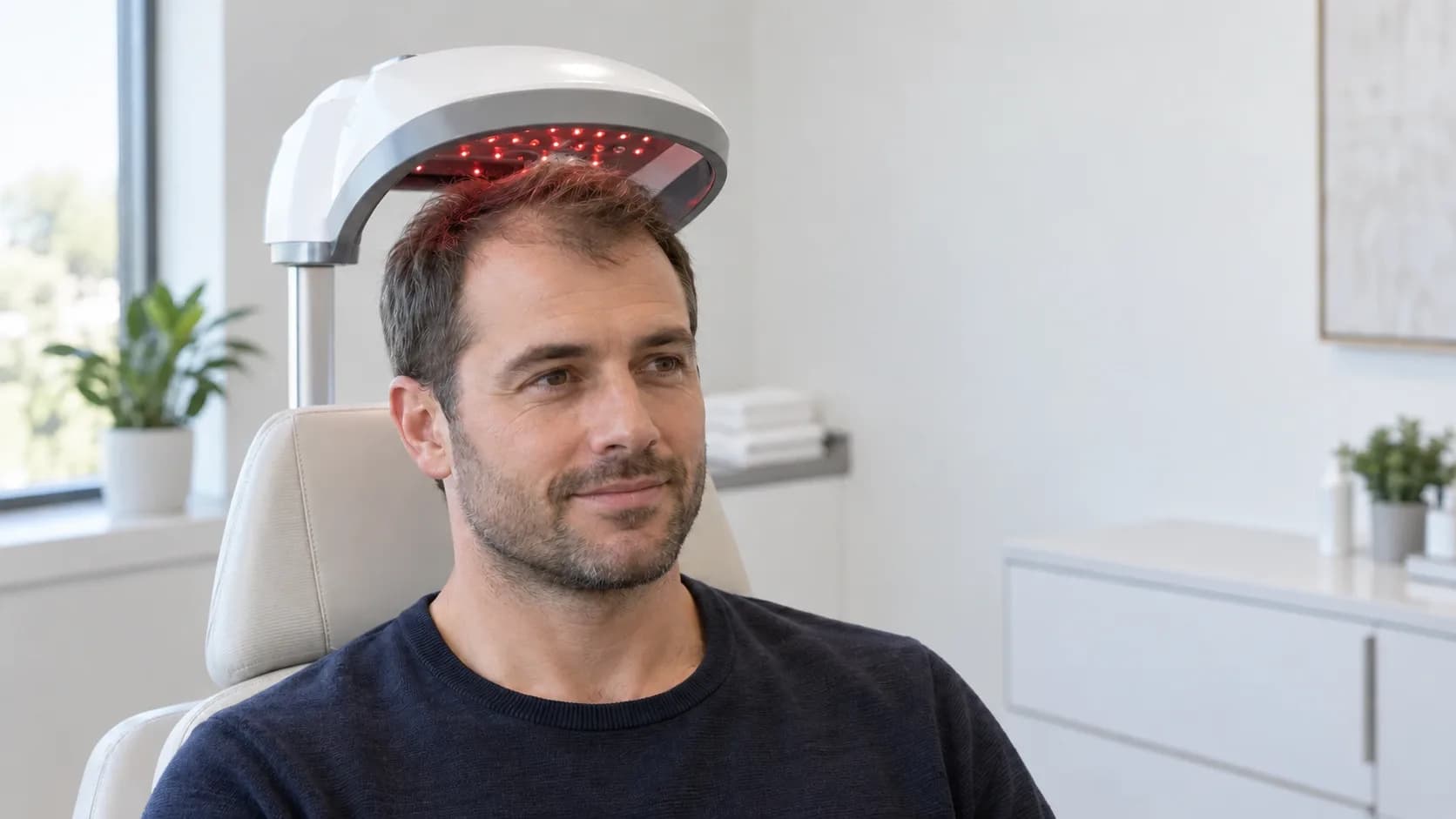
Laser Hair Therapy for Men
Laser hair therapy for men is a non-invasive treatment that uses red or near-infrared light to stimulate hair follicles and improve hair growth in men with androgenetic alopecia.
Low-level laser therapy (LLLT), also called photobiomodulation, offers men a non-surgical way to stimulate hair follicles, improve hair density, and slow the progression of androgenetic alopecia. Research supports its use as an adjuvant treatment, but it works best for men with early-stage thinning who still have viable follicles.
What Is Laser Hair Therapy for Men?
Laser hair therapy for men is a non-invasive treatment that uses red or near-infrared light to stimulate hair follicles and improve hair growth in men with androgenetic alopecia.
Laser hair therapy applies low-level light energy to the scalp to encourage hair regrowth. Clinicians also call it low-level laser therapy (LLLT), low-level light therapy, or photobiomodulation (PBM/PBMT). These terms describe the same core concept: light that stimulates biological processes without generating heat or damaging tissue (Avci et al. 2013).
Laser hair therapy differs fundamentally from laser hair removal. Removal devices use high-energy light to destroy follicles. Hair growth devices use low-energy light to activate them. The goal is the opposite: preservation and stimulation rather than destruction.
Men can choose between in-office laser systems and at-home devices. Clinical systems typically deliver higher irradiance under professional supervision. At-home options include laser caps, combs, and bands that men use several times per week. Both approaches aim to deliver therapeutic light directly to the scalp.
How Does Laser Hair Therapy Stimulate Hair Growth?
Laser hair therapy stimulates hair growth by delivering specific wavelengths of light that follicular cells absorb, triggering increased cellular energy production, improved microcirculation, and a shift of follicles into the active growth phase.
How Does Light Energy Interact With Hair Follicles?
Follicular cells absorb red and near-infrared light through photoreceptors in mitochondria, which increases cellular energy production and stimulates follicle activity.
Follicular tissue contains photoreceptors that respond to specific wavelengths of light. The primary target is cytochrome c oxidase, a key enzyme in the mitochondrial respiratory chain. When light activates this enzyme, mitochondria produce more adenosine triphosphate (ATP), the energy currency of the cell (Avci et al. 2013). Higher ATP levels give follicular cells the fuel they need to function more actively.
The cellular response depends on wavelength. Visible red light (roughly 630 to 660 nanometers) and near-infrared light (roughly 800 to 900 nanometers) penetrate scalp tissue most effectively. These ranges reach follicle depth without causing thermal damage.
How Can Photobiomodulation Influence the Hair Growth Cycle?
Photobiomodulation can prolong the anagen (growth) phase, promote follicular cell proliferation, and partially reverse the miniaturization process in androgenetic alopecia.
Each hair follicle cycles through growth (anagen), transition (catagen), and rest (telogen) phases. Androgenetic alopecia progressively shortens the anagen phase, so hairs grow thinner and shorter over time. Photobiomodulation appears to counteract this process by stimulating follicular cell proliferation and supporting follicles that have begun to miniaturize (Zarei et al. 2016). The treatment cannot revive a follicle that has died, but it can improve the function of follicles that still produce fine, vellus-like hairs.
Can Laser Therapy Improve Blood Supply to the Scalp?
Low-level laser therapy increases microcirculation around follicles, which improves oxygen and nutrient delivery to active hair roots.
Healthy follicles depend on a rich blood supply. Research suggests that photobiomodulation dilates local blood vessels and increases microcirculation in treated tissue (Liu et al. 2019). Better circulation delivers more oxygen and nutrients to follicular cells. This improved blood supply supports the metabolic demands of an actively growing follicle and complements the direct cellular effects of light.
Is Laser Hair Therapy Effective for Male Pattern Hair Loss?
Controlled studies show that laser hair therapy can improve hair density and thickness in men with androgenetic alopecia, though individual responses vary and evidence is stronger for some devices than others.
Randomized, sham-controlled trials provide the strongest evidence. Leavitt and colleagues (2009) found that men using a laser comb device showed significantly greater hair density increases than men using a sham device after 26 weeks. Jimenez et al. (2014) confirmed these results in a larger multicenter trial of men and women with pattern hair loss.
Evidence reviews echo this conclusion with caution. A systematic review of LLLT for hair loss concluded that the therapy shows promise, but study heterogeneity in devices, wavelengths, and dosing limits firm conclusions (Liu et al. 2019). Egger et al. (2020) similarly described the evidence as encouraging but noted that more standardized research is needed. Men should view laser therapy as a supported but not definitive treatment.
Which Men Are Most Likely to Benefit From Laser Hair Therapy?

Men with early-stage androgenetic alopecia benefit most, because treatment stimulates follicles that still exist; men with advanced baldness see little effect.
Is Laser Therapy Suitable for Early Male Pattern Baldness?
Yes, early-stage thinning responds best, because miniaturized follicles retain the biological machinery that light can reactivate.
Men with early recession, a thinning crown, or diffuse thinning preserve large numbers of miniaturized follicles. These follicles still produce hair, albeit fine and short. Photobiomodulation can thicken these hairs and extend their growth phase. Early intervention protects the follicle reserve before permanent loss occurs.
Can Men With Advanced Hair Loss Benefit From Laser Therapy?
No, laser therapy cannot restore hair over smooth bald areas where follicles have been lost; these men need surgical restoration instead.
Laser therapy requires a viable follicle as its target. Shiny bald skin lacks follicles, so light has nothing to stimulate. Men with advanced baldness should consult a hair restoration specialist about transplantation. Laser therapy may still play a supportive role after surgery.
Does the Cause of Hair Loss Affect Treatment Results?
Yes, laser therapy targets androgenetic alopecia; scarring alopecias and autoimmune hair loss require medical treatment first.
Androgenetic alopecia responds to light therapy because follicles miniaturize gradually. Scarring alopecias destroy follicles permanently, and alopecia areata involves immune attack. Neither condition suits laser therapy as a primary treatment. A correct diagnosis from a dermatologist must precede any light-based intervention.
Which Wavelengths Are Used for Hair Growth?
Red light (630-660 nm) and near-infrared light (800-900 nm) are the most studied wavelengths, because they penetrate scalp tissue deeply enough to reach follicles.
Wavelength determines penetration depth. Shorter wavelengths scatter in superficial tissue. The 630 to 660 nm range targets follicular structures effectively, while 800 to 900 nm near-infrared light penetrates deeper. Both ranges appear in clinically tested devices (Lanzafame et al. 2013). Laser diodes produce coherent, focused light, while LEDs produce broader, incoherent output. Both can deliver therapeutic photons, but lasers typically achieve higher irradiance at the follicle.
How Often Should Men Use Laser Hair Therapy?
Most protocols require three to five sessions per week for several months, because hair growth responds to cumulative, consistent light exposure.
Why Does Laser Hair Therapy Require Repeated Sessions?
Hair grows in cycles, so light must reach follicles repeatedly over time to influence the follicle population effectively.
A single exposure cannot shift enough follicles into anagen at once. Repeated treatments accumulate biological effects across successive growth cycles. Consistency matters more than intensity. Men who follow the schedule rigorously outperform those who treat sporadically.
Can Too Much Light Reduce the Effectiveness of Treatment?
Yes, photobiomodulation follows a biphasic dose response, so exceeding recommended doses provides no added benefit and may reduce results.
Low doses stimulate. High doses inhibit. This biphasic response means that longer sessions or more frequent use do not accelerate growth. Each device specifies an optimal dose, and men should follow manufacturer parameters exactly.
How Long Does It Take to See Hair Growth?
Most men notice reduced shedding within 8 to 12 weeks and visible density changes within 4 to 6 months of consistent use.
Hair grows slowly, roughly one centimeter per month. Early changes appear as less shedding and slightly thicker strands. Meaningful cosmetic improvement requires patience and continued treatment, with periodic photographic monitoring.
What Types of Laser Hair Therapy Devices Are Available for Men?
Men can choose laser caps, laser combs, and laser bands, each delivering red or near-infrared light to the scalp through different coverage patterns.
How Do Laser Caps Work?
Laser caps contain an array of diodes inside a helmet-like shell that bathes the whole scalp in light during each session.
Caps offer hands-free, full-coverage treatment. Men wear them for 15 to 30 minutes per session. The main limitation is cost, and caps deliver light through hair, so dense hair can block photons.
What Are Laser Combs and Laser Bands?
Laser combs and bands part the hair during use, which brings light into closer contact with the scalp.
Combs require manual movement across the scalp. Bands rest on the head and combine parting teeth with diodes. Both improve scalp contact compared with caps, but they demand more user effort and cover smaller areas per session.
Are At-Home Laser Devices as Effective as Clinical Treatment?
At-home devices with validated specifications can match clinical systems, but effectiveness varies widely between products, so men should check the evidence for each specific device.
Not all devices deliver equivalent irradiance, wavelength accuracy, or dosing. FDA clearance indicates safety, not proof of strong effectiveness. Men should verify wavelength, coverage, and clinical trial data before purchase.
Why Does Light Need to Reach the Scalp?
Hair absorbs and scatters light, so devices must part or compress hair to deliver photons to follicle depth.
Dark, dense hair blocks transmission. Devices that maintain direct scalp contact solve this problem. Hair color, density, and length all influence delivery, which partly explains why individual results vary.
What Can Men Expect During a Laser Hair Therapy Session?
A session involves scalp assessment, light application for 10 to 30 minutes, and no downtime; men can resume normal activities immediately.
Professional sessions begin with a scalp evaluation and photography. The clinician positions the device, and the man feels mild warmth or nothing at all. At-home sessions follow the same pattern without supervision. Treatment causes no pain and requires no recovery period.
What Are the Benefits of Laser Hair Therapy for Men?
Laser hair therapy offers improved density, thicker strands, preservation of existing hair, and a non-surgical profile with minimal side effects.
Can Laser Therapy Increase Hair Density?
Yes, controlled trials report measurable density increases compared with sham treatment after several months of use (Jimenez et al. 2014).
Can It Improve Hair Thickness?
Yes, treated hairs often show increased shaft diameter, which improves the visual fullness of thinning areas.
Can It Help Preserve Existing Hair?
Yes, consistent treatment supports follicles under androgenetic pressure and slows the conversion of thick hairs into fine vellus hairs.
Is It a Non-Surgical Option for Hair Loss?
Yes, photobiomodulation involves no incisions, no anesthesia, and no systemic medication.
Does It Require Downtime?
No, men return to work and exercise immediately after each session.
What Are the Limitations of Laser Hair Therapy?
Response varies between individuals, treatment demands long-term commitment and ongoing cost, and evidence lacks full standardization across devices and protocols.
Results differ because follicle biology, hair characteristics, and device quality differ. Treatment requires months of consistent use, and benefits fade after discontinuation. No universal dosing standard exists, and long-term data beyond two to three years remain limited. Consumer devices vary enormously in specifications.
Is Laser Hair Therapy Safe for Men?
Yes, low-level laser therapy has an excellent safety profile, with only mild and temporary side effects reported in clinical studies.
What Side Effects Can Laser Hair Therapy Cause?
Temporary warmth, mild dryness, itching, and scalp tenderness are the most commonly reported effects, and they resolve without intervention.
Are There Men Who Should Avoid Laser Hair Therapy?
Men taking photosensitizing medications, those with undiagnosed or rapidly progressing hair loss, and those with inflammatory scalp disorders should seek medical evaluation before treatment.
Does Red-Light Hair Therapy Damage the Scalp?
No, therapeutic lasers use non-ionizing light at low power, which cannot damage DNA or burn tissue when used as directed.
Can Men Combine Laser Hair Therapy With Other Hair Loss Treatments?
Yes, laser therapy pairs well with minoxidil, finasteride, PRP, and hair transplantation, and combination strategies often outperform single treatments.
Can Laser Therapy Be Used With Minoxidil?
Yes, the two work through different mechanisms, and combined use targets both follicle energy and blood flow support.
Can It Be Combined With Finasteride?
Yes, finasteride reduces the hormonal drive behind miniaturization while laser therapy stimulates follicular activity, creating a complementary effect (Zarei et al. 2016).
Can Laser Therapy Be Combined With PRP?
Yes, many clinics combine both, though evidence for the combined protocol remains preliminary.
Can It Be Used Before or After Hair Transplantation?
Yes, laser therapy may support healing and graft survival after transplantation, but timing must follow the surgeon's protocol.
How Does Laser Hair Therapy Compare With Other Male Hair Loss Treatments?
Laser therapy occupies the middle ground between drug therapy and surgery: it is non-invasive like minoxidil but slower, and it is less powerful than transplantation but far less invasive.
Treatment | Mechanism | Invasiveness | Evidence Strength | Typical Timeline |
Laser therapy | Follicle stimulation | None | Moderate | 4-6 months |
Minoxidil | Blood flow and growth phase support | None (topical) | Strong | 3-6 months |
Finasteride | DHT reduction | None (oral) | Strong | 6-12 months |
PRP | Growth factor delivery | Minimal (injections) | Moderate | 3-6 months |
Hair transplantation | Follicle relocation | Surgical | Strong | 6-12 months |
Laser Therapy vs Minoxidil
Minoxidil has stronger evidence and lower long-term cost, but it demands twice-daily application and can cause scalp irritation. Laser therapy offers convenience without systemic or topical exposure.
Laser Therapy vs Finasteride
Finasteride addresses the hormonal cause of androgenetic alopecia, while laser therapy stimulates follicles directly. Finasteride carries a small risk of sexual side effects that laser therapy does not.
Laser Therapy vs PRP
PRP delivers growth factors through injections and requires clinic visits. Laser therapy is painless and home-based. Both show moderate evidence.
Laser Therapy vs Hair Transplantation
Transplantation permanently restores hair in bald areas and suits advanced loss. Laser therapy supports existing follicles and suits early thinning. Doctors often combine them.
How Should Men Choose a Laser Hair Therapy Device?
Men should prioritize wavelength (630-660 nm or 800-900 nm), adequate irradiance, proven scalp contact, a realistic treatment schedule, device-specific clinical evidence, and appropriate regulatory clearance.
Men should match the device to their lifestyle. A cap suits men who value convenience. A comb suits men willing to invest manual effort for better scalp contact. FDA clearance confirms safety, not superiority, so men should read the actual trial data behind each product.
What Results Can Men Realistically Expect From Laser Hair Therapy?
Men should expect gradual, modest improvement in thickness and density over four to six months, not dramatic regrowth, and results require ongoing maintenance.
Baseline photographs taken monthly provide objective tracking. Realistic expectations prevent disappointment. The treatment enhances existing follicles; it cannot recreate follicles that have disappeared.
When Should a Man See a Dermatologist About Hair Loss?
Men should consult a dermatologist for sudden shedding, patchy loss, scalp pain or inflammation, or any hair loss that fails to respond to self-directed treatment.
Sudden hair loss can signal thyroid disease, anemia, or autoimmune conditions. Scarring alopecias destroy follicles quickly and demand urgent treatment. A dermatologist must confirm the diagnosis before a man invests in any light-based device.
Frequently Asked Questions About Laser Hair Therapy for Men
Does Laser Hair Therapy Really Regrow Hair in Men?
Yes, it can regrow hair in thinning areas where follicles survive, and controlled trials confirm measurable density gains (Leavitt et al. 2009).
How Long Does Laser Hair Therapy Take to Work?
Most men see early changes in 8 to 12 weeks and visible results in 4 to 6 months.
Can Laser Therapy Stop Male Pattern Baldness?
It can slow progression, but it rarely stops the condition completely; most men combine it with finasteride for stronger control.
Can Laser Hair Therapy Regrow a Receding Hairline?
It can thicken fine hairs at the hairline, but it cannot restore a deeply receded line to its original position.
Can Laser Therapy Thicken Miniaturized Hair?
Yes, thickening miniaturized hairs is one of its best-supported effects.
Can Men Use Laser Hair Therapy at Home?
Yes, cleared at-home devices make home treatment practical and safe when men follow instructions.
How Many Times a Week Should Men Use Laser Hair Therapy?
Most protocols call for three to five sessions per week, and men should never exceed the device schedule.
Is Laser Hair Therapy Painful?
No, sessions are painless and produce only mild warmth at most.
Are Laser Hair Therapy Results Permanent?
No, men must maintain treatment, because benefits diminish after they stop.
Can Laser Hair Therapy Be Used After a Hair Transplant?
Yes, many surgeons incorporate it into postoperative care after grafts have stabilized.
What Is the Bottom Line on Laser Hair Therapy for Men?
Laser hair therapy is a safe, non-surgical option that works best for men with early androgenetic alopecia who commit to consistent, long-term use and combine it with proven treatments.
The evidence supports photobiomodulation as a legitimate component of a broader hair-loss strategy. It will not replace finasteride, minoxidil, or transplantation, but it strengthens results when men use it correctly. The path to success starts with a correct diagnosis, continues with a well-chosen device, and succeeds through patience.
References
Avci, Pinar, et al. "Low-Level Laser (Light) Therapy (LLLT) in Skin: Stimulating, Healing, Restoring." Seminars in Cutaneous Medicine and Surgery, vol. 32, no. 1, 2013, pp. 41-52.
Egger, Anna, et al. "Examining the Safety and Efficacy of Low-Level Laser Therapy for Male and Female Pattern Hair Loss: A Review of the Literature." Skin Appendage Disorders, vol. 6, no. 5, 2020, pp. 259-267.
Jimenez, Joaquin J., et al. "Efficacy and Safety of a Low-Level Laser Device in the Treatment of Male and Female Pattern Hair Loss: A Multicenter, Randomized, Sham Device-Controlled, Double-Blind Study." American Journal of Clinical Dermatology, vol. 15, no. 2, 2014, pp. 115-127.
Lanzafame, Raymond, et al. "The Growth of Human Scalp Hair Mediated by Visible Red Light Laser and LED Sources in Males." Lasers in Surgery and Medicine, vol. 45, no. 8, 2013, pp. 487-495.
Leavitt, Matt, et al. "HairMax LaserComb Laser Phototherapy Device in the Treatment of Male Androgenetic Alopecia: A Randomized, Double-Blind, Sham Device-Controlled, Multicentre Trial." Clinical Drug Investigation, vol. 29, no. 5, 2009, pp. 283-292.
Liu, K. H., et al. "Low-Level Laser Therapy for Hair Loss: A Systematic Review and Meta-Analysis." Lasers in Medical Science, vol. 34, no. 6, 2019, pp. 1063-1071.
Zarei, Mina, et al. "Low Level Laser Therapy and Hair Regrowth: An Evidence-Based Review." Lasers in Medical Science, vol. 31, no. 2, 2016, pp. 363-371.