
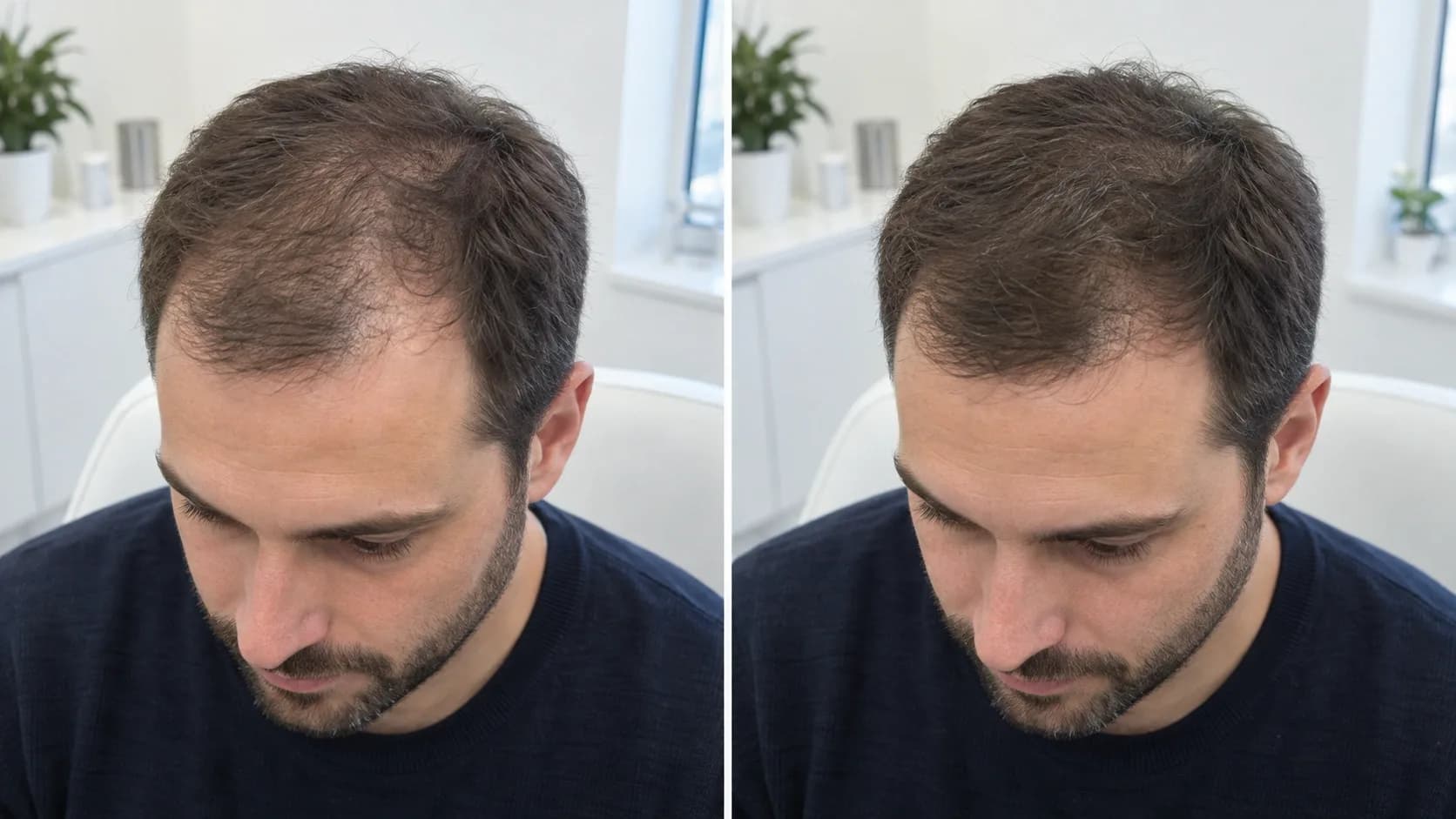
Laser Hair Therapy Before and After
Expect gradual change over months: first reduced shedding, then fine new hairs, then thicker strands and better coverage, with the most visible laser hair therapy results appearing around four to six months.
Laser hair therapy before and after comparisons show gradual improvements in hair density, thickness, and shedding control over four to six months, not overnight regrowth. Low-level laser therapy (LLLT) uses red light to stimulate follicular activity, and the visual changes documented in laser hair therapy results reflect a biological process that unfolds in stages. This guide explains what the scalp looks like at each phase, how to evaluate laser hair growth results accurately, and which factors shape your individual outcome. Every statement below aligns with peer-reviewed clinical research, so you can judge expectations against evidence rather than marketing.
What Can You Expect From Laser Hair Therapy Before and After Treatment?
Expect gradual change over months: first reduced shedding, then fine new hairs, then thicker strands and better coverage, with the most visible laser hair therapy results appearing around four to six months.
Laser hair therapy, also called low-level laser therapy for hair loss, applies red or near-infrared light to the scalp at doses too low to heat or damage tissue. In clinical settings, specialists use this approach to treat thinning hair, and the "before and after" comparison documents how the same scalp regions change during that process. Before-and-after results represent three different biological events that patients often confuse: true regrowth of new hairs, a slowdown of shedding that preserves existing density, and an increase in the caliber of miniaturized strands. Each event has a different timeline and a different visual signature. Research confirms that LLLT hair growth follows a delayed pattern because light first alters cellular behavior inside the follicle, and only later does the surface appearance change (Avci et al. 2014). Set your expectations accordingly: meaningful laser hair regrowth is a months-long project, and early patience directly predicts later satisfaction.
How Does Laser Hair Therapy Affect Hair Follicles?
Laser light triggers photobiomodulation, a process where light energy absorbed by scalp cells improves cellular function and may shift follicles toward active growth.
Photobiomodulation describes how low-level light interacts with biological tissue without raising temperature. When red light reaches the scalp, chromophores inside cells absorb the photons and convert that energy into cellular signaling changes. In the follicle, this interaction may increase mitochondrial activity, improve blood flow to the dermal papilla, and extend the anagen phase of the hair growth cycle, which is the active production period of each strand (Avci et al. 2014). These cellular shifts explain why follicular activity rises before any mirror-visible change appears. However, the light can only influence follicles that remain alive. A follicle that still produces even a thin, short vellus hair can respond; a follicle that has been inactive for many years offers little biological substrate for treatment. This principle shapes every realistic expectation about laser therapy for thinning hair.
What Does Hair Look Like Before Starting Laser Therapy?
Before treatment, most patients show increased scalp visibility, reduced density, and miniaturized hairs; documenting these signs with baseline photos creates the reference point for all later comparisons.
What Signs Do Before-Treatment Photos Typically Show?
Typical baseline photos reveal five signs: more visible scalp, lower hair density, miniaturized strands, recession or crown thinning, and elevated daily shedding.
Hair miniaturization sits at the center of most baseline images. Each affected follicle produces a strand that is progressively thinner, shorter, and lighter in color than the hair it replaced. In androgenetic alopecia, the most common treatment target, this miniaturization follows a recognizable map: the hairline and crown in men, and the central part line in women. Increased scalp visibility follows density loss almost mathematically, because fewer shafts per square centimeter expose more skin. Elevated shedding completes the picture, as follicles spend less time in anagen and more hairs enter the resting phase simultaneously.
Why Should You Take Baseline Photos Before Treatment?
Baseline photos freeze your true starting point and eliminate the distortions of memory, styling, and lighting that make informal judgment unreliable.
Human memory compresses gradual change; six months from now you will remember your starting density as worse or better than it was. Standardized photography solves this problem by locking camera position, lighting, hair length, and parting at day zero. Clinical trials depend on this method precisely because it turns subjective impression into comparable data (Jimenez et al. 2014). Take five views on day one: hairline, both temples, crown, mid-scalp, and a top-down overview. Repeat the exact setup every month. This disciplined baseline transforms your later evaluation from guesswork into measurement.
What Changes Can You See During the First Months of Laser Hair Therapy?
The laser hair therapy results timeline runs from invisible cellular change in months one and two, to early fine hairs by month four, to clearly visible thickness and coverage by month six.
Treatment Period | Biological Event | What You Will Actually See |
Months 1–2 | Cellular signaling shifts inside follicles | Scalp looks nearly unchanged; shedding may briefly increase |
Months 3–4 | Shedding often stabilizes; early regrowth begins | Fine, short new hairs appear at the part line and hairline |
Months 5–6 | Caliber of existing strands increases | Reduced scalp visibility; clearer coverage in photos |
After month 6 | Response consolidates | Density matures; maintenance phase begins |
What Happens During Months 1 and 2?
Almost nothing visible happens in the first two months, and that is normal biology, not failure.
The light works on follicle cells first and on appearance second. Some patients notice a temporary rise in shedding during this window because resting hairs get pushed out as follicles cycle. The scalp in the mirror will likely look the same as it did on day one, which is exactly why your standardized baseline photos matter more than your mirror during this phase.
What Can Happen During Months 3 and 4?
Around weeks eight to sixteen, shedding often decreases and fine new hairs begin to emerge, changes that photographs reveal more reliably than daily observation.
Clinical series position the first measurable improvements inside this window. Korean researchers observed significant increases in hair density after twelve weeks of 650 nm laser diode treatment (Kim et al. 2013). The new strands look thin, pale, and short at first, so you may miss them under bathroom lighting while a monthly top-down photo catches them immediately.
What Can You Expect Around Months 5 and 6?
By months five and six, individual strands look thicker and coverage improves enough that other people may notice.
This phase separates caliber change from regrowth. Existing miniaturized hairs thicken as they spend more time in anagen, and the accumulated new hairs from the previous phase gain pigment and length. Randomized trials have documented visible improvement at the twenty-six week mark in both men and women (Jimenez et al. 2014). This is also the point where inconsistent users and consistent users begin to diverge noticeably.
What Happens After Six Months?
After six months the response matures into a maintenance pattern, and continued treatment preserves what you built.
Density gains consolidate rather than accelerate. At this stage, clinicians typically transition patients to a reduced maintenance schedule, because the underlying cause of loss, especially androgenetic alopecia, never stops acting on follicles. Stopping entirely invites gradual reversal, a pattern the durability section below examines in detail.
What Do Successful Laser Hair Therapy Before and After Results Look Like?

Successful results combine three elements: less visible scalp, thicker individual strands, and controlled shedding.
How Can Hair Density Change?
Density improvement shows up as reduced scalp visibility and fuller coverage, and its visual size depends on whether your loss is diffuse or localized.
Diffuse thinning, common in women, spreads improvement across the whole top of the scalp so progress looks subtle at first. Localized thinning, such as a receding hairline, concentrates change in one region, so even modest density gains create an obvious before-and-after contrast. The same absolute number of new hairs therefore produces very different photographs depending on the distribution pattern.
Can Individual Hair Strands Become Thicker?
Yes. Miniaturized hairs can regain caliber, and this thickening of existing strands accounts for much of the visible improvement in mid-stage treatment photos.
Distinguish this from genuine regrowth. A follicle that miniaturized from producing 80-micron hair to 40-micron hair can climb back toward its original caliber when its anagen phase lengthens. That single change doubles the strand's visual mass without a single new follicle activating. Trials measuring both hair count and hair diameter confirm this dual mechanism (Lanzafame et al. 2013).
Can Laser Therapy Reduce Visible Hair Shedding?
Yes, and stabilization often matters more than regrowth for long-term density.
Every shed hair that stays in place preserves the baseline you began with. Preventing further loss functions as a quiet success metric, especially for patients whose primary complaint is handfuls of hair in the drain. A stable density plateau, combined with modest thickening, often produces a better five-year outcome than aggressive early regrowth followed by uncontrolled loss.
Do Laser Hair Therapy Results Look Different in Men and Women?
Yes. Male results concentrate at the hairline and crown, while female results spread across the central scalp with a widening part line.
Feature | Men | Women |
Typical pattern | Receding hairline and crown thinning | Diffuse central thinning |
First visible change | Hairline stabilization | Narrower-looking part line |
Best comparison angle | Frontal and crown views | Top-down part-line view |
Baseline concern | Follicle loss in bald zones | Overall density decline |
What Do Before and After Results Look Like in Men?
Male photos show crown coverage recovery and hairline stabilization most clearly.
Diffuse male pattern loss, where thinning spreads across the top rather than receding sharply, behaves visually like female loss and responds similarly on camera. Dense, long-standing bald zones respond least, which connects to the follicle viability principle from earlier.
What Do Before and After Results Look Like in Women?
Female photos show the part line narrowing and the overall top view looking fuller.
Because women usually keep their frontal hairline, the part line serves as the sharpest ruler of progress. A one-millimeter narrowing of visible scalp along the part reads as a dramatic improvement in photographs, even when total regrowth counts stay modest.
Why Should Results Be Evaluated According to Hair Loss Pattern?
Pattern determines which camera angles reveal change and how large an improvement looks, so a single universal standard misjudges individual results.
A man with crown thinning and a woman with diffuse loss can gain identical follicle counts yet produce completely different photo sets. Manufacturers and clinics that publish separate male and female galleries acknowledge this reality. Your evaluation standard should match your own pattern, not someone else's.
Which Factors Influence Laser Hair Therapy Before and After Results?
Five factors control your outcome: the cause of loss, the stage of loss, treatment consistency, age and genetics, and your individual hair growth cycle.
How Does the Cause of Hair Loss Affect Treatment Response?
LLLT performs best against androgenetic alopecia; thinning from thyroid disease, iron deficiency, or medication demands treatment of the root cause first.
Photobiomodulation assumes follicles that are suppressed but alive. Hormonal and nutritional causes suppress follicles through a different pathway that light alone cannot correct. Correct diagnosis before treatment therefore functions as a prerequisite, not a formality.
Does the Stage of Hair Loss Matter?
Yes. Earlier-stage thinning offers more viable follicles and produces larger visible gains than advanced loss.
Reviews of the clinical literature note that response weakens as loss advances, because miniaturized follicles outnumber dead ones in early stages (Liu et al. 2019). A scalp that recently started thinning holds far more treatable follicles than one that has been bare for a decade.
How Does Treatment Consistency Affect Results?
Skipping sessions directly reduces biological stimulus, and stopping early makes honest evaluation impossible.
Follicles respond to repeated, rhythmic light exposure. Sporadic use delivers sub-therapeutic dosing, and quitting at month three abandons the process precisely before the visible phase begins. Treat the schedule like a medication course, because biologically it is one.
How Do Age, Genetics, and Hair Growth Cycles Affect Outcomes?
Biology guarantees variation: identical devices produce different timelines in different people.
Age slows every regenerative process, and genetic sensitivity of follicles to androgens sets the speed of miniaturization that therapy must counteract. Individual cycle lengths also differ, so two compliant patients starting the same week can reach visible milestones six to eight weeks apart. Trials report average improvements precisely because individual results scatter around that average (Suchonwanit et al. 2019).
How Should You Compare Laser Hair Therapy Before and After Photos?
Compare only photos taken under identical conditions: same camera position, lighting, hair length, parting, and scalp region.
What Should Stay the Same in Each Photograph?
Lock five variables: camera position, lighting, hair length, parting, and angle.
Change any one variable and you change the apparent density without changing a single hair. Wet hair clumps and exposes scalp; a side-lit shot hides thinning; a fresh haircut erases the length that camouflages loss. Document your setup on day one and copy it exactly every month.
Which Areas Should You Photograph?
Photograph five zones: the hairline, both temples, the crown, the mid-scalp, and a full top view.
Each zone tells a different part of the story, and improvement rarely arrives uniformly. A crown that looks unchanged may coexist with a hairline that clearly advanced, and only a complete photo set captures that.
Why Can Daily Mirror Checks Be Misleading?
Gradual change hides from daily eyes, and styling and lighting rewrite what you see each morning.
Psychophysics research on gradual change shows that observers adapt to slow shifts and stop perceiving them. Your monthly standardized photograph bypasses this adaptation entirely, which is why photos, not mirrors, serve as the honest record.
How Much Hair Regrowth Can Laser Therapy Produce?
No universal percentage predicts an individual result; clinical trials report averages, and individual laser hair growth results scatter widely around them.
Randomized trials report meaningful average gains in hair count after twenty-six weeks (Jimenez et al. 2014), but an average is a population statement, not a personal promise. Also separate the four measurements that photographs blur together:
Measurement | What It Captures | How Photos Handle It |
Hair count | Number of follicles producing hair | Mostly invisible until density rises |
Hair density | Hairs per unit of scalp area | Visible as coverage |
Hair caliber | Diameter of each strand | Visible as thickness and body |
Visible coverage | Cosmetic impression | What photos actually show |
Photographic improvement therefore does not equal restoration. A visibly fuller part can coexist with a modest absolute count gain, and both qualify as success.
Can Laser Hair Therapy Restore Areas That Are Completely Bald?
No treatment can guarantee regrowth on long-standing bald skin, because follicle viability sets the ceiling of what light can achieve.
Thinning hair means living follicles in retreat. Long-standing baldness usually means follicles that have ceased production and undergone structural change. LLLT can revive the former but not recreate the latter. Present any claim of guaranteed full restoration with justified skepticism.
What If You Do Not See Results After Several Months?
Work through a five-step check: confirm session consistency, revisit the diagnosis, compare standardized photos, verify the treatment duration, and consult a qualified professional.
Inconsistent use tops the list of silent failures. Next, reconsider whether the original diagnosis actually fits, because telogen effluvium, alopecia areata, and scarring alopecias each demand a different response. Then examine your photo archive rather than your mirror; some responders show photographic gains they cannot feel. Finally, bring the full record to a dermatologist, who can add trichoscopy, a microscopic scalp examination, to your evaluation toolkit.
Do Laser Hair Therapy Results Last?
Results last as long as treatment continues, because LLLT manages an ongoing condition rather than curing it.
Maintenance therapy preserves the density and caliber you built. Discontinuation removes the biological stimulus, and follicles gradually resume miniaturization under continued androgen exposure. Think of the therapy as holding a door open, not as locking it permanently. The distinction between maintained improvement and permanent reversal defines honest long-term expectations.
Is Laser Hair Therapy Safe for Hair Loss Treatment?
LLLT carries a strong safety profile as a non-invasive treatment, though suitability and long-term evidence deserve individual review.
Trials report high tolerability with side effects limited mostly to mild, transient scalp sensations (Jimenez et al. 2014). The non-invasive nature contrasts sharply with surgical hair restoration. Still, discuss photosensitizing medications and any relevant medical conditions with a physician before starting, because light-based therapy interacts with certain drugs. Safety in trials describes populations, and your personal history deserves its own assessment.
Can Laser Hair Therapy Be Combined With Other Hair Loss Treatments?
Yes. Combination approaches often outperform single therapies, but they require individualized medical design.
Minoxidil, a topical agent that prolongs anagen, pairs logically with LLLT because the two mechanisms attack the same problem from different directions. Other medically appropriate options include finasteride for eligible men and nutritional correction where deficiency exists. A dermatologist should sequence and monitor combinations, because stacking treatments without oversight complicates the attribution of results and the detection of side effects.
How Can You Tell Whether Before and After Photos Show Genuine Improvement?
Genuine photos share consistent conditions, the same person and scalp region, an adequate treatment interval, and unchanged styling, and they stand alongside objective clinical assessment.
Lighting tricks alone can double apparent density: wet hair, product, a lowered camera angle, or a harsh overhead bulb all manufacture improvement or hide it. Look for the same hair length, the same part, and a plausible interval of at least sixteen weeks. Even honest photos benefit from corroboration through density measurement or trichoscopy, because clinical instruments detect change that cameras miss.
What Should You Know Before Using Laser Hair Therapy?
Confirm the diagnosis, set realistic expectations, understand the multi-month commitment, follow the schedule, document your baseline, and review suitability with a healthcare professional.
Six commitments convert hope into a plan. Get the correct diagnosis first. Accept the months-long timeline before you start. Follow the prescribed frequency without improvisation. Photograph your baseline on day one. Then review your medical history with a professional who can flag contraindications and integrate laser therapy into a complete hair-loss management plan. This preparation takes one afternoon and protects you from months of wasted effort.
Frequently Asked Questions About Laser Hair Therapy Before and After
How Long Does Laser Hair Therapy Take to Show Visible Results?
Most visible change appears between eight and twenty-six weeks, depending on the individual.
Can Laser Hair Therapy Make Thinning Hair Look Thicker?
Yes. Increased strand caliber, not just new growth, creates much of the thickening effect.
Can Laser Therapy Stop Hair Shedding?
It often reduces shedding, and that stabilization alone protects density.
What Should My Hair Look Like After Three Months of Laser Therapy?
Expect stabilized shedding and the first fine, short new hairs along the part or hairline.
What Should My Hair Look Like After Six Months?
Expect visibly thicker strands, narrower scalp exposure, and clear differences in standardized photos.
Can Laser Hair Therapy Regrow Hair on the Hairline?
It can thicken miniaturized hairs at the hairline, but long-bald zones rarely respond.
Does Laser Hair Therapy Work Better for Early Hair Loss?
Yes. More viable follicles in early stages produce stronger responses.
Do Laser Hair Therapy Results Vary Between Men and Women?
Mechanisms match, but patterns differ, so the visible changes and best photo angles differ too.
Do I Need to Continue Laser Therapy After Seeing Results?
Yes. Maintenance treatment preserves gains; stopping invites gradual reversal.
What Should I Do If My Laser Hair Therapy Results Are Not Improving?
Check consistency, reconfirm the diagnosis, review standardized photos, and consult a dermatologist.
Key Takeaways From Laser Hair Therapy Before and After Results
Laser hair therapy before and after results reward patience, consistency, and honest measurement.
Results develop gradually, with reduced shedding often arriving first and density change following at four to six months. Standardized photography outperforms memory and mirrors as an evaluation tool. Individual response hinges on the cause and stage of loss, treatment consistency, and biological variation. And laser therapy works best as one component of an individualized hair-loss management plan built on correct diagnosis and professional guidance. Enter with realistic expectations, document rigorously, and commit to the schedule, and the evidence supports a genuinely worthwhile outcome.
References
Avci, Parviz, et al. "Low-Level Laser (Light) Therapy (LLLT) for Treatment of Hair Loss." Lasers in Surgery and Medicine, vol. 46, no. 2, 2014, pp. 144-151.
Jimenez, Joaquin J., et al. "Efficacy and Safety of a Low-Level Laser Device in the Treatment of Male and Female Pattern Hair Loss: A Multicenter, Randomized, Sham Device-Controlled, Double-Blind Study." American Journal of Clinical Dermatology, vol. 15, no. 2, 2014, pp. 115-127.
Kim, Han-Soo, et al. "A 650-nm, 100-mW Laser Diode Laser Treatment for Androgenetic Alopecia: A Randomized, Double-Blind, Sham Device-Controlled Multicenter Study." Dermatologic Surgery, vol. 39, no. 11, 2013, pp. 1745-1753.
Lanzafame, Raymond, et al. "The Growth of Human Scalp Hair Mediated by Visible Red Light Laser and LED Sources in Males." Lasers in Surgery and Medicine, vol. 45, no. 8, 2013, pp. 487-495.
Liu, Kai-Hua, et al. "Low-Level Laser Therapy for Hair Loss: A Review of Clinical Trials." Lasers in Medical Science, vol. 34, no. 6, 2019, pp. 1063-1078.
Suchonwanit, Tharesa, et al. "Low-Level Laser Therapy for the Treatment of Androgenetic Alopecia in Thai Men and Women: A 24-Week, Randomized, Double-Blind, Sham Device-Controlled Trial." Lasers in Medical Science, vol. 34, no. 6, 2019, pp. 1107-1114.