
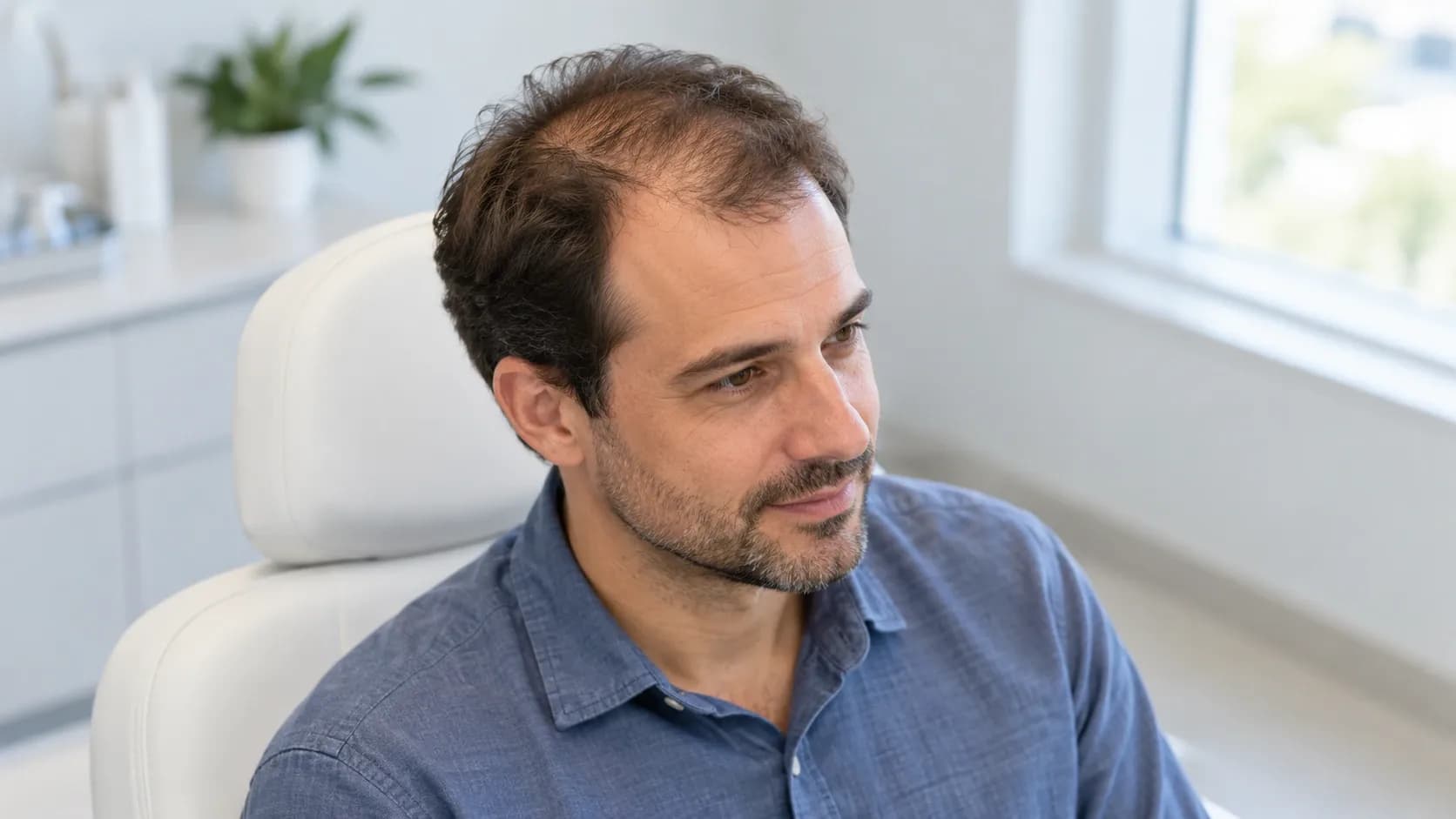
Hair Mesotherapy Timeline: How Long Does It Take to See Results?
Hair mesotherapy is a minimally invasive treatment that delivers selected substances directly into the scalp through multiple small injections.
Hair mesotherapy does not produce visible hair growth immediately. Most patients see the first meaningful changes in hair density between three and six months, because hair follicles grow on a biological cycle that no injection can accelerate beyond its natural rhythm. The first week belongs to scalp recovery, months one to three belong to early biological shifts, and months three to six provide the first reliable window for assessment (Gentile 2015).
What Is Hair Mesotherapy?
Hair mesotherapy is a minimally invasive treatment that delivers selected substances directly into the scalp through multiple small injections. It aims to support the scalp environment and address hair thinning, but it works as an injectable scalp-support therapy, not as a systemic medication or a surgical procedure.
Mesotherapy describes a technique, not a single formula. A practitioner injects a preparation into the mesoderm, the middle layer of skin where hair follicles sit. The injected mixture varies between protocols. It may contain vitamins, amino acids, minerals, or selected pharmacological agents. The specific composition depends on the diagnosis, the practitioner, and the treatment plan (Kanti 2017).
This variability matters for expectations. Because formulations differ, results differ. One patient may receive a nutrient-based preparation, while another receives a formula with an active drug. Two people can therefore follow the same timeline structure but experience different outcomes.
Mesotherapy also differs from both systemic medication and hair transplantation. Oral or topical medications act throughout the body or across a broad scalp surface. Mesotherapy delivers substances locally, in concentrated points. Transplantation physically moves hair follicles from one area to another. Mesotherapy does none of this. It attempts to support the existing follicular environment.
Who May Consider Hair Mesotherapy?
People with early hair thinning or reduced density are the most common candidates. Mesotherapy appears most relevant in androgenetic alopecia and related diffuse hair-loss presentations, but a medical evaluation should confirm the diagnosis before any injection begins.
The underlying cause of hair loss shapes the timeline. Androgenetic alopecia, telogen effluvium, and alopecia areata behave differently. A preparation that supports follicles in one condition may do little in another. A qualified evaluation can rule out reversible causes such as iron deficiency, thyroid dysfunction, or medication effects (Ramos 2015).
A consultation serves another purpose. It establishes a baseline. Without baseline photographs and density measurements, neither the patient nor the practitioner can judge whether the timeline is progressing as expected.
What Happens During a Hair Mesotherapy Session?
The practitioner cleanses the scalp, maps the target areas, and delivers a series of small injections across the thinning zones. A session typically lasts thirty to sixty minutes, and the formulation injected depends on the chosen protocol.
Preparation comes first. The scalp is cleaned to reduce contamination risk. Some protocols apply a topical anesthetic to limit discomfort. The practitioner then marks the areas of concern and administers injections at consistent intervals. The depth, spacing, and volume of each injection follow the selected technique (Kanti 2017).
Session count and frequency vary between protocols. Some plans schedule weekly sessions initially, then shift to monthly maintenance. Others space sessions from the start. This is why no universal calendar exists. The timeline depends partly on the plan itself.
What Should You Expect Immediately After Hair Mesotherapy?
Expect temporary local reactions, not new hair. Redness, tenderness, pinpoint marks, and mild swelling are common in the first hours and days. Visible hair growth does not begin at this stage.
These reactions reflect the injection process itself. Small punctures trigger a localized inflammatory response. This response is part of normal healing, not evidence of treatment failure or success (Gentile 2015).
Post-treatment care follows the practitioner's instructions. Typical guidance includes avoiding aggressive washing, intense exercise, and direct sun exposure for a short period. Individual recovery differs. Some people return to normal activity within a day; others feel scalp sensitivity longer.
What Happens During the First Week After Hair Mesotherapy?
The first week is about healing. Day one brings the strongest sensitivity. Days two to three show settling reactions. Days four to seven move the scalp toward normal. None of these stages should be read as early regrowth.
On day one, the scalp may feel tender or tight. Small bumps at injection points are common. By days two to three, redness and swelling typically fade. By days four to seven, most surface reactions resolve.
An important caution applies here. Changes in how hair looks during week one usually reflect styling limitations, scalp sensitivity, or normal shedding patterns. They do not measure efficacy. Judging the treatment at this point would misread recovery for results.
What Changes Can Occur During Weeks Two to Four?
Very little that is visible. The scalp finishes recovering while biological activity inside the follicles may begin. Noticeable density change rarely appears this early.
Scalp recovery and follicular biology are two separate processes. The skin heals within days. Follicular cycles operate over months. A follicle that shifts from a resting phase toward a growth phase needs weeks before any hair emerges above the skin (Ramos 2015).
Baseline shedding also colors this period. A person losing one hundred hairs daily may not perceive any change at week three. Consistent follow-up matters more than isolated daily checks.
What Can You Expect After One to Three Months?
 This is the first window where change becomes measurable. Shedding patterns, hair texture, and early density shifts may be monitored, but results still vary with the cause and severity of hair loss.
The hair-growth cycle explains the delay. Each follicle cycles through growth, transition, and rest phases. Treatment can only influence follicles over successive cycles. Hair that responds in month one must still grow long enough to change appearance (Gentile 2015).
This stage rewards patience and documentation. Photographs taken monthly under the same lighting reveal shifts that daily mirror checks miss.
When Do Hair Mesotherapy Results Become Noticeable?
There is no universal date. Most meaningful evaluation happens between three and six months, because diagnosis, protocol, baseline density, and individual response all shift the timeline.
Early scalp changes differ from meaningful density changes. Reduced redness, better scalp comfort, or a fresher hair feel are real, but they are not regrowth. Meaningful change means more visible hair in thinning zones.
Standardized clinical assessment outperforms daily visual comparison. Trichoscopy, calibrated photographs, and measured density provide objective data. Research on injectable scalp treatments consistently uses such tools rather than patient impressions alone (Alves and Grimalt 2016).
What Happens Between Three and Six Months?
This period offers the clearest assessment of treatment response. Hair density, shedding levels, and overall scalp condition should be evaluated together.
A longer observation window separates genuine improvement from fluctuation. Some patients require additional sessions beyond this window. Others plateau.
It also helps to compare expectations with biology. Injectable scalp treatments work within the hair-growth cycle, which runs in months, not weeks. Any protocol promising rapid density change in two weeks conflicts with follicular physiology (Adil and Godwin 2017).
How Many Hair Mesotherapy Sessions May Be Needed?
There is no fixed number for everyone. Mesotherapy is planned as a series, and follow-up assessments determine whether further sessions remain appropriate.
Protocols commonly involve an initial cluster of sessions followed by maintenance treatments. The exact schedule depends on the diagnosis, the formulation, and the observed response (Kanti 2017). A single session rarely provides enough exposure to evaluate the treatment fairly.
Hair Mesotherapy vs. PRP: How Do Their Timelines Differ?
Mesotherapy injects a selected formulation; platelet-rich plasma (PRP) injects a concentration of the patient's own platelets. Composition drives the protocol, and evidence in androgenetic alopecia shows both approaches can help, with outcomes that vary by study design.
PRP preparations carry growth factors released from platelets. Formulated mesotherapy cocktails carry different active ingredients. Each requires its own session frequency and evaluation window.
Controlled research shows PRP can improve hair counts and density in androgenetic alopecia (Gentile 2015; Alves and Grimalt 2016). Mesotherapy studies show positive outcomes as well, though formulations and methods differ more widely. Comparing timelines between the two is only fair when protocols match in session number and follow-up duration.
Hair Mesotherapy vs. Hair Transplant: How Do Their Results Differ?
Mesotherapy supports existing follicles through injections. Hair transplantation redistributes follicles surgically. Their recovery periods, goals, and timelines differ fundamentally, and neither is universally superior.
Feature | Hair Mesotherapy | Hair Transplantation |
Approach | Injectable scalp treatment | Surgical follicle relocation |
Goal | Support existing follicles | Restore density in bald zones |
Downtime | Minimal, hours to days | Days to weeks |
First visible change | 3 to 6 months | 6 to 12 months |
Suitable cases | Early thinning, diffuse loss | Stable bald areas with donor supply |
Transplanted hair follows its own slow growth curve after surgery. Mesotherapy, when it works, works gradually on follicles that remain active. The two treatments can even complement each other in selected cases (Orentreich 1959).
What Factors Can Affect the Hair Mesotherapy Timeline?
Seven main factors shape the timeline: the type and severity of hair loss, baseline density, age, the formulation used, session frequency, concurrent treatments, and consistency of follow-up.
Factor | Effect on Timeline |
Underlying cause | Diagnosis determines whether follicles can respond |
Severity | Advanced loss leaves fewer viable follicles to support |
Age and biology | Individual response varies |
Formulation | Active ingredients differ in mechanism |
Session schedule | Series-based protocols need completion |
Concurrent medication | Combined regimens can change outcomes |
Follow-up quality | Objective monitoring prevents false conclusions |
How Should Hair Mesotherapy Progress Be Monitored?
Use standardized photographs, consistent lighting, and monthly reviews. Assess density over months, not days.
Comparable photographs under fixed lighting and angles create a reliable record. Clinical evaluation adds shedding counts and scalp examination. This structure distinguishes real improvement from normal variation (Adil and Godwin 2017).
What Are the Limitations of Hair Mesotherapy for Hair Loss?
Mesotherapy does not guarantee regrowth. Evidence quality varies, formulations differ, and treating the underlying cause remains essential.
Mesotherapy should not replace established medical or surgical options. Where a diagnosis points to a proven systemic treatment, that treatment deserves priority. Mesotherapy fits as an adjunct or a selected option, not an automatic alternative (Kanti 2017).
What Should You Know Before Starting Hair Mesotherapy?
Confirm the diagnosis, review your medical history, discuss the formulation and schedule, set realistic expectations, and agree on a follow-up plan before the first session.
These five steps protect both safety and interpretation. A defined baseline and a defined review date turn an uncertain timeline into a measurable process.
Hair Mesotherapy Timeline: Key Milestones at a Glance
Recovery dominates the first week. Observation dominates weeks two to four. Evaluation begins in months one to three. Assessment becomes meaningful in months three to six. Strategy review follows beyond six months.
Stage | Focus |
Immediately after | Scalp recovery, temporary reactions |
First week | Healing, short-term settling |
Weeks 2 to 4 | Observation without firm conclusions |
Months 1 to 3 | Early shedding and texture shifts |
Months 3 to 6 | Longer-term response assessment |
Beyond 6 months | Continue, adjust, or reconsider strategy |
Frequently Asked Questions About the Hair Mesotherapy Timeline
When does hair mesotherapy start working?
Biological activity can begin before anything is visible. Visible growth needs follicles to complete growth phases, which takes months.
Can you see results after one hair mesotherapy session?
One session rarely provides enough exposure for evaluation. Protocols typically involve a series with structured follow-up.
Does hair mesotherapy cause temporary shedding?
Shedding can change for many reasons. Persistent or unexpected shedding deserves professional review.
How long do hair mesotherapy results last?
Durability depends on the underlying condition and the protocol. Maintenance sessions may be needed.
Is hair mesotherapy suitable for advanced hair loss?
Suitability depends on remaining viable follicles. Procedures that restore density address advanced loss differently than injectable support therapies.
Key Takeaways From the Hair Mesotherapy Timeline
Judge hair mesotherapy over months, not days. Early changes reflect healing. Density assessment needs longer follow-up. Response varies between individuals, and objective monitoring shapes how the timeline should be read.
References
Adil, A., and M. Godwin. "The Effectiveness of Treatments for Androgenetic Alopecia: A Systematic Review and Meta-Analysis." Journal of the American Academy of Dermatology, vol. 77, no. 1, 2017, pp. 136-141.
Alves, R., and R. Grimalt. "Randomized Placebo-Controlled, Double-Blind, Half-Head Study to Assess the Efficacy of Platelet-Rich Plasma on the Treatment of Androgenetic Alopecia." Dermatologic Surgery, vol. 42, no. 4, 2016, pp. 491-497.
Gentile, P., et al. "The Effect of Platelet-Rich Plasma in Hair Regrowth: A Randomized Placebo-Controlled Trial." Stem Cells Translational Medicine, vol. 4, no. 11, 2015, pp. 1317-1323.
Kanti, V., et al. "Evidence-Based (S3) Guideline for the Treatment of Androgenetic Alopecia." Journal of the European Academy of Dermatology and Venereology, vol. 31, no. 6, 2017, pp. 948-957.
Orentreich, N. "Autografts in Alopecias and Other Selected Dermatological Conditions." Annals of the New York Academy of Sciences, vol. 83, 1959, pp. 463-479.
Ramos, P. M., H. A. Miot, and M. F. Gavazzoni Dias. "Female Pattern Hair Loss: A Clinical and Pathophysiological Review." Anais Brasileiros de Dermatologia, vol. 90, no. 4, 2015, pp. 529-543.