
What Should You Expect During Exosome Recovery After Hair Treatment?
Exosome recovery usually involves mild scalp redness, tenderness, swelling, or pinpoint bleeding for a short period.

Exosome recovery usually involves mild scalp redness, tenderness, swelling, or pinpoint bleeding for a short period. The exact response depends on the delivery method, your skin sensitivity, and whether you received standalone treatment or exosomes after a hair transplant. Skin healing and hair growth follow different timelines, so an early return to normal activities does not prove that new hair will grow.
Exosome hair treatment recovery focuses first on the scalp surface. Injections and microneedling temporarily disrupt the skin barrier. Your body then closes these small wounds and settles the local inflammatory response. Most practical aftercare aims to protect this process.
A second process may involve hair follicles. Researchers study whether extracellular vesicles can affect follicle signaling, hair density, and shaft thickness. These possible changes require months of assessment. Current research does not support a guaranteed result or a universal treatment timeline.
What Happens to Your Scalp During Exosome Recovery?
Your scalp repairs tiny injection or microneedling wounds while local redness and sensitivity gradually settle. Any later change in hair growth involves a separate biological process.
Exosomes belong to a broader group called extracellular vesicles. Cells release these lipid-bound particles, which cannot replicate on their own. They carry biological material and participate in cell signaling. They do not function as living stem cells. Research guidelines also warn against calling every small extracellular vesicle an exosome unless researchers confirm its cellular origin (Welsh et al. 2024).
The delivery procedure explains most early symptoms. Microinjections create multiple small entry points. Scalp microneedling creates many controlled channels across a wider area. Both methods can cause short-term inflammation. Topical application on intact skin creates a different situation because it does not produce the same needle injury.
Recovery after exosome injections therefore describes more than the product itself. It includes your response to skin penetration, any other substance applied during the session, and your existing scalp condition. This distinction helps you evaluate symptoms without assuming that every reaction comes from exosomes.
What Does the Exosome Recovery Timeline Look Like?
Initial scalp recovery often takes several days, while hair outcomes require months of observation. No study establishes one timeline that applies to every product and protocol.
The table below gives a general framework rather than a medical schedule. Your provider may recommend different limits.
Period | Main recovery focus | Practical priority |
First 24 hours | Injection or microneedling sites | Protect the scalp and follow washing instructions |
Days 2 to 3 | Early reduction of irritation | Use gentle care and avoid unnecessary friction |
Days 4 to 7 | Return toward normal skin comfort | Resume activities gradually when approved |
Weeks 2 to 4 | Scalp condition and treatment tolerance | Record symptoms and maintain prescribed care |
Months 2 to 6 | Hair density, thickness, and shedding | Compare standardized photographs and measurements |
A 2025 systematic review included 11 clinical studies across different alopecia types and exosome sources. The studies used different products, delivery methods, outcome measures, and follow-up periods. Small samples and uneven study designs limited direct comparisons. These limitations prevent researchers from defining a standard recovery or result timeline (Al Ameer et al. 2025).
What Should You Expect During the First 24 Hours?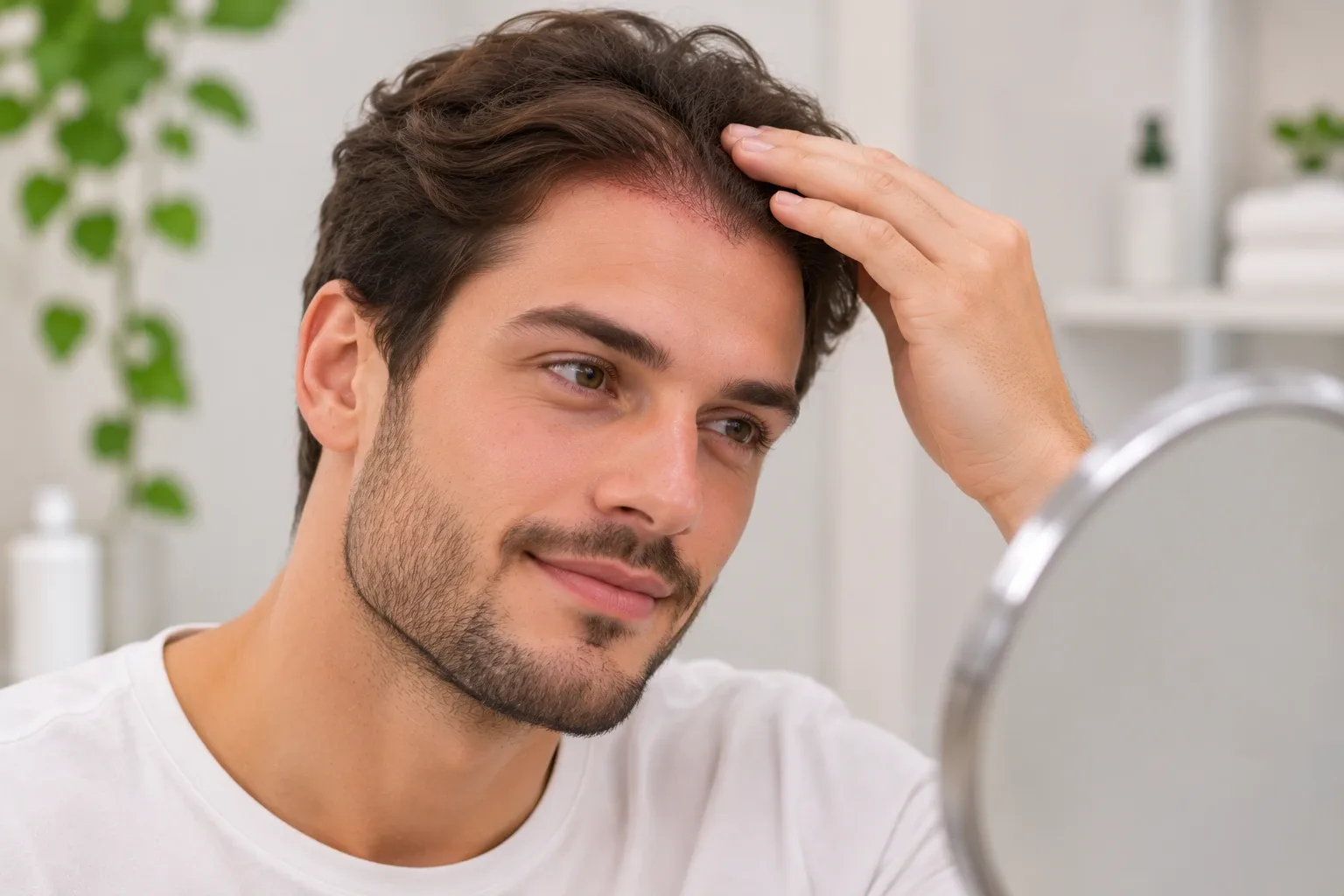
You may notice mild redness, tenderness, swelling, or tiny spots of bleeding. Keep the treated area clean and avoid touching it without a reason.
Needle-related inflammation usually causes these early changes. Microneedling studies commonly report erythema, pain, edema, and temporary irritation. Pinpoint bleeding can also occur (Gowda et al. 2021).
Follow your provider’s instructions about washing, topical products, and touching the scalp. Do not apply leftover serums or home remedies to broken skin. A product that suits intact skin may irritate open microchannels.
Avoid strenuous activity if your provider links sweating or heat with a higher risk of irritation. Protect your pillow if spotting occurs. Contact the provider if bleeding continues or pain increases.
How Does Recovery Usually Change on Days 2 and 3?
Redness and sensitivity often start to settle during this period, but the scalp may still react to friction, sunlight, and harsh products.
Wash your hair only when your protocol permits it. Use lukewarm water and gentle pressure. Let shampoo flow over the area instead of scrubbing the entry points. Pat the scalp dry with a clean towel.
Delay scratching, exfoliation, and irritating cosmetics while tenderness remains. Limit direct sunlight on the treated skin. These steps reduce avoidable stress while the barrier recovers.
What Can You Resume on Days 4 to 7?
Many people can gradually return to their usual hair-care routine as irritation improves, provided their provider agrees.
Increase activity according to your symptoms rather than the calendar alone. A person with persistent redness after microneedling may need more caution than someone with mild injection-site tenderness.
Worsening symptoms deserve attention. Increasing heat, pain, swelling, or discharge does not fit a simple settling pattern. Ask for an assessment instead of masking the problem with new products.
Why Do Weeks 2 to 4 Matter?
This stage helps you confirm that the scalp has tolerated the procedure, but it cannot confirm hair regeneration.
A calm scalp shows recovery from the procedure. It does not demonstrate a change in follicle activity. Record any prolonged itching, flaking, bumps, or pigment change because these findings may need separate treatment.
Continue your established hair-loss plan unless your prescriber changes it. Abruptly stopping a proven treatment can confuse later assessments and allow the underlying condition to progress.
How Should You Assess Hair Changes During Months 2 to 6?
Use consistent photographs and clinical measurements to assess density, shaft thickness, and shedding over time. Avoid judging results from daily mirror checks.
Take photographs under the same lighting, angle, hair length, and styling conditions. Compare images at set intervals. A clinician may add trichoscopy or counts within a marked scalp area.
Research studies often use several months of follow-up. Some extend to one year. Their different designs mean that one study’s measurement point cannot predict your personal response (Al Ameer et al. 2025).
Which Exosome Aftercare Steps Protect the Scalp?
Follow the exact washing, activity, sun, and product instructions for your procedure. Gentle handling matters more than adding extra recovery products.
Aftercare should match the procedure’s physical effects. Standalone injections mainly require injection-site care. Microneedling adds broader surface irritation. Exosomes after hair transplant require graft and donor-wound protection as well.
Aftercare issue | Standalone exosome treatment | Exosomes with hair transplantation |
Main concern | Needle-site irritation | Grafts, recipient sites, and donor wounds |
Washing | Follow the treatment protocol | Follow the surgeon’s graft-care protocol |
Exercise | Limit according to heat, sweat, and symptoms | Follow surgical activity restrictions |
Topical products | Avoid unapproved products on broken skin | Coordinate all products with the surgical team |
Added evidence | Early hair-growth research | Insufficient proof of faster graft healing |
When Can You Wash Your Hair After Exosome Therapy?
Some protocols allow gentle washing after about 24 hours, but your provider’s instructions take priority.
The correct timing depends on skin penetration and any combined procedure. When washing becomes permitted, avoid strong water pressure, nails, and vigorous rubbing. Use only approved products.
Fresh transplant grafts need a different washing method. Do not transfer a standalone exosome routine to a surgical scalp.
When Can You Exercise, Swim, or Use a Sauna?
Resume these activities only when your provider considers the scalp ready. Heat, sweat, friction, and shared water can irritate early recovery.
Strenuous workouts raise scalp temperature and sweat production. Swimming adds water exposure and possible contamination. Saunas add prolonged heat. Helmets and tight headwear add pressure.
Each activity creates a different challenge, so ask about them separately. Post-transplant limits may last longer because surgery, rather than exosome application, controls the main restrictions.
How Should You Manage Sunlight and Hair Styling?
Protect sensitive skin from direct sun and delay chemical treatments until the scalp has recovered.
Use the sun-protection method your provider recommends. A loose covering may suit one protocol but disturb transplant grafts under another.
Delay hair dye, bleach, perming, aggressive exfoliation, and strong styling products until approval. Heat styling can also worsen dryness or discomfort. Do not place unapproved cosmetic serums on freshly needled skin.
Do Sleep, Food, and Hydration Change Recovery?
Normal sleep, balanced meals, and adequate hydration support general health, but they do not guarantee faster healing or hair growth.
Follow any instructions about head position and pillow protection. Eat enough protein and maintain a varied diet. Correct a documented nutrient deficiency with professional guidance rather than taking high-dose supplements without testing.
Avoid smoking or alcohol when your provider restricts them, especially after surgery. These instructions belong to your individual risk plan.
Which Exosome Therapy Side Effects Need Attention?
Mild, short-lived local reactions can occur after treatment. Spreading redness, increasing pain, pus, fever, or severe swelling requires medical assessment.
Current hair studies report mostly mild local events, but the evidence remains small and varied. A lack of serious events in early studies cannot establish the safety of every commercial product or repeated long-term use (Al Ameer et al. 2025).
Are Redness, Swelling, and Tenderness Normal?
Mild versions can follow injections or microneedling and should generally improve rather than intensify.
Needle depth, treatment area, device type, and individual sensitivity can affect intensity. A broad microneedled area may feel different from several microinjections.
Track the direction of symptoms. Steady improvement supports routine monitoring. Escalating discomfort calls for professional review.
Why Can Itching, Irritation, or Minor Bleeding Occur?
Skin penetration and surface inflammation can cause these reactions. Scratching can add trauma and contamination.
Do not pick crusts or rub itchy areas. Ask your provider which soothing options suit the treated skin. Contact the provider if irritation persists, spreads, or develops bumps or discharge.
Microneedling research also describes uncommon pigment changes, pustules, scarring, and infection. These outcomes remain less common than temporary redness and swelling, but they show why proper technique and follow-up matter (Gowda et al. 2021).
Which Warning Signs Require Urgent Care?
Seek prompt assessment for spreading redness, warmth, worsening pain, pus, fever, or increasing swelling. Breathing difficulty or swelling of the tongue or throat requires emergency care.
Do not self-treat a possible infection or allergic reaction with random creams or leftover medication. A clinician needs to examine the pattern and identify the cause.
Keep the product name, source, batch details, session date, and delivery method available. This information can help the treating team assess an unexpected reaction.
How Does Recovery Differ After Standalone Treatment and Hair Transplantation?
Standalone treatment mainly involves needle-site recovery. Hair transplantation adds graft protection, recipient-site healing, and donor-area care.
These procedures should never share one generic recovery sheet. The surgical procedure determines most initial restrictions after transplantation.
What Defines Recovery After Standalone Exosome Injections?
Recovery centers on localized injection reactions and short-term scalp protection, without transplant grafts to safeguard.
Microinjections create focal entry points. Microneedling creates a broader pattern of superficial injury. Mesotherapy describes a technique involving small intradermal injections, not proof that every injected formula has the same evidence.
Platelet-rich plasma, or PRP, uses concentrated material from the patient’s blood. Exosome preparations use extracellular vesicles from a stated biological source. These treatments differ in composition and should not serve as interchangeable recovery models.
What Changes When Exosomes Follow a Hair Transplant?
The surgeon’s transplant protocol controls washing, sleep position, exercise, and scalp contact.
Recipient sites contain newly placed follicular units. The donor area also needs care after follicular unit extraction or strip harvesting. Possible surgical issues include edema, folliculitis, infection, scarring, and temporary shedding (Kerure and Patwardhan 2018).
Current evidence does not justify a promise that adjunctive exosomes will accelerate graft healing or improve graft survival for every patient. Ask whether the claimed benefit applies to the exact product and procedure used in your case.
Which Factors Can Change Your Exosome Recovery?
Delivery technique, scalp health, individual sensitivity, product quality, and clinical protocol can all change the recovery experience.
Two treatments sold under the same name may differ greatly. Compare the full procedure rather than the label alone.
How Do Injection Technique and Microneedling Depth Affect Recovery?
Greater skin disruption can produce more noticeable temporary irritation, although individual responses vary.
Treatment depth, needle density, pressure, treated area, and operator technique shape the immediate injury. Radiofrequency microneedling adds thermal energy and creates another recovery profile.
Ask which device and method the provider plans to use. This information gives more useful context than a general claim of minimal downtime.
Why Do Scalp Health and Sensitivity Matter?
Existing inflammation, infection, dermatitis, or fragile skin can alter symptoms and treatment suitability.
A clinician should assess active scalp disease before skin penetration. Psoriasis, seborrheic dermatitis, folliculitis, and scarring alopecia require different management from uncomplicated androgenetic alopecia.
Tell the provider about previous pigment changes, keloids, allergies, bleeding problems, and medicines that affect clotting. These details support safer planning.
Why Does Product Quality Matter?
Biological source, characterization, sterility, storage, and traceability affect what you actually receive.
Request documents that identify the source and finished preparation. Ask whether the product contains isolated extracellular vesicles, conditioned medium, a broader secretome, or added active ingredients.
MISEV2023 emphasizes clear nomenclature, source details, separation methods, and characterization. Particle counts alone cannot establish identity, purity, or clinical effectiveness (Welsh et al. 2024). Marketing claims cannot replace this evidence.
How Can You Support Hair Health While Your Scalp Recovers?
Protect the healing scalp and manage the diagnosed cause of hair loss separately. Procedural recovery does not treat androgenetic alopecia by itself.
This distinction prevents false conclusions. A quiet scalp may coexist with continuing follicle miniaturization. Hair growth support therefore requires diagnosis, appropriate treatment, and consistent follow-up.
What Makes a Hair-Care Routine Gentle?
Use approved, non-irritating products and avoid unnecessary chemical or mechanical stress during early healing.
Clean the scalp according to your protocol. Postpone aggressive exfoliation and tight styling that pulls on sensitive areas. Do not add several new products at once because a reaction would become difficult to trace.
Where Do Nutrition, Minoxidil, and Finasteride Fit?
Correct confirmed nutritional problems and use evidence-based medication only when a qualified prescriber considers it appropriate.
Adequate protein supports normal hair production. Supplements cannot correct every form of alopecia, and excess doses can cause harm.
A systematic review and meta-analysis found that minoxidil and finasteride improved outcomes compared with placebo in studied patients with androgenetic alopecia (Adil and Godwin 2017). Suitability still depends on sex, diagnosis, contraindications, pregnancy considerations, and adverse-effect risk. Do not start, stop, or change these medicines without guidance.
Why Does Clinical Follow-Up Improve Assessment?
Structured follow-up separates visible change from normal variation and helps identify persistent disease.
Use fixed photo intervals and the same scalp views. A dermatologist can assess density, shaft diameter, shedding, scalp inflammation, and alternative diagnoses.
Bring a record of all procedures and products. This history helps the clinician interpret improvement, stagnation, or new symptoms.
Do You Need Time Off Work After Exosome Treatment?
Many people can return to desk-based work on the same day if symptoms remain mild and the provider agrees. Physical work and strenuous exercise require separate clearance.
Consider visibility, comfort, headwear, heat, dust, and touching the scalp. A remote desk task creates fewer challenges than work involving helmets or heavy exertion.
Hair transplantation usually adds more restrictions because it involves surgery. Base your work plan on the full procedure rather than the exosome label.
When Should You Contact Your Doctor During Recovery?
Contact the treating provider for persistent redness, worsening pain, unusual discharge, or any unexpected reaction. Severe allergy symptoms require emergency help.
Routine follow-up suits stable symptoms and planned hair assessments. Prompt review suits changes that move in the wrong direction. Do not wait for a scheduled hair-growth appointment when infection or allergy seems possible.
Keep photographs of symptom changes and a list of applied products. Retain the treatment record and product information for the medical review.
What Do Patients Commonly Ask About Exosome Recovery?
Most questions concern washing, discomfort, exercise, shedding, and result duration. The correct answer depends on the procedure and the limits of current evidence.
The answers below provide general guidance, not a replacement for your treatment plan.
How Long Does Exosome Recovery Take?
Initial scalp recovery often takes a few days, but technique and individual response can extend this period. Hair outcomes require longer assessment and may remain uncertain.
Can You Wash Your Hair the Day After Exosome Treatment?
Some protocols permit washing after approximately 24 hours. Follow your provider’s timing and use a gentle method.
Is Exosome Treatment Painful During Recovery?
Mild soreness or tenderness can occur. Persistent or worsening pain needs assessment rather than assumption.
When Can You Exercise After Exosome Injections?
Your provider should set the timing according to sweating, heat, friction, and scalp recovery. Transplant patients need the surgeon’s separate activity plan.
Can You Dye Your Hair After Exosome Therapy?
Wait until the scalp has recovered and your provider approves chemical treatment. Applying dye to irritated skin can add unnecessary exposure.
Does Exosome Treatment Stop Hair Shedding Immediately?
No immediate reduction is guaranteed. Shedding depends on the diagnosis, hair cycle, other treatments, and individual response.
Can You Use Minoxidil After Exosome Treatment?
Confirm the restart timing with your prescriber, especially after microneedling. Broken or irritated skin can change tolerability and absorption.
Does Exosome Therapy Speed Up Hair Transplant Recovery?
Researchers continue to study this adjunctive use. Current evidence cannot confirm faster healing or better graft survival for every patient.
Are Exosome Hair Treatment Results Permanent?
Long-term durability remains unproven. Androgenetic alopecia and other causes can continue to affect density after treatment.
What Are the Key Takeaways About Exosome Recovery?
Match aftercare to the actual procedure, monitor symptoms by their direction, and judge hair outcomes with long-term measurements rather than early skin healing.
Use this practical checklist:
Identify whether you received injections, microneedling, topical application, or a transplant combination.
Follow procedure-specific washing and activity instructions.
Contact a professional when symptoms worsen or systemic signs appear.
Keep the exact product and session details.
Track hair changes with consistent photographs and clinical tools.
Continue evidence-based hair-loss care under professional guidance.
Treat claims of guaranteed regrowth, zero downtime, or permanent results with caution.
References
The references below cover extracellular vesicle standards, clinical hair research, microneedling safety, transplant complications, and established alopecia treatments.
Adil, Areej, and Marshall Godwin. “The Effectiveness of Treatments for Androgenetic Alopecia: A Systematic Review and Meta-Analysis.” Journal of the American Academy of Dermatology, vol. 77, no. 1, 2017, pp. 136–141.e5. https://doi.org/10.1016/j.jaad.2017.02.054.
Al Ameer, Mohammed A., et al. “Exosomes and Hair Regeneration: A Systematic Review of Clinical Evidence Across Alopecia Types and Exosome Sources.” Clinical, Cosmetic and Investigational Dermatology, vol. 18, 2025, pp. 2215–2227. https://doi.org/10.2147/CCID.S543451.
Gowda, Asha, et al. “A Systematic Review Examining the Potential Adverse Effects of Microneedling.” The Journal of Clinical and Aesthetic Dermatology, vol. 14, no. 1, 2021, pp. 45–54. PubMed Central, https://pmc.ncbi.nlm.nih.gov/articles/PMC7869810/.
Kerure, Amit S., and Narendra Patwardhan. “Complications in Hair Transplantation.” Journal of Cutaneous and Aesthetic Surgery, vol. 11, no. 4, 2018, pp. 182–189. https://doi.org/10.4103/JCAS.JCAS_125_18.
Welsh, Joshua A., et al. “Minimal Information for Studies of Extracellular Vesicles (MISEV2023): From Basic to Advanced Approaches.” Journal of Extracellular Vesicles, vol. 13, no. 2, 2024, article e12404. https://doi.org/10.1002/jev2.12404.