
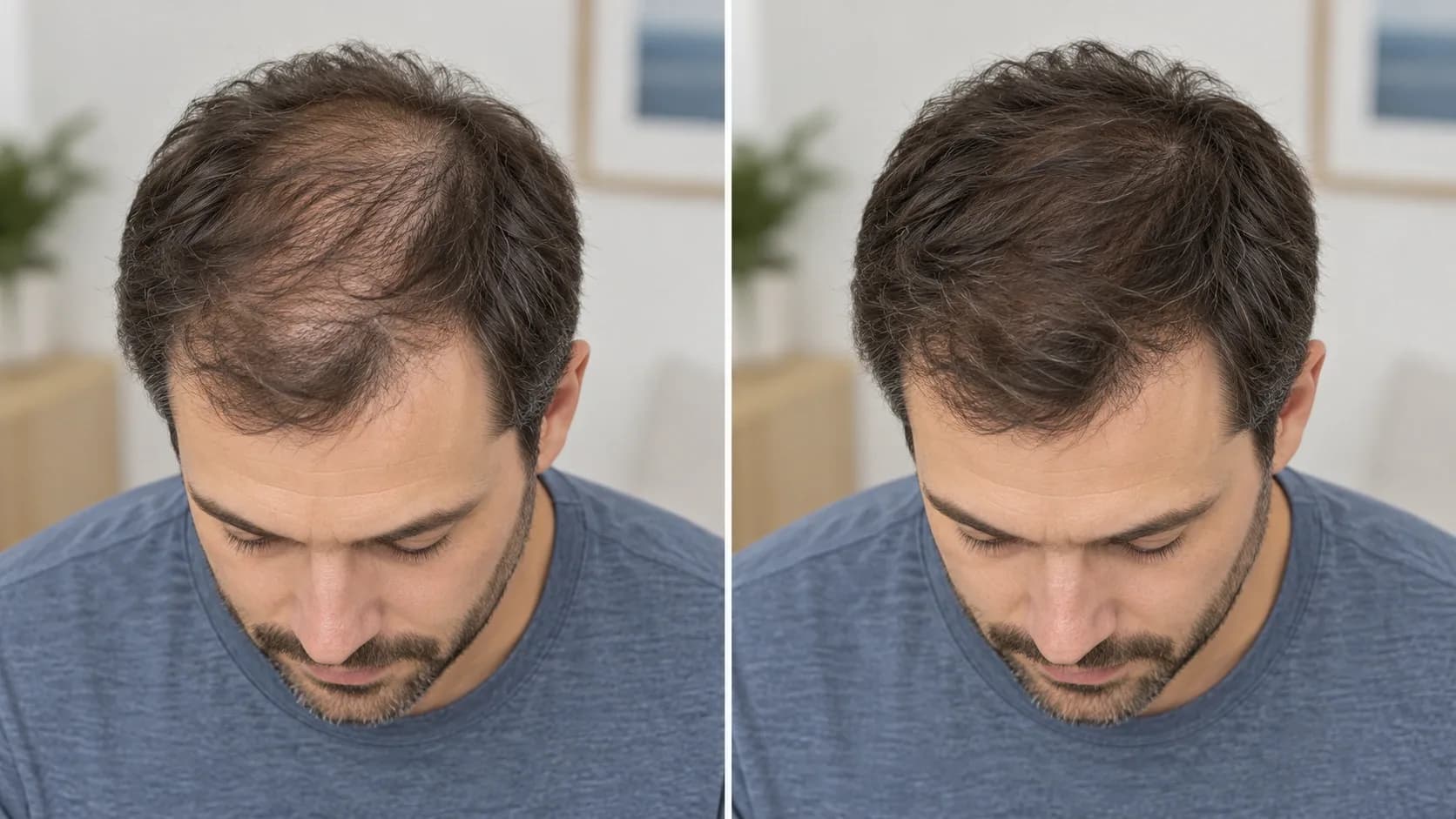
PRF Before and After: What Results Can You Expect?
Platelet-rich fibrin (PRF) is a second-generation platelet concentrate made from your own blood without anticoagulants.
Platelet-rich fibrin (PRF) is a second-generation platelet concentrate made from your own blood without anticoagulants. Its fibrin matrix releases growth factors slowly into the scalp, which is why patients search for PRF before and after results before choosing hair restoration. These results develop gradually rather than immediately. The speed and degree of visible change depend on the cause and extent of hair loss, follicle viability, the treatment protocol, and individual response. Before-and-after photographs can illustrate realistic changes, but no image can guarantee an identical outcome for you.
What Does PRF Before and After Actually Show?
PRF before and after comparisons mainly show five changes: higher hair density, thicker hair shafts, less visible scalp, improved hairline coverage, and reduced shedding. Clinicians also assess overall hair texture and how the hair reflects light across the crown and parting.
What clinicians evaluate | What a positive change looks like |
Hair density and coverage | More hairs per follicular unit on trichoscopy |
Hair shaft diameter | Thicker, more pigmented strands |
Scalp visibility | Less skin showing through thinning zones |
Shedding | Fewer hairs in the pull test |
Overall appearance | Fuller hairline and crown contour |
Standardized photography matters because it makes each comparison honest. The same lighting, hair length, and camera distance isolate the true treatment effect.
Why Can Hair Look Fuller Without Dramatic New Growth?
Thicker existing hairs alone can make hair look fuller because perceived density depends heavily on hair shaft diameter. When miniaturized follicles produce slightly thicker strands, the scalp hides better. This is follicle stimulation, not the creation of new follicles. The human scalp cannot grow new follicles after birth, so PRF works by waking up follicles that still function (Bhoite et al. 2022).
When Do PRF Before and After Results Start to Appear?
Most visible PRF results appear between 3 and 6 months, with continued improvement up to a year. Early weeks mainly show scalp recovery, not regrowth.
What Can Change During the First Few Weeks?
Expect temporary redness, tenderness, swelling, or small bruises at the injection sites. Shedding may briefly increase because the treatment shifts follicles into a new growth cycle. Immediate photographs mislead at this stage because the scalp is still recovering from the injections.
What Changes Can Occur During Months 1 to 3?
Fine early changes begin as follicular activity increases. Patients often report less shedding and slightly better hair texture first. Visible regrowth stays limited because each hair needs weeks to grow long enough to notice.
What Can PRF Results Look Like Around 3 to 6 Months?
This is the window where density and thickness changes become photographable. Areas with viable follicles show progressive improvement in coverage and caliber. Compare photos only when lighting, hair length, and angle match the baseline images.
What Happens After 6 Months?
Clinicians reassess hair density and caliber to decide whether maintenance sessions fit your case. Final appearance varies widely because genetics, hormone levels, and baseline follicle count differ between patients. The published case report of three patients documented photographic improvements only after four i-PRF sessions, not immediately after one (Arora and Shukla 2019).
Which Hair Changes Are Most Noticeable After PRF?

The most noticeable changes are reduced shedding, thicker miniaturized hairs, and modest density gains in areas with living follicles.
Can PRF Make Existing Hair Thicker?
Yes. PRF can increase hair shaft diameter in follicles that remain alive but miniaturized. Thicker strands raise the terminal-to-vellus hair ratio, which directly improves how full the scalp looks (Bhoite et al. 2022).
Can PRF Reduce Hair Shedding?
Reduced shedding is often the earliest response and may appear within the first months. Stabilization is not the same as regrowth, but stopping active loss protects the density you still have.
Can PRF Improve Hair Density?
Density can improve through two routes: more active follicles and thicker individual hairs. The ceiling depends on how many viable follicles remain in the treated zone. Completely bald, shiny skin usually lacks the follicle reserve that PRF needs to work on.
Can PRF Improve a Receding Hairline?
A receding hairline can respond when miniaturized but viable follicles still exist in the area. Long-standing, fully bald zones respond far less because the follicles have already disappeared.
What Factors Influence PRF Before and After Results?
Four factors dominate: the cause of hair loss, the stage of loss, the protocol used, and your individual biology.
How Does the Cause of Hair Loss Affect PRF Outcomes?
Androgenetic alopecia is the condition most studied with PRF. Diffuse thinning requires diagnosis first because thyroid disease, iron deficiency, and telogen effluvium need different treatment. PRF is not a universal solution for every type of alopecia.
Does the Stage of Hair Loss Matter?
Early and moderate thinning respond better than advanced baldness. Viable follicles can recover; permanently lost follicles cannot. Extensive longstanding baldness usually needs surgical restoration instead of regenerative injections.
How Does the Treatment Protocol Affect the Outcome?
Protocol details shape results. Published studies used 3 to 4 sessions at 2-week to monthly intervals, with PRF prepared at low centrifugation speeds around 700 to 800 rpm (Shrestha et al. 2024). Maintenance planning and injection technique should be individualized rather than copied from a generic template.
Why Do Age, Scalp Health, and Individual Biology Matter?
The hair growth cycle determines how fast new results appear. Scalp inflammation, hormonal sensitivity, and genetic androgenetic drive all influence response. This biological variability explains why two patients on identical protocols can end up with different outcomes.
How Should You Compare PRF Before and After Photos?
Valid comparisons require identical lighting, hair styling, angles, and time intervals between the two images.
Why Should Photos Use the Same Lighting?
Lighting changes how much scalp shows through the hair. Harsh overhead light exaggerates thinning; soft frontal light hides it. Matching light direction keeps the comparison honest.
Why Should Hair Position and Length Stay Consistent?
Wet, longer, combed-forward, or styled hair can simulate density that does not exist. The same hair length and parting direction must appear in both photographs.
Which Angles Provide the Most Useful Comparison?
Shoot five standard views: the front hairline, the top, the crown, and both sides, from the same distance each time. These angles capture the zones where androgenetic alopecia progresses.
Why Should You Compare Results Over the Same Time Period?
A two-week comparison shows recovery, not regrowth. Only multi-month intervals reveal true hair restoration results. Chronological documentation beats a single attractive after photo.
What Do Published PRF Cases Tell Us About Before and After Results?
Published cases show promising but preliminary evidence. A 2019 case report described three patients with androgenetic alopecia who received four i-PRF sessions and showed photographic improvement afterward (Arora and Shukla 2019). A 15-patient series reported noticeable improvement in 73% of subjects after four sessions, though patients also used background therapy (Bhoite et al. 2022). Three tiny samples cannot predict individual results. Larger controlled studies with longer follow-up remain necessary before anyone can state firm conclusions.
What Is the Difference Between PRF Before and After and PRP Before and After?
PRP is platelet-rich plasma; PRF is a platelet concentrate that includes a natural fibrin matrix. PRP releases growth factors quickly, while the PRF matrix acts as a scaffold that releases growth factors more slowly and for a longer period (Kobayashi et al. 2016). No high-quality comparative trial has proven PRF superior to PRP for hair restoration. You should not transfer PRP study results onto PRF, because preparation and release kinetics differ (Shrestha et al. 2024).
Feature | PRP | PRF |
Anticoagulant | Required | Not used |
Structure | Liquid plasma | Fibrin matrix scaffold |
Growth factor release | Rapid | Slow and sustained |
Evidence base for hair loss | Larger, moderate quality | Small, emerging |
How Long Can PRF Results Last?
PRF does not remove the genetic and hormonal cause of androgenetic alopecia. Improvement after the initial series gradually fades without upkeep. Maintenance sessions, reported at intervals of roughly 6 to 12 months depending on the practice and individual response, preserve gains. Maintenance of improvement is not permanent restoration.
What Should You Expect If PRF Does Not Produce Major Visible Changes?
Stabilization or reduced shedding counts as a meaningful outcome even without dramatic regrowth. In that case, review three things: whether the diagnosis was correct, whether follicles remain viable, and whether complementary evidence-based treatments fit your case. PRF never comes with a guaranteed result.
Who May Be More Likely to See Noticeable PRF Results?
People with early or moderate thinning, miniaturized but viable follicles, realistic expectations, and a hair loss type that suits regenerative treatment respond best. Advanced longstanding baldness usually requires a different strategy, such as transplantation.
What Are the Limitations of PRF Before and After Photos?
Photos illustrate possibility, not probability. Camera settings, styling, short follow-up, and differing protocols can exaggerate or hide change. Patient satisfaction never replaces objective clinical assessment, and a photograph alone cannot prove that PRF caused the improvement.
What Questions Should You Ask Before Starting PRF Hair Restoration?
Ask your clinician these eight questions before your first session:
What is causing my hair loss?
Are my follicles still viable in the treatment area?
How many PRF sessions do you recommend?
When should I expect measurable changes?
How will you photograph and assess progress?
What happens if my response is limited?
Will I need maintenance treatments?
Are other evidence-based hair loss treatments appropriate for me?
PRF Before and After: What Is a Realistic Outcome?
A realistic PRF outcome follows a progression: less shedding first, early follicular changes next, then possible gains in density and hair thickness over 3 to 12 months. Results are gradual and individualized. Before-and-after images show what is possible, never what is promised. A proper medical diagnosis before treatment remains the foundation of any good result.
Frequently Asked Questions
How soon can you see PRF before and after results?
Early shedding reduction can appear within 1 to 3 months. Photographic density changes usually show between 3 and 6 months.
Can PRF regrow hair in completely bald areas?
Usually not. Completely bald areas lack viable follicles, and PRF cannot create new ones.
How many PRF sessions are needed before seeing results?
Published studies used 3 to 4 sessions spaced 2 to 4 weeks apart (Shrestha et al. 2024).
Does PRF make thinning hair thicker?
Yes, it can increase the diameter of miniaturized hairs, which improves perceived fullness.
Can PRF stop hair shedding?
It can reduce shedding in many patients, especially when the shedding stems from follicle miniaturization.
How long do PRF hair restoration results last?
Results fade gradually without maintenance. Sessions every 6 to 12 months help sustain improvement.
Are PRF before and after photos reliable?
Only when lighting, angle, hair length, and time interval match. A single photo proves nothing.
Is PRF better than PRP for hair restoration?
No high-quality evidence confirms this. PRF offers slower growth factor release, but superiority remains unproven (Kobayashi et al. 2016).
References
Arora, R., and S. Shukla. "Injectable-Platelet-Rich Fibrin-Smart Blood with Stem Cells for the Treatment of Alopecia: A Report of Three Patients." International Journal of Trichology, vol. 11, no. 3, 2019, pp. 128-131.
Bhoite, K. S., et al. "Injectable Platelet Rich Fibrin Therapy for Androgenetic Alopecia: A Series of 15 Cases." International Journal of Research in Dermatology, vol. 8, no. 4, 2022, pp. 398-402.
Kobayashi, E., et al. "Comparative Release of Growth Factors from PRP, PRF, and Advanced-PRF." Clinical Oral Investigations, vol. 20, 2016, pp. 2353-2360.
Shrestha, S., et al. "Platelet-Rich Fibrin: A Review of Its Role as a New Treatment in Androgenetic Alopecia." Journal of Cosmetic Dermatology, vol. 23, no. 8, 2024, pp. 2524-2530.