
Laser Hair Therapy vs PRF: Which Hair Loss Treatment Is Better?
Laser hair therapy and platelet-rich fibrin (PRF) are not interchangeable treatments. Laser hair therapy uses low-level light to support follicular activity in pattern hair loss, while PRF uses an injectable blood-derived preparation that contains platelets.
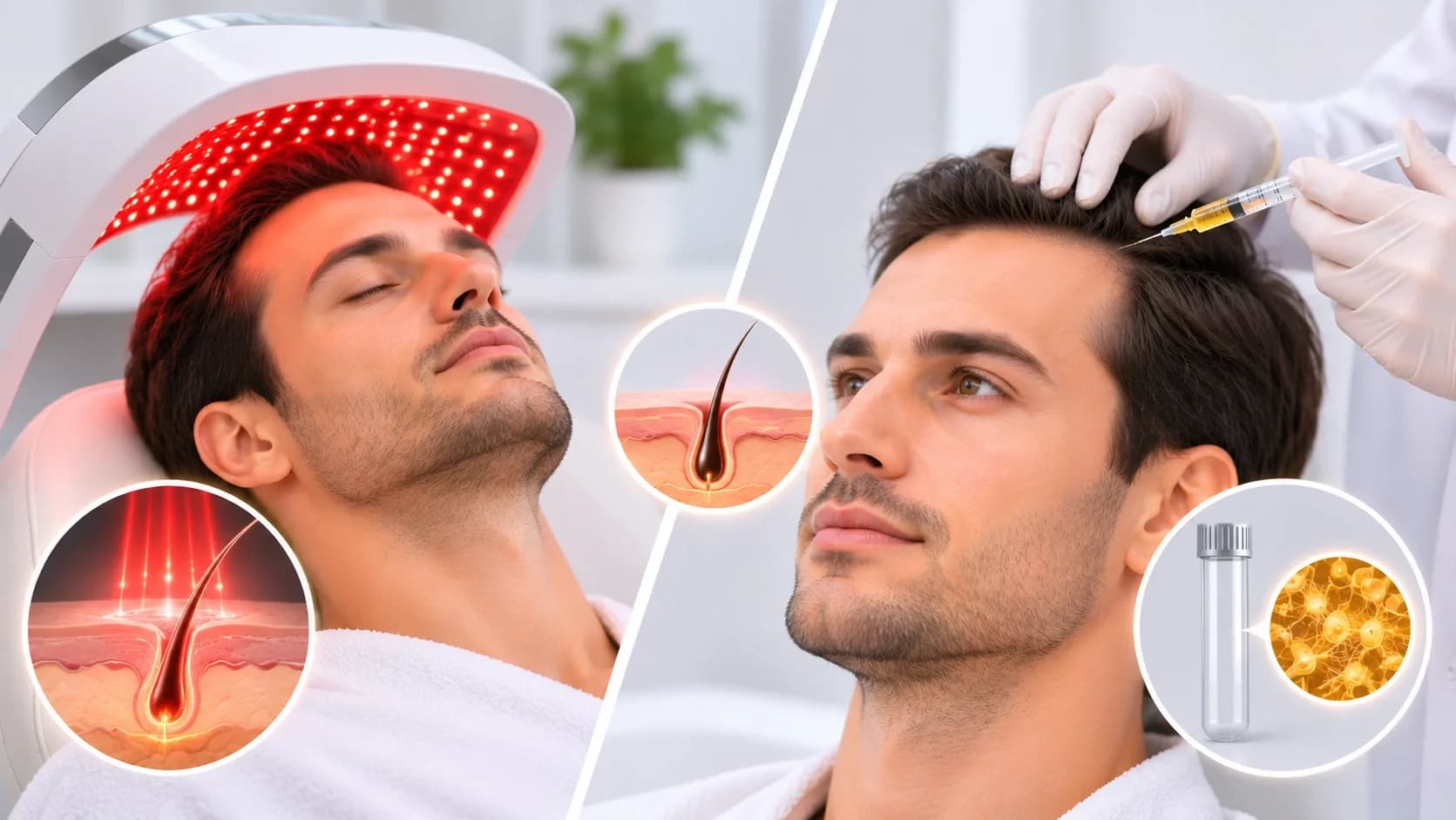
Laser hair therapy and platelet-rich fibrin (PRF) are not interchangeable treatments. Laser hair therapy uses low-level light to support follicular activity in pattern hair loss, while PRF uses an injectable blood-derived preparation that contains platelets, growth factors, and a fibrin matrix. Current evidence supports low-level laser therapy for androgenetic alopecia more consistently than PRF, but neither option suits every patient, and neither creates new follicles in completely bald skin.
People comparing PRF vs laser hair therapy usually want one practical answer: which option is more effective, safer, easier to maintain, and worth the cost. The honest answer is that the right choice depends on the diagnosis, the stage of hair loss, the presence of viable follicles, and the strength of evidence behind each option. Androgenetic alopecia remains the main condition where laser hair therapy has been studied most often. PRF has a strong biological rationale and promising early reports, but hair-specific evidence is still limited and less standardized (Schiavone et al. 2018; Lueangarun et al. 2021).
This guide compares laser treatment for hair loss and PRF hair restoration by mechanism, candidacy, evidence, procedure, timeline, safety, cost, and decision-making. It also separates platelet-rich fibrin from platelet-rich plasma, because the evidence for PRP should not automatically be used to claim PRF effectiveness.
What Is Laser Hair Therapy?
Laser hair therapy is a non-invasive treatment that uses low-level light, also called low-level laser therapy, low-level light therapy, or photobiomodulation, to stimulate scalp follicles in some people with androgenetic alopecia.
Low-level laser therapy, or LLLT, describes the use of red or near-infrared light at doses that do not intentionally cut or burn tissue. Devices may appear as laser caps, helmets, combs, hairbands, or clinical systems. These devices deliver light to the scalp at wavelengths commonly reported around the red-light range, with many studied devices using approximately 620 to 678 nanometers (Lueangarun et al. 2021).
The proposed mechanism involves photobiomodulation. In simple terms, light energy may influence cellular signaling in the hair follicle environment. Researchers discuss effects on mitochondrial activity, blood flow, inflammation, and the anagen phase of the hair cycle. These mechanisms are plausible, but they should be read as supportive biology rather than proof that every user will regrow hair.
The strongest clinical research focus involves androgenetic alopecia, also called male or female pattern hair loss. This condition causes follicular miniaturization, shorter anagen duration, and gradual reduction in hair shaft diameter. A meta-analysis of randomized controlled trials reported that LLLT increased hair density compared with sham treatment in adults with androgenetic alopecia, while also noting heterogeneity across studies (Liu et al. 2019).
What Is PRF Hair Treatment?
PRF hair treatment is a minimally invasive procedure in which a clinician prepares platelet-rich fibrin from the patient’s blood and injects it into the scalp to support the follicular environment.
Platelet-rich fibrin is an autologous blood concentrate. “Autologous” means the material comes from the same patient. After a blood sample is collected, a centrifuge separates the blood into layers. The PRF layer contains platelets, leukocytes in many preparations, and a natural fibrin network. The fibrin matrix acts like a scaffold and may slow the release of growth factors after placement (Stevens and Khetarpal 2019).
Clinicians use PRF for hair restoration because platelets release growth factors linked to tissue repair and cell signaling. These include factors associated with angiogenesis, extracellular matrix support, and follicular cycling. This rationale is biologically credible, but a credible mechanism is not the same as proven clinical superiority.
PRF differs from platelet-rich plasma. PRP preparation usually involves anticoagulation and a faster spin process, while many PRF protocols avoid anticoagulants and use lower-speed centrifugation. The result is a preparation with different cell content and fibrin structure. Because PRP and PRF are not identical, results from PRP trials should not be presented as direct evidence for PRF.
Evidence specifically for PRF in androgenetic alopecia is promising but limited. Studies and reviews describe improvements in hair density, hair pull tests, and patient-reported outcomes, but many are prospective studies, case series, or protocols with small samples. The field still needs standardized preparation methods and larger comparative trials (Schiavone et al. 2018; Sharma et al. 2024).
How Do Laser Hair Therapy and PRF Work Differently?
Laser hair therapy uses light energy at the scalp surface, while PRF uses injected biological material derived from the patient’s blood.
Laser hair therapy works through photobiomodulation. The device emits low-level light that may influence cellular energy production and follicular signaling. This approach is external, repeatable, and usually painless. The main challenge is adherence, because users need consistent sessions over many weeks or months.
PRF works through a biological route. The clinician injects a platelet-rich fibrin preparation into targeted areas of the scalp. The platelets may release growth factors, while the fibrin matrix may prolong local signaling. This approach is more invasive and depends on clinical technique, sterile preparation, and patient-specific blood quality.
Both treatments aim to improve the environment around existing follicles. Neither treatment reliably creates new follicles in areas where follicles have been permanently lost. This point matters for patients with advanced baldness, because expectations must match follicular reality.
Laser Hair Therapy vs PRF: Key Differences at a Glance
Laser hair therapy is non-invasive, device-based, and evidence-supported for pattern hair loss. PRF is minimally invasive, blood-derived, and promising but less standardized.
Comparison factor | Laser hair therapy | PRF hair restoration |
Treatment method | Low-level light exposure | Injection of a blood-derived preparation |
Source | Laser or light-emitting device | Patient’s own blood |
Invasiveness | Non-invasive | Minimally invasive |
Typical setting | Home or clinic, depending on device | Clinical setting |
Treatment commitment | Repeated sessions over time | A planned series of injections, sometimes with maintenance |
Main practical consideration | Consistent device use | Clinic visits and injection tolerance |
Evidence base | Meta-analyses support potential benefit for pattern hair loss | Biological rationale and early studies are promising, but evidence is less established |
Potential role | Standalone or complementary option | Potential complementary option |
This table does not declare a universal winner. It shows that the treatments differ in method, burden, evidence, and patient experience. The better option is the one that fits the diagnosis, follicle status, lifestyle, and risk tolerance.
Which Treatment Is More Effective for Hair Regrowth?
Laser hair therapy currently has stronger clinical trial support for androgenetic alopecia. PRF may improve hair density in some studies, but the evidence is not yet strong enough to claim consistent superiority.
Effectiveness should be judged through objective outcomes, not photos alone or marketing language. The most useful measures include hair density, hair count, hair shaft diameter, terminal-to-vellus hair ratio, shedding changes, and standardized photography. Patient satisfaction matters, but satisfaction can rise even when objective improvement is small.
For laser hair therapy, randomized controlled trials and meta-analyses report increased hair density in some patients with pattern hair loss. One meta-analysis found a significant increase in hair density for LLLT versus sham devices, although the authors noted heterogeneity across included trials (Liu et al. 2019). A later systematic review focused on FDA-cleared home-use devices also reported a significant density increase, while recommending longer-term studies and more severe-stage research (Lueangarun et al. 2021).
For PRF, the picture is less settled. Early studies report meaningful gains in hair density and quality of life, especially in female pattern hair loss and selected androgenetic alopecia cases (Sharma et al. 2024). However, the evidence base remains smaller than the LLLT evidence base, and protocols vary widely. A biological explanation for PRF should not be treated as proof that it outperforms laser therapy.
Direct comparison is the missing piece. Researchers still need a well-designed head-to-head trial that uses standardized outcomes, consistent protocols, and clear patient selection criteria. Until that evidence exists, claims that PRF beats laser hair therapy, or vice versa, remain stronger than the data.
Who Is a Good Candidate for Each Hair Loss Treatment?
Laser hair therapy suits some people with early or moderate androgenetic alopecia who can use a device consistently. PRF may suit people who accept injections and have enough viable follicles to respond.
Laser hair therapy fits patients with early-to-moderate pattern hair loss. These patients usually still have miniaturized follicles rather than fully smooth bald skin. The treatment also fits people who prefer a non-invasive option and can follow a regular schedule. Realistic users understand that improvement may be modest and gradual.
PRF candidates need more clinical screening. A qualified clinician should assess the scalp, review medications, evaluate platelet and bleeding risks, and confirm that the hair loss pattern is appropriate. PRF may be considered when the goal is to support follicular health in selected cases, but it should not be offered as a guaranteed solution.
Advanced follicular loss limits both options. If the scalp has been bald for years and follicles have disappeared, stimulation alone rarely restores meaningful density. In that situation, discussion may shift toward hair transplantation or camouflage strategies rather than repeated stimulation.
The cause of hair loss matters as much as the treatment. Telogen effluvium, alopecia areata, scarring alopecia, thyroid disease, iron deficiency, medication effects, and rapid weight loss require different thinking. Pattern hair loss follows a different pathway from sudden shedding. Diagnosis should come before procedure selection (Kanti et al. 2018).
What Happens During Each Treatment Session?
Laser therapy sessions involve placing a light device on the scalp for a set time. PRF sessions involve blood collection, centrifugation, and scalp injections.
What happens during laser hair therapy?
The scalp is prepared, the device is positioned over thinning areas, and light is delivered for the protocol’s required time.
The user or clinician places a laser cap, helmet, comb, or panel over the target area. The device runs for a defined period, which may range from several minutes to longer sessions depending on the product and protocol. Home devices require correct positioning, clean hair or scalp conditions as instructed, and regular use. Clinical devices may use different energy settings and supervision.
What happens during PRF hair restoration?
A clinician draws blood, spins it to prepare PRF, then injects the PRF into selected scalp zones.
The appointment starts with venipuncture. The blood sample is centrifuged without anticoagulant in many PRF protocols. The clinician then collects the fibrin-rich portion and injects small aliquots into the scalp. Patients may feel pressure, stinging, tenderness, or swelling afterward. The exact technique depends on the clinician’s protocol and the patient’s pattern of loss.
How Long Does It Take to See Results?
Neither treatment gives instant regrowth. Most changes require several months, and progress should be measured with standardized photos and clinical assessments.
Laser hair therapy works through repeated exposure. Many studies evaluate results across 16 to 26 weeks, and some patients need longer follow-up. Stopping treatment too early can hide a real trend or create false disappointment. Continued use may be necessary to maintain benefit.
PRF outcomes also take time. Early responses may appear within weeks in some reports, but meaningful density change usually requires multiple sessions and follow-up over months. Response varies with protocol, injection technique, baseline follicle health, and maintenance plan.
Progress tracking should stay consistent. Standardized lighting, camera distance, part line, and scalp zones improve comparison. Trichoscopy or phototrichogram analysis can add objectivity. The goal is to detect a trend, not to judge the result after one session.
Laser Hair Therapy vs PRF: Side Effects and Safety
Laser hair therapy is usually well tolerated. PRF carries injection-related risks such as pain, bruising, swelling, and bleeding.
Laser hair therapy has a favorable safety profile in most studies. Possible issues include scalp warmth, mild irritation, dryness, headache, or discomfort from device fit. Users should follow manufacturer instructions and avoid looking directly into active light sources.
PRF uses the patient’s own blood, but that fact does not remove risk. Injection can cause pain, bruising, swelling, pinpoint bleeding, infection if technique is poor, and rare vascular or allergic-type concerns. Sterile preparation and clinician skill matter. Patients should disclose blood disorders, anticoagulants, scalp infections, autoimmune conditions, pregnancy, and prior adverse reactions.
Sudden or unexplained hair loss needs medical review. Rapid shedding, patchy loss, scalp pain, scarring, or systemic symptoms should not be treated with a stimulation device before evaluation.
Which Treatment Is More Affordable?
Laser hair therapy often has a higher upfront device cost. PRF usually has lower upfront cost per visit but can become expensive when multiple sessions and maintenance are required.
A quality home laser device may require a single major purchase, but price varies by technology, clearance status, build quality, and warranty. A clinic-based laser program may shift the cost into repeated visits. Buyers should compare evidence, device specifications, return policy, and realistic adherence before purchase.
PRF pricing depends on the number of sessions, the area treated, the preparation method, clinician fees, and local market rates. A low per-session price can still become costly if the plan requires several sessions plus maintenance. Patients should ask for the full expected plan, including follow-up and retreatment.
Geography changes the answer. Costs differ between countries, cities, and clinics. Device quality also differs across brands. The safest comparison uses total treatment burden, not one isolated price.
Can Laser Hair Therapy and PRF Be Combined?
Yes, they can be combined in some individualized plans, but combination does not guarantee better results.
The rationale is logical. Laser therapy may support follicular signaling through light, while PRF may support the biological environment through growth factors and fibrin. A clinician may use both when the diagnosis supports stimulation and the patient accepts the time and cost.
Evidence still limits the claim. A treatment that works alone does not automatically work better in combination. Combination protocols need studies that isolate the added benefit of PRF or laser therapy. Until then, clinicians should explain the reasoning and uncertainty clearly.
Established treatments may also enter the plan. Topical minoxidil remains a standard option for many patients with androgenetic alopecia, and prescription options may be appropriate for selected candidates. Some evidence suggests LLLT plus minoxidil may improve outcomes compared with minoxidil alone, but treatment decisions should stay individualized (Mawu et al. 2025).
Are Laser Hair Therapy and PRF Better Than Medication or Hair Transplant Surgery?
Not necessarily. Medication can address specific drivers of pattern hair loss, and hair transplantation redistributes follicles. Laser therapy and PRF do not replace those roles in every patient.
Topical minoxidil and prescription 5-alpha reductase inhibitors target different aspects of androgenetic alopecia. Network meta-analysis evidence supports the role of these medications in male pattern hair loss, with relative efficacy varying by drug, dose, and endpoint (Gupta et al. 2022). Laser therapy and PRF should not be framed as automatic replacements for proven therapy.
Hair transplantation works by a different principle. A transplant redistributes follicles from donor areas to thinning or bald zones. It does not create unlimited new follicles, but it can restore hair in areas where stimulation alone cannot. Stimulation may support non-transplanted hair or complement recovery, but it does not duplicate surgical redistribution.
A dermatologist or hair-restoration specialist should guide stage-based planning. Some patients need diagnosis only. Some need medication. Some need stimulation. Some need surgery. Many need a sequence rather than a single product.
How to Choose Between Laser Hair Therapy and PRF?
Choose the option that matches the diagnosis, follicle status, evidence, lifestyle, budget, and tolerance for treatment burden.
Start with the cause. Pattern hair loss, telogen effluvium, alopecia areata, and scarring alopecia require different pathways. A wrong diagnosis leads to the wrong procedure. Confirm the stage next, because miniaturized follicles respond better than absent follicles.
Then compare practical fit. Laser therapy fits people who want a non-invasive option and can use a device consistently. PRF fits people who accept needles and want an injectable biologic approach. Cost matters, but total plan cost matters more than one session or one device.
Ask the clinician for measurable outcomes. Request baseline photography, follow-up timing, objective endpoints, maintenance rules, and alternative options. Strong plans define success before treatment begins. Weak plans rely on promises.
Frequently Asked Questions
Is PRF better than laser therapy for hair loss?
Current evidence does not prove that PRF is better than laser therapy for hair loss. LLLT has more consistent evidence for androgenetic alopecia, while PRF remains promising but less standardized.
Does laser hair therapy stimulate dormant hair follicles?
It may improve the activity of viable follicles in some cases. It cannot reliably restore follicles that have been permanently destroyed.
How many PRF sessions are needed for hair growth?
No single schedule fits everyone. Protocols vary by clinician, diagnosis, and response, so patients should follow an individualized plan with objective review.
Can laser hair therapy stop genetic hair loss?
No treatment should be described as a cure for genetic pattern hair loss. LLLT may improve density in some patients, but it does not remove the underlying genetic process.
Is PRF more effective than PRP for hair restoration?
Evidence is insufficient to assume PRF is consistently more effective than PRP. PRF and PRP differ in preparation and composition, and superiority claims need stronger comparative trials.
Can I use laser hair therapy at home?
Yes, many patients use cleared home devices. The key is choosing an appropriate device and following the manufacturer and clinician instructions.
Do the results of laser hair therapy and PRF last permanently?
Results are not guaranteed to be permanent. Ongoing management may be needed, depending on the treatment response and the cause of hair loss.
Conclusion: Making an Informed Choice Between Laser Hair Therapy and PRF
Laser hair therapy offers non-invasive light-based follicular stimulation with moderate evidence for pattern hair loss. PRF offers injectable biologic support with encouraging but less settled evidence.
The central distinction is simple. Laser hair therapy works through photobiomodulation, while PRF works through platelets, growth factors, and fibrin. One is external and repeatable. The other is biological and procedural. Both require realistic expectations, correct diagnosis, and time.
Effectiveness, convenience, safety, and cost should shape the decision together. Marketing claims should not replace clinical assessment. A qualified dermatologist or hair-restoration specialist can identify the cause, stage the loss, and build an evidence-based plan that fits the patient rather than the trend.
References
Adil, A., and M. Godwin. “The Effectiveness of Treatments for Androgenetic Alopecia: A Systematic Review and Meta-Analysis.” Journal of the American Academy of Dermatology, vol. 77, no. 1, 2017, pp. 136–141.
Gupta, Aditya K., et al. “Relative Efficacy of Minoxidil and the 5-α Reductase Inhibitors in Androgenetic Alopecia Treatment of Male Patients: A Network Meta-analysis.” JAMA Dermatology, 2022.
Kanti, V., et al. “Evidence-Based (S3) Guideline for the Treatment of Androgenetic Alopecia in Women and in Men: Short Version.” Journal of the European Academy of Dermatology and Venereology, vol. 32, no. 1, 2018, pp. 11–22.
Liu, Kao-Hui, et al. “Comparative Effectiveness of Low-Level Laser Therapy for Adult Androgenic Alopecia: A System Review and Meta-Analysis of Randomized Controlled Trials.” Lasers in Medical Science, vol. 34, no. 6, 2019, pp. 1063–1069.
Lueangarun, S., et al. “A Systematic Review and Meta-analysis of Randomized Controlled Trials of United States Food and Drug Administration-Approved, Home-Use, Low-Level Light/Laser Therapy Devices for Pattern Hair Loss.” Lasers in Medical Science, 2021.
Mawu, Ferra Olivia, et al. “Comparative Efficacy and Safety of Low-Level Laser Therapy and Topical Minoxidil Combination vs. Topical Minoxidil Monotherapy in Androgenetic Alopecia Management.” Lasers in Medical Science, 2025.
Schiavone, G., et al. “Injectable Platelet-, Leukocyte-, and Fibrin-Rich Plasma in the Management of Androgenetic Alopecia.” Dermatologic Surgery, vol. 44, no. 9, 2018, pp. 1183–1190.
Sharma, S., et al. “Injectable Platelet-Rich Fibrin for Treatment of Female Pattern Hair Loss.” Journal of Cosmetic and Laser Therapy, vol. 26, no. 1–4, 2024, pp. 17–25.
Stevens, B. S. J., and M. D. S. Khetarpal. “Platelet-Rich Plasma for Androgenetic Alopecia: A Review of the Literature and Proposed Treatment Protocol.” International Journal of Women’s Dermatology, 2019.