
Hair Mesotherapy vs PRP: Which Hair Loss Treatment Is Right for You?
Hair mesotherapy injects a selected formulation into the scalp. PRP hair treatment injects a platelet concentrate prepared from your own blood.

Hair mesotherapy injects a selected formulation into the scalp. PRP hair treatment injects a platelet concentrate prepared from your own blood. Neither option suits every type of hair loss. Your diagnosis, the exact product, the treatment protocol, and your health history should guide the choice.
Both treatments aim to improve hair density or hair quality without surgery. They differ in composition, biological action, evidence, and practical demands. Mesotherapy describes a delivery method rather than one medication. PRP describes a blood-derived product rather than one fixed formula. These distinctions explain why research results vary between studies.
This comparison explains how each treatment works, which conditions may respond, and what current research shows. It also covers sessions, timelines, side effects, costs, and alternatives. The goal is to help you assess a specific treatment plan with realistic expectations.
What Is Hair Mesotherapy?
Hair mesotherapy uses multiple small injections to place active substances into the scalp. The ingredients determine the treatment’s purpose, risks, and evidence. A vitamin mixture, a growth-factor product, and dutasteride mesotherapy represent different interventions.
A provider may select medications, vitamins, peptides, minerals, or other bioactive ingredients. Some products combine several substances. The term “hair mesotherapy treatment” therefore gives little information unless it names the exact formulation, concentration, and dose. Likewise, mesotherapy for hair growth covers several products rather than one standardized method.
Research on one product cannot prove the value of every mesotherapy mixture. Tang and colleagues reviewed 12 studies involving 253 men and 274 women in 2022. The studies reported positive results, but the authors noted small samples and limited comparisons with other treatments (Tang et al., 2022). This evidence supports further research, not a blanket claim for all formulations.
Dutasteride mesotherapy offers a clear example. It delivers a prescription 5-alpha-reductase inhibitor into the scalp for androgenetic alopecia. This approach differs from cosmetic vitamin injections in its target, precautions, and evidence base.
What Is PRP Hair Treatment?
PRP uses plasma with a concentrated platelet fraction from your own blood. A typical procedure involves blood collection, centrifugation, separation, and scalp injection. The final product varies with the preparation system and protocol.
Centrifugation spins the blood sample so its components separate by density. The provider then collects the platelet-rich layer and injects it into selected thinning areas. Platelets contain alpha granules. These granules release signaling proteins after activation.
The released factors include platelet-derived growth factor, vascular endothelial growth factor, and insulin-like growth factor 1. Laboratory research links these signals to cell activity, blood vessel formation, and hair-cycle regulation (Alves and Grimalt, 2018). These biological actions explain the rationale for PRP, but they do not guarantee regrowth.
PRP protocols differ in blood volume, centrifugation force, platelet concentration, white-cell content, activation method, and injection technique. Two treatments can both carry the PRP label yet deliver different biological products.
Hair Mesotherapy vs PRP: What Are the Main Differences?
Mesotherapy delivers an externally selected substance, while PRP delivers an autologous platelet concentrate. Autologous means that the material comes from your own body. Both methods lack complete standardization, but the source of variation differs.
Comparison factor | Hair mesotherapy | PRP hair treatment |
Injected material | A selected medication or other formulation | Platelet-rich plasma from the patient’s blood |
Main source of variation | Ingredients, concentration, solvent, and dose | Platelet yield, cellular content, activation, and preparation |
Preparation | Product selection and sterile preparation | Blood collection, processing, and fraction selection |
Proposed action | Depends on the active substance | Platelet-derived signals may support follicular activity |
Treatment target | Can include androgen pathways or general follicular support | Mainly targets local signaling and tissue processes |
Evidence | Specific to each formulation | Broader for androgenetic alopecia, but heterogeneous |
The table compares treatment categories, not universal products. A named mesotherapy drug may have a clearer pharmacological target than a cosmetic mixture. A PRP system may still produce variable platelet doses despite using your blood. Product-level details therefore matter more than the label alone.
How Do Hair Mesotherapy and PRP Work on Hair Follicles?
PRP mainly supplies platelet-derived signals that may affect follicular cells and the surrounding tissue. Mesotherapy works through the pharmacological or biological properties of its ingredients. Dutasteride-based mesotherapy targets the androgen pathway involved in pattern hair loss.
In androgenetic alopecia, susceptible follicles gradually produce thinner and shorter hairs. Clinicians call this process hair follicle miniaturization. Dihydrotestosterone, or DHT, contributes to this process in genetically susceptible follicles. The enzyme 5-alpha-reductase converts testosterone into DHT.
Dutasteride inhibits type 1 and type 2 forms of this enzyme. It can therefore reduce the androgen signal that drives miniaturization. A systematic review found encouraging results for intralesional dutasteride, but only one included study supplied enough hair-count data for a pooled estimate. The authors also found stronger overall evidence for oral treatment than for injections (Herz-Ruelas et al., 2020).
PRP follows another route. Its growth factors and cytokines may influence dermal papilla cells, local blood vessels, inflammation, and the anagen phase. Anagen is the active growth stage of the hair cycle. Non-drug mesotherapy may also target follicular support, but each ingredient requires its own mechanism and evidence.
Which Types of Hair Loss Can Respond to Mesotherapy or PRP?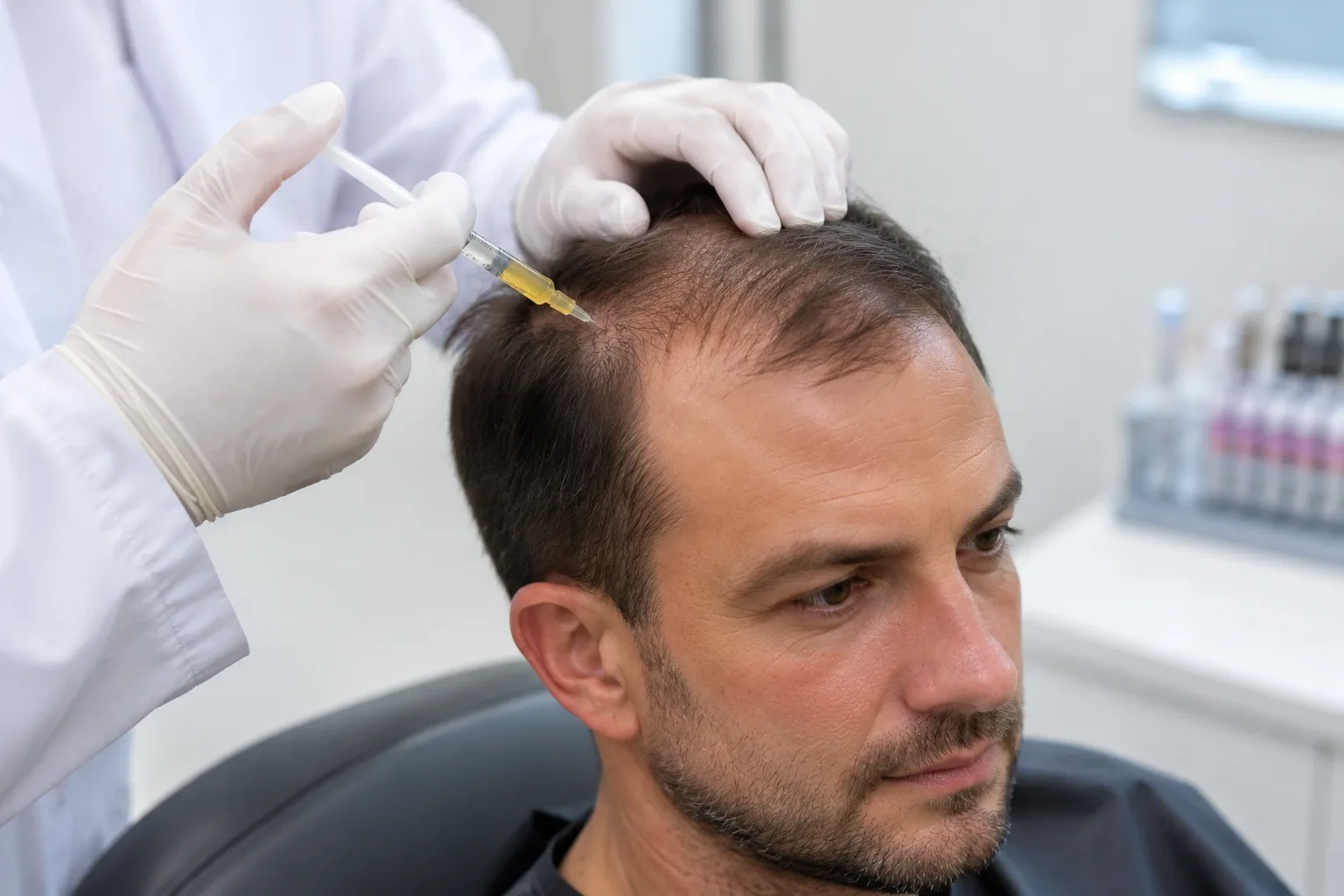
Researchers study both treatments most often for androgenetic alopecia, especially when thinning follicles remain active. Sudden shedding, patchy loss, scalp inflammation, and advanced baldness need different diagnostic priorities.
Hair loss pattern | Possible role of injections | Main reason for caution |
Male or female pattern hair loss | PRP or a formulation-specific mesotherapy protocol may support selected patients | Response depends on the diagnosis, stage, and protocol |
Early diffuse thinning | Treatment may aim to preserve miniaturizing follicles | The clinician must rule out telogen effluvium and other causes |
Sudden or persistent shedding | No automatic role until the trigger receives assessment | Illness, nutrition, hormones, medication, and stress can drive shedding |
Patchy hair loss | Diagnosis-specific research may consider PRP in some settings | Alopecia areata involves immune activity and needs targeted care |
Advanced smooth bald areas | Injections have limited restorative value | Permanently lost follicles cannot provide a reliable target for regrowth |
Early treatment has a logical advantage because viable follicles can still respond. Trichoscopy can reveal variation in hair shaft diameter and other signs of miniaturization. This magnified scalp examination helps a clinician distinguish pattern loss from some other disorders.
Diffuse shedding does not always equal androgenetic alopecia. Iron deficiency, thyroid disease, postpartum changes, infection, and rapid weight loss can produce similar complaints. An injectable growth treatment cannot correct those root causes.
Hair Mesotherapy vs PRP: What Does the Comparative Clinical Research Show?
A 2024 retrospective study found improvement with some PRP and mesotherapy products, but the results differed across all four protocols. The study supports product-specific assessment rather than a general claim that either category wins.
Stefanis and colleagues studied 72 patients with androgenetic alopecia. They compared two PRP formulations with two mesotherapy products containing recombinant growth factors and stem-cell-conditioned media. The team measured hair thickness, hair density, and hair count in frontal and vertex regions over six months (Stefanis et al., 2024).
One mesotherapy product and one PRP preparation improved most measured parameters in at least one scalp region. The other products produced fewer significant changes. Hair thickness also differed between the two PRP groups. These findings show that the preparation itself can influence the outcome.
The retrospective design prevented random allocation and raised the risk of confounding. The groups differed in size and age. The study also lasted only six months. Its findings cannot establish long-term superiority. They also cannot predict results for vitamin mixtures or dutasteride mesotherapy because the study tested different formulations.
Which Treatment Is More Effective for Hair Regrowth?
PRP for androgenetic alopecia has the broader clinical research base, especially for hair density. Mesotherapy evidence depends on the injected agent. Current studies do not support one universal winner for every patient.
A 2023 meta-analysis examined nine randomized trials with 238 patients. PRP increased hair density at three and six months compared with placebo. Hair count and hair diameter improved from baseline, but they did not differ significantly from placebo (Zhang et al., 2023). This distinction matters because improvement within a group does not always prove superiority over a control.
A 2024 review of 21 studies involving 628 women also reported gains in density and thickness after PRP. However, the analysis included different forms of female hair loss and found substantial variation between studies (Yuan et al., 2024). Readers should not transfer a pooled result directly to their own diagnosis.
Dutasteride research also shows mixed outcomes. Nohria and colleagues reported no statistically significant change in density or shaft diameter in a 2024 case series of ten patients. Small samples and concurrent treatments limited the conclusions (Nohria et al., 2024). This result does not invalidate every dutasteride protocol, but it argues against guaranteed claims.
Outcome | What it measures | Why it matters |
Reduced shedding | The amount of hair leaving the scalp | May show stabilization before visible density changes |
Hair density | The number of hairs in a defined scalp area | Estimates coverage with an objective unit |
Total hair count | The number of hairs in a marked field | Tracks change at the same location |
Hair shaft thickness | The diameter of individual fibers | Reflects hair caliber and miniaturization |
Global appearance | Coverage in standardized photographs | Shows whether measurements translate into visible change |
How Many Sessions Are Needed for Mesotherapy and PRP?
No universal session count fits either treatment. PRP often involves an initial series and later reassessment. Mesotherapy schedules vary with the drug or product. The plan should include a point for continuing, changing, or stopping treatment.
The comparative study used three monthly PRP sessions. Its mesotherapy protocols used six or eight sessions at shorter intervals (Stefanis et al., 2024). These schedules describe the studied products, not a medical standard for every provider.
Treatment frequency can affect cost, discomfort, adherence, and cumulative risk. More sessions do not automatically create a stronger response. A sound plan links each visit to a defined formulation and a measurable objective.
Baseline records should come before the first injection. Later reviews should use the same scalp sites and methods. This approach prevents unnecessary treatment when the measurements show no meaningful benefit.
When Do Hair Mesotherapy and PRP Results Become Visible?
Results usually develop over months rather than days. Reduced shedding or better texture may appear before measurable gains in density or thickness. Six months provides a useful research checkpoint, not a promised personal deadline.
Hair follicles cycle through growth, transition, and resting stages. Scalp injections cannot turn this biological process into an instant cosmetic change. New or thicker fibers also need time to reach a visible length.
The underlying diagnosis affects the timeline. Ongoing miniaturization can offset a treatment response. An unresolved trigger can maintain shedding. Inconsistent attendance can also change the total dose and exposure time.
Some patients need maintenance to preserve a benefit. Neither method removes the genetic and hormonal drivers of androgenetic alopecia. A long-term plan should therefore address disease control as well as the initial cosmetic response.
What Are the Side Effects and Risks of Hair Mesotherapy vs PRP?
Both treatments can cause short-term injection reactions. Mesotherapy also carries ingredient-specific risks. PRP avoids an externally selected active drug as its main ingredient, but blood processing and injections still require sterile technique and medical screening.
Risk area | Hair mesotherapy | PRP hair treatment |
Common local effects | Redness, tenderness, swelling, bruising, and brief pain | Redness, tenderness, swelling, pinpoint bleeding, and brief pain |
Product-related effects | Depends on every ingredient, preservative, solvent, and concentration | Depends on blood quality, platelet function, additives, and processing |
Medication concerns | Relevant when the formula contains dutasteride or another drug | No primary drug-related effect from an external mesotherapy medication |
Procedure concerns | Infection, poor placement, or tissue injury | Infection, poor placement, or tissue injury |
Prevention | Exact formula review, contraindication screening, and sterile administration | Health and medication review, validated processing, and sterile administration |
Dutasteride requires special caution because local injection does not remove every medication-related concern. The patient’s sex, pregnancy status, medical history, and other drugs can affect suitability. Rare reports also describe paradoxical hair loss after some dutasteride injection protocols, so product composition and follow-up matter (Nohria et al., 2024).
A review of mesotherapy complications found reports with different severity and stressed weak standardization (Plachouri and Georgiou, 2019). Patients should report persistent swelling, severe pain, discharge, fever, worsening hair loss, or any systemic symptom. Prompt assessment can identify infection, inflammation, or an ingredient reaction.
Hair Mesotherapy vs PRP: How Should You Compare Cost and Treatment Value?
Compare the full course, the exact protocol, and the follow-up plan rather than a single-session price. Treatment value depends on measurable benefit, safety, and maintenance needs.
Mesotherapy prices can vary with the medication, product brand, number of vials, and session frequency. PRP prices can vary with the preparation system, blood-processing steps, and staff time. Location and professional expertise also affect both options.
A lower price may reflect a different product or a shorter course. It may not provide an equivalent treatment. Ask for a written total that includes the initial series, expected maintenance, assessments, and management of side effects.
The exact formulation belongs in that estimate. A named prescription drug and an unspecified cosmetic mixture should not share one value judgment. A PRP quote should also state the preparation method and the planned number of injections.
Can You Combine Hair Mesotherapy and PRP?
Some treatment plans combine them, but evidence for one combination does not cover every mixture. The clinician must assess the added benefit, cumulative injection burden, and ingredient-specific risks.
A PRP and non-drug mesotherapy combination mainly combines two forms of local biological signaling. A PRP and dutasteride combination adds an androgen-targeting drug. These plans have different safety questions and different evidence requirements.
Combination treatment can complicate attribution. If hair density improves or a reaction occurs, the patient may not know which component caused it. A clear baseline, stable co-treatments, and careful records can reduce this uncertainty.
More interventions do not guarantee synergy. The plan should explain why each component addresses a distinct treatment goal. It should also define what result would justify continuing both.
Who Is a Suitable Candidate for Hair Mesotherapy or PRP?
A suitable candidate has a confirmed diagnosis, viable follicles, a realistic goal, and no relevant contraindication. The best option depends on the exact formulation, scalp condition, medical history, and previous response to treatment.
PRP may suit selected people with androgenetic alopecia who want a nonsurgical option. Blood disorders, platelet problems, some medications, and active infection can affect eligibility. The provider should review these factors before blood collection.
Medication-based mesotherapy needs an additional drug safety review. This step matters for people who are pregnant, trying to conceive, or managing other medical conditions. A product without a full ingredient list does not allow an informed assessment.
Sudden loss, unexplained persistent shedding, scalp scale, pustules, pain, or scarring needs diagnostic attention first. These features can point to inflammatory, infectious, hormonal, nutritional, or scarring disorders. Growth-focused injections may delay the correct treatment in such cases.
How Do Mesotherapy and PRP Compare With Other Hair Loss Treatments?
Injectables form only one part of hair loss care. Topical minoxidil and appropriate prescription treatments have established roles in androgenetic alopecia. Hair transplantation serves a different purpose by redistributing follicles.
Option | Main role | Key practical issue |
Topical minoxidil | Supports growth through regular home use | Requires consistent application and can cause local or hair-related side effects |
Prescription anti-androgen treatment | Targets hormonal drivers in suitable patients | Needs diagnosis-specific selection and safety screening |
PRP | Provides platelet-derived signals through injections | Protocols and costs vary |
Mesotherapy | Delivers a selected active substance | Evidence and risk change with the formulation |
Hair transplantation | Moves permanent donor follicles into selected bald areas | Does not stop ongoing loss in untreated native hair |
A 2023 treatment review described topical minoxidil and oral finasteride as traditional standard care. It also found encouraging PRP results but called for more standardized protocols (Kaiser et al., 2023). Prescription choices differ for men and women, so no single drug pathway fits every patient.
Transplantation may suit stable patients with enough donor hair and established loss. It cannot replace medical control of progressive androgenetic alopecia. The treatment plan should match the biological problem rather than the popularity of a procedure.
How Should You Choose Between Hair Mesotherapy and PRP?
Choose a documented protocol after a diagnostic assessment. Compare the exact substance or PRP system, supporting evidence, risks, total cost, and monitoring method before treatment.
Confirm the diagnosis. Ask whether you have androgenetic alopecia, telogen effluvium, alopecia areata, or another disorder.
Set one main objective. Decide whether you want less shedding, better caliber, improved density, or disease stabilization.
Request the full formulation. For mesotherapy, ask for every active ingredient, concentration, solvent, and prescription status.
Request the PRP protocol. Ask about the preparation system, platelet concentration, activation, injection method, and session plan.
Check direct evidence. Look for research on the same diagnosis and a closely matching formulation or preparation.
Review personal risks. Discuss medical conditions, medicines, pregnancy, allergies, and previous injection reactions.
Define success and stopping rules. Agree on baseline measurements, review dates, and the response needed to continue.
This process shifts the decision from a broad PRP vs mesotherapy for hair loss debate to a specific clinical comparison. It also exposes vague claims before you commit to a full course.
What Do Patients Ask Most About Hair Mesotherapy vs PRP?
Patients mainly want to know whether one option works better, what the products contain, and how they can judge progress. The answers below address practical points that the main comparison does not cover.
Is PRP Better Than Hair Mesotherapy?
PRP has stronger overall research support for androgenetic alopecia, but no study proves its superiority over every mesotherapy formulation. A direct comparison must name both protocols.
A fair comparison also needs similar patients and the same outcome measures. Results from one growth-factor product cannot settle the question for dutasteride, vitamins, peptides, or other mixtures.
Does Hair Mesotherapy Contain PRP?
Conventional hair mesotherapy and PRP remain distinct treatments. PRP can use an injection technique, but its defining ingredient comes from processed blood rather than a selected mesotherapy formula.
Some providers use overlapping technical terms. Ask what enters the syringe and how the staff prepares it. That answer gives more clarity than the procedure name.
Is Mesotherapy With Dutasteride the Same as Vitamin Mesotherapy?
No. Dutasteride mesotherapy delivers a drug that inhibits 5-alpha-reductase. Vitamin mesotherapy supplies nutritional or cosmetic ingredients and does not share that drug mechanism.
The two options also need different evidence and safety reviews. The presence of a prescription medication changes the assessment even when both treatments use similar needles.
Can PRP or Mesotherapy Stop Hair Loss Permanently?
Neither treatment offers a guaranteed permanent stop. Androgenetic alopecia can continue when the underlying susceptibility remains.
A successful plan may need ongoing management. Sudden loss from a temporary trigger follows a different course, but recovery depends on correcting that trigger rather than on permanent effects from an injection.
Are Hair Mesotherapy and PRP Painful?
Both can cause brief discomfort because they involve multiple scalp injections. Pain varies with injection depth, technique, scalp sensitivity, and personal pain tolerance.
Providers may use different comfort measures. Ask what they use and whether those measures add any risk or affect the product. Severe or persistent pain needs assessment rather than routine reassurance.
Can Women Undergo Hair Mesotherapy or PRP?
Selected women can receive either treatment after diagnosis and screening. Female hair loss has several possible causes, so pattern loss should not become the default explanation.
PRP research includes women with several diagnoses (Yuan et al., 2024). Medication-containing mesotherapy needs extra precautions during pregnancy, breastfeeding, and reproductive planning.
Can You Receive PRP and Mesotherapy on the Same Day?
Same-day treatment depends on the ingredients, total injection burden, and clinician assessment. No general schedule establishes that this approach improves results.
A combined appointment can also make side effects harder to assign to one product. The plan should explain the reason for the timing and the evidence behind it.
How Can Patients Tell Whether a Treatment Is Working?
Use consistent measurements rather than memory or a single mirror check. Standardized photographs, fixed-site hair counts, density measurements, and trichoscopy provide stronger evidence.
Keep lighting, hair length, styling, and camera angle consistent. Compare the same frontal and vertex sites at planned intervals. Record shedding separately so it does not get confused with a true change in coverage.
What Is the Bottom Line on Hair Mesotherapy vs PRP?
PRP uses your processed blood, while mesotherapy uses a selected formulation. PRP has broader evidence for pattern hair loss, but product variation affects both treatments. Diagnosis and protocol quality should drive the decision.
A reliable plan names the intervention, explains its biological target, and states its limits. It also uses measurable follow-up and realistic goals. Patients should expect gradual change when a response occurs, not a guaranteed cure.
The most useful next step is an individualized hair loss assessment. That review can identify reversible triggers, confirm androgenetic alopecia, and place injections alongside appropriate medical or surgical options.
References
Alves, Rubina, and Ramon Grimalt. “A Review of Platelet-Rich Plasma: History, Biology, Mechanism of Action, and Classification.” Skin Appendage Disorders, vol. 4, no. 1, 2018, pp. 18-24. https://doi.org/10.1159/000477353.
Herz-Ruelas, Maira Elizabeth, et al. “Efficacy of Intralesional and Oral Dutasteride in the Treatment of Androgenetic Alopecia: A Systematic Review.” Skin Appendage Disorders, vol. 6, no. 6, 2020, pp. 338-345. https://doi.org/10.1159/000510697.
Kaiser, Michael, et al. “Treatment of Androgenetic Alopecia: Current Guidance and Unmet Needs.” Clinical, Cosmetic and Investigational Dermatology, vol. 16, 2023, pp. 1387-1406. https://doi.org/10.2147/CCID.S385861.
Nohria, Ambika, et al. “Outcomes of Androgenetic Alopecia Treated with Dutasteride Mesotherapy: A Case Series.” JAAD Case Reports, vol. 54, 2024, pp. 53-58. https://doi.org/10.1016/j.jdcr.2024.09.024.
Plachouri, Kerasia-Maria, and Sophia Georgiou. “Mesotherapy: Safety Profile and Management of Complications.” Journal of Cosmetic Dermatology, vol. 18, no. 6, 2019, pp. 1601-1605. https://doi.org/10.1111/jocd.13115.
Stefanis, Athanasios J., et al. “Efficacy of Platelet-Rich Plasma versus Mesotherapy with Recombinant Growth Factors and Stem Cell-Conditioned Media in Androgenetic Alopecia: A Retrospective Study.” Skin Appendage Disorders, vol. 10, no. 5, 2024, pp. 376-382. https://doi.org/10.1159/000539105.
Tang, Ziyuan, et al. “Current Application of Mesotherapy in Pattern Hair Loss: A Systematic Review.” Journal of Cosmetic Dermatology, vol. 21, no. 10, 2022, pp. 4184-4193. https://doi.org/10.1111/jocd.14900.
Yuan, Jing, et al. “Effectiveness of Platelet-Rich Plasma in Treating Female Hair Loss: A Systematic Review and Meta-Analysis of Randomized Controlled Trials.” Skin Research and Technology, vol. 30, no. 8, 2024, e70004. https://doi.org/10.1111/srt.70004.
Zhang, XiuXiu, et al. “Platelet-Rich Plasma for Androgenetic Alopecia: A Systematic Review and Meta-Analysis of Randomized Controlled Trials.” Journal of Cutaneous Medicine and Surgery, vol. 27, no. 5, 2023, pp. 504-508. https://doi.org/10.1177/12034754231191461.