
Hair Mesotherapy for Men: How Does It Work and Is It Effective?
Hair mesotherapy for men uses microinjections to deliver vitamins, minerals, amino acids, and sometimes medications directly into the scalp.
Hair mesotherapy for men uses microinjections to deliver vitamins, minerals, amino acids, and sometimes medications directly into the scalp. Early research shows promise for hair thinning, but evidence remains limited, and mesotherapy works best as a complementary option rather than a replacement for proven treatments like minoxidil and finasteride.
Male hair loss drives millions of men toward injectable treatments each year. Many want faster results than topical products offer, and many want to avoid daily pills. Hair mesotherapy answers both desires because it places active substances exactly where hair follicles live.
Men should understand one critical distinction before they book a session. Mesotherapy may improve hair quality and support follicles that still function. It cannot reverse follicular death or treat the hormonal cause of male pattern baldness on its own. Current studies report encouraging hair density gains, yet researchers agree that larger trials must confirm these findings (Tang et al. 2022).
What Is Hair Mesotherapy for Men?
Scalp mesotherapy delivers small doses of active substances into the dermis through fine-needle injections, targeting the layer of skin where hair follicles sit.
A practitioner injects a mesotherapy solution into the middle layer of the scalp skin. The word "mesotherapy" comes from the Greek word for this middle layer. The technique deposits the solution in tiny amounts across the thinning area, which raises local concentration while it lowers systemic exposure (Gupta et al. 2023).
This delivery method differs sharply from conventional topical hair treatments. A topical product must cross the skin barrier, and much of it never reaches the follicle. An injection bypasses that barrier and places the substance beside the follicle. This difference explains why men consider scalp injections when creams and foams disappoint them.
How Does Hair Mesotherapy Affect Male Hair Follicles?
Local delivery raises the concentration of active substances around the follicle, improves the scalp environment, and may prolong the growth phase of the hair growth cycle, but only viable follicles can respond.
The biological rationale rests on proximity. Hair follicles sit inside the dermis, so an intradermal injection places nutrients, peptides, or drugs within millimeters of the target. Researchers believe this local bath supports cell metabolism and microcirculation around the follicle (Gupta et al. 2023).
A follicle cycles through growth, transition, and rest phases. Treatments that extend the growth phase or push resting follicles back into growth can increase hair density over time. Minoxidil works through exactly this kind of cycle modulation, which shows that follicle biology can respond to the right stimulus (Messenger and Rundegren 2004).
This mechanism sets a hard limit on results. A follicle must still be alive to respond. Mesotherapy cannot revive follicles that have already disappeared from the scalp.
What Causes Hair Loss in Men That Mesotherapy May Target?
Mesotherapy targets conditions where follicles remain alive but underperform, mainly early androgenetic alopecia, while diffuse shedding and telogen effluvium require a confirmed diagnosis first.
Does Androgenetic Alopecia Respond to Mesotherapy?
Early-stage male pattern baldness is the most studied indication because miniaturized follicles can still produce thicker hair when their environment improves.
In androgenetic alopecia, dihydrotestosterone (DHT) binds to follicle receptors and shrinks genetically sensitive follicles. Hair becomes finer and shorter with each cycle. This process of follicular miniaturization creates the receding hairline and crown thinning that men recognize early (Trueb 2002).
Early-stage thinning suits follicle-supportive treatments best. At that stage, follicles still exist and still produce hair, so a supportive environment can plausibly thicken their output. This logic matches why finasteride, a DHT blocker, works best in men with mild to moderate loss (Kaufman et al. 1998).
How Does Diffuse Hair Thinning Differ From Pattern Loss?
Diffuse thinning spreads evenly across the scalp, while pattern loss follows a defined map, and the two conditions demand different treatment plans.
Pattern hair loss follows predictable zones. Diffuse shedding appears everywhere at once and often signals a trigger such as stress, illness, or nutritional deficiency. A practitioner must identify the correct diagnosis before any injection plan, because a treatment that suits one cause may waste time and money in another.
Can Mesotherapy Help Telogen Effluvium?
Evidence for mesotherapy in telogen effluvium remains extremely limited because almost all trials focus on pattern hair loss instead.
Telogen effluvium pushes large numbers of follicles into the resting phase at once, usually after a trigger. The condition often reverses on its own once the trigger resolves (Rebora 2019). Systematic reviews confirm that telogen effluvium appears in only a small fraction of mesotherapy studies, so no firm conclusion exists for this condition (Gupta et al. 2023).
What Ingredients Can Be Used in Hair Mesotherapy for Men?
Formulas vary widely and may include vitamins, minerals, amino acids, peptides, growth factors, hyaluronic acid, or established hair-loss drugs such as minoxidil and dutasteride.
Ingredient group | Common examples | Proposed role |
Vitamins | Biotin, B-complex, vitamins A, C, E | Support follicle cell metabolism |
Minerals | Zinc, selenium, copper, manganese | Stabilize follicle structure and enzyme function |
Amino acids | Arginine, cysteine, lysine, taurine | Supply building blocks for keratin |
Peptides and growth factors | Copper tripeptide, decapeptides | Signal follicle activity and repair |
Hydrators | Low-molecular-weight hyaluronic acid | Improve scalp hydration and environment |
Medications | Minoxidil, dutasteride, finasteride | Direct effects on growth cycle or DHT |
Why Do Vitamins and Minerals Appear in Most Formulas?
Practitioners include them to correct local nutritional deficits and support the energy-hungry cells of the hair matrix, even though oral deficiency must be ruled out separately.
The hair matrix ranks among the most rapidly dividing cell populations in the body, so it demands constant nutrient supply. Formulas therefore often combine B-complex vitamins, biotin, and trace minerals. One analyzed commercial solution contained 24 amino acids, 13 vitamins, four coenzymes, four nucleic acids, and five minerals, which shows how complex these cocktails can become (Gupta et al. 2023).
What Role Do Amino Acids, Peptides, and Growth Factors Play?
They provide raw material for keratin and act as signaling molecules that may encourage follicle cells toward growth behavior.
Amino acids form the structural basis of keratin, the protein that builds the hair shaft. Peptides and growth factors go further and act as chemical signals. Research groups have studied several growth factor preparations through mesotherapy, and early reports describe measurable density gains, though study sizes stay small (Gupta et al. 2023).
Why Do Some Formulas Contain Minoxidil or Other Medications?
Some clinics inject minoxidil or 5-alpha-reductase inhibitors to combine the drug's proven mechanism with local delivery, but the injection route itself is not the approved method for these medicines.
Minoxidil extends the growth phase and enlarges miniaturized follicles through topical use (Messenger and Rundegren 2004). Injecting it aims to raise scalp concentration while it cuts skin-surface side effects such as unwanted facial hair. Men must distinguish the ingredient from the delivery method here. Minoxidil earned approval as a topical product, and robust evidence supports that route (Olsen et al. 2007). The injected route remains off-label.
Why Is There No Standard Mesotherapy Formula?
No regulatory body has approved a specific scalp mesotherapy cocktail, so each clinic selects its own ingredients, depth, and schedule.
Systematic reviews repeatedly flag this absence of standardization as the field's core weakness. Studies differ in agents, concentrations, needle depth, and session frequency, which makes comparisons between trials unreliable (Tang et al. 2022). Every patient should ask for the exact ingredient list before treatment, because the formula defines both the expected benefit and the risk profile.
Who Is a Suitable Candidate for Hair Mesotherapy?
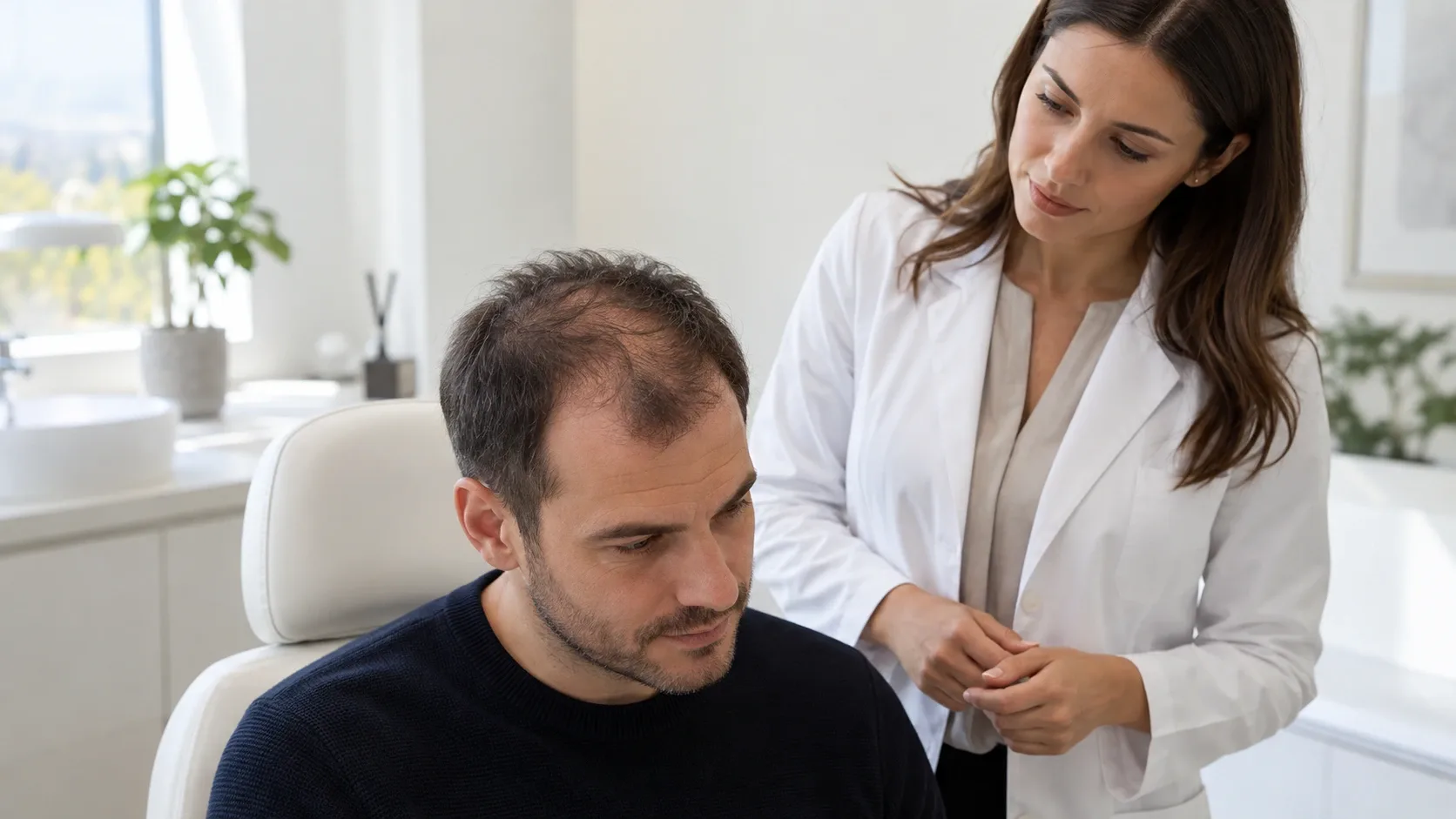
Men with early or moderate thinning, miniaturized but living follicles, and realistic expectations about a minimally invasive complementary treatment make the best candidates.
A thorough scalp assessment confirms whether follicles remain viable. Trichoscopy lets a clinician count hairs per follicular unit and measure shaft diameter, which reveals miniaturization. Men who want a non-surgical add-on to an existing plan, rather than a miracle cure, align best with what the evidence supports.
Who Should Not Rely on Hair Mesotherapy Alone?
Men with advanced baldness, smooth shiny areas where follicles have died, or hair loss from conditions that need medical treatment should not expect mesotherapy to solve their problem.
Follicles that have vanished cannot respond to any injection. In addition, alopecia areata, scarring alopecias, and thyroid or iron-deficiency related shedding demand specific medical therapy. Diagnosis must come before treatment selection, because the wrong treatment delays the right one.
How Is Hair Mesotherapy Performed in Men?
A trained practitioner reviews medical history, cleans the scalp, and injects the solution across thinning zones with a fine needle or a mesotherapy device, usually within 30 to 60 minutes.
How Is the Scalp Prepared Before Injection?
The practitioner confirms the diagnosis, reviews medications and allergies, cleans the scalp, and may apply numbing cream for comfort.
This step protects the patient. A history of keloid scarring, bleeding disorders, active scalp infection, or allergy to formula components can change or cancel the plan. Sterile technique starts here, not at the needle.
How Are the Mesotherapy Injections Delivered?
The practitioner places a series of shallow microinjections spaced a few millimeters apart across each thinning area, either by hand or with a multi-needle injection device.
Manual injection gives the practitioner precise depth control. Mechanical devices speed the process and keep spacing even. In trials, researchers typically injected around 2 ml of solution per session at weekly intervals (Tang et al. 2022).
How Long Does a Hair Mesotherapy Session Take?
Most sessions take 30 to 60 minutes, depending on the size of the treated area and the injection method.
Numbing cream adds 20 to 30 minutes when the clinic uses it. Large crown areas take longer than a small frontal zone. Patients should plan for the full appointment, not just the injection time.
Does Hair Mesotherapy for Men Hurt?
Most men describe mild stinging or pressure, and numbing cream plus a skilled technique keep discomfort low.
Pain varies with needle depth, formula acidity, and individual sensitivity. Reported side effects in trials include transient pain, headache, and scalp tightness, and most cases resolve quickly (Gupta et al. 2023). Sharp or worsening pain after a session always deserves a call to the clinic.
How Many Hair Mesotherapy Sessions Do Men Need?
Treatment usually starts with weekly sessions for 6 to 8 weeks, followed by maintenance every few months, because follicle biology responds slowly and cumulatively.
No universal number fits every patient. Protocol length depends on the formula, the diagnosis, and the response. Trial schedules cluster around 8 to 12 weekly injections before assessment (Tang et al. 2022). Men who respond often continue with maintenance sessions to hold their gains.
When Can Men Expect Results From Hair Mesotherapy?
Early changes such as reduced shedding may appear within 4 to 8 weeks, but visible density improvement needs 3 to 6 months because hair grows slowly and each follicle must complete part of its cycle.
Hair grows roughly one centimeter per month. A follicle pushed toward growth needs months before the new shaft becomes visible at the surface. This biology explains why researchers evaluate outcomes after at least one full hair growth cycle. Photographs and trichoscopy at baseline and at month three give an honest comparison.
Does Hair Mesotherapy Actually Work for Male Hair Loss?
Early studies report real improvements in hair density and thickness, but small samples, mixed formulas, and short follow-up periods prevent firm conclusions.
The largest systematic review to date included 27 studies and 6 classes of injected agents. Several trials found statistically significant hair growth, yet the authors stressed the lack of standardized regimens and called for large controlled trials (Gupta et al. 2023). Another review of 12 studies covering 253 men and 274 women found positive efficacy in every included study, with no significant side effects, but again flagged insufficient sample sizes (Tang et al. 2022).
Two randomized trials compared vitamin and peptide formulas against topical minoxidil. One found no significant difference between groups, while another found a greater increase in follicle count with mesotherapy. Results therefore cannot be generalized from one mesotherapy cocktail to another, because each formula behaves like a different treatment.
How Effective Is Mesotherapy Compared With Established Hair-Loss Treatments?
Established treatments carry far stronger evidence, while mesotherapy offers a promising but less proven option that may work best alongside them.
Treatment | Delivery | Evidence strength | Primary mechanism |
Intradermal microinjections | Early, small trials | Local nutrients, peptides, or drugs | |
Minoxidil 5% | Topical, daily | Large RCTs | Prolongs growth phase (Olsen et al. 2007) |
Finasteride | Oral, daily | Large RCTs | Blocks DHT production (Kaufman et al. 1998) |
Autologous injections | Moderate RCTs | Growth factors from own blood (Gentile et al. 2015) | |
Light exposure | Moderate trials | Cellular energy stimulation (Avci et al. 2013) |
How Does Mesotherapy Compare With Minoxidil?
Minoxidil holds the stronger evidence base and regulator approval, while mesotherapy delivers agents locally and may suit men who poorly tolerate topical products.
Trials of 5% minoxidil involved hundreds of patients and confirmed superiority over placebo (Olsen et al. 2007). Mesotherapy trials involved dozens of patients with mixed formulas. Mesotherapy may still add value as an adjunct, because it can deliver minoxidil itself to the scalp with less surface irritation.
How Does Mesotherapy Compare With Finasteride?
Finasteride attacks the hormonal cause of pattern loss, while mesotherapy supports follicles locally, so the two treatments are not interchangeable.
Finasteride lowers scalp DHT and stops miniaturization at its source. Large trials proved its benefit in men with mild to moderate androgenetic alopecia (Kaufman et al. 1998). Mesotherapy does not reliably reduce DHT unless the formula includes a 5-alpha-reductase inhibitor. A man with active miniaturization needs the hormonal effect that only medication provides.
How Does Mesotherapy Compare With PRP?
PRP injects growth factors from the patient's own blood, while mesotherapy injects a formulated solution, and PRP currently holds deeper clinical evidence.
A randomized placebo-controlled trial found that platelet-rich plasma increased hair density and follicle count in pattern hair loss (Gentile et al. 2015). Histomorphometric studies confirmed thicker epidermis and more follicles after PRP sessions (Cervelli et al. 2014). Mesotherapy evidence remains thinner, though the injection skill overlaps.
How Does Mesotherapy Compare With Low-Level Laser Therapy?
Laser therapy works through light energy without needles, while mesotherapy works through injected substances, and both show early positive signals with modest evidence.
Low-level laser therapy stimulates cellular metabolism through photobiomodulation and has produced hair count improvements in controlled studies (Avci et al. 2013). Men who fear needles often prefer light devices, while men who want direct delivery of nutrients prefer injections. Downtime stays minimal with both.
Can Hair Mesotherapy Be Combined With Other Hair-Loss Treatments?
Yes, clinicians often combine mesotherapy with minoxidil, finasteride, or PRP, but a specialist should design the combination to avoid duplication and overlap.
A sensible plan pairs a proven baseline therapy with mesotherapy as support. For example, finasteride controls DHT while injections supply nutrients to the follicle. The clinician must check that the plan does not repeat the same drug through two routes at once. Each combination needs individual assessment based on diagnosis, stage, and tolerance.
What Side Effects Can Men Experience After Hair Mesotherapy?
Most reactions stay mild and local, but rare serious complications such as infection or inflammatory reactions demand an experienced practitioner and sterile products.
Reaction | Typical frequency | Usual course |
Redness at injection sites | Common | Hours to days |
Itching or tenderness | Common | Self-limited (Gupta et al. 2023) |
Swelling or headache | Common | Resolves within days |
Injection-site infection | Uncommon | Needs medical treatment |
Granulomatous reaction | Rare | Needs specialist care |
Paradoxical hair loss | Rare | Reported case reports (Issa et al. 2022) |
What Short-Term Reactions Are Normal?
Redness, mild itching, tenderness, swelling, and scalp tightness count as expected responses that fade within days.
Trials consistently list these effects, and most patients tolerate them well (Tang et al. 2022). Cold compresses and patience usually manage them.
What Serious Complications Should Men Watch For?
Infection, persistent inflammatory nodules, scarring, and paradoxical hair loss are rare but documented, and product quality plus practitioner skill strongly influence risk.
Published case reports describe injection-site infection, granulomatous foreign-body reactions, and even hair loss triggered by the procedure itself (Issa et al. 2022). Reviews link these events to unregulated formulas, contaminated products, or poor technique. A reputable clinic uses licensed ingredients, sterile single-use needles, and transparent records.
What Should Men Do After a Hair Mesotherapy Session?
Keep the scalp dry and calm for 24 to 48 hours, skip intense exercise and heat, and resume normal activities once redness settles.
Men should avoid washing the hair, swimming, saunas, and heavy workouts for at least a day. Direct sun exposure irritates freshly injected skin. Most patients return to work the same day, and normal routines resume within 48 hours if healing stays smooth.
How Much Does Hair Mesotherapy for Men Cost?
Prices vary widely by country, formula, and practitioner expertise, and men should evaluate the full course cost rather than the per-session price.
The number of sessions multiplies the total. A premium formula with medications costs more than a vitamin blend. A comparison based only on the per-session fee misleads, because a cheap series with an unknown cocktail may deliver no benefit at all. Clinics should quote the complete plan in writing.
How Should Men Choose a Hair Mesotherapy Provider?
Choose a medically trained practitioner who diagnoses the hair loss first, discloses every ingredient, and works in a sterile clinical setting.
The provider should hold relevant medical qualifications and demonstrable injection experience. Transparency matters most: the clinic must state exactly what enters the scalp and why. A proper diagnosis, honest outcome discussion, and clean treatment room separate professional practice from marketing.
What Questions Should Men Ask Before Starting Mesotherapy?
Ask about diagnosis, ingredients, rationale, session count, realistic results, side effects, and alternatives before you pay for anything.
What type of hair loss do I have, and how was it confirmed?
What exact substances will you inject into my scalp?
Why did you select this formula for my diagnosis?
How many sessions do you recommend, and why?
What results do you consider realistic for my stage?
What side effects should I expect, and how do you handle complications?
Which alternative treatments might suit me better?
Is Hair Mesotherapy Worth Considering for Men With Hair Loss?
Mesotherapy earns consideration as a complementary tool for early thinning in men with viable follicles, but it should not automatically replace evidence-based treatment.
The honest position looks like this. Mesotherapy shows early positive signals, carries mostly mild side effects, and fits men who want a minimally invasive supportive option. It does not yet match the evidence behind minoxidil or finasteride, and it cannot restore dead follicles. An individualized diagnosis and a realistic plan remain the foundation of good hair loss care.
What Do Men Most Often Ask About Hair Mesotherapy?
Men mainly want to know whether mesotherapy can stop baldness, regrow a hairline, work on bald skin, and how long results last.
Can Hair Mesotherapy Stop Male Pattern Baldness?
No treatment fully stops genetic hair loss, and mesotherapy alone does not block DHT. Combination with medication gives stronger control.
Can Hair Mesotherapy Regrow a Receding Hairline?
It may thicken miniaturized hairs at the hairline, but it cannot recreate a hairline that follicles have already abandoned.
Can Mesotherapy Work on a Completely Bald Area?
No. Smooth bald skin lacks viable follicles, so injections there offer nothing for the follicle to revive.
How Long Do the Results of Hair Mesotherapy Last?
Results depend on maintenance, and most responders need periodic sessions because the underlying tendency toward loss continues.
Can Men Return to Work After Mesotherapy?
Yes, most men resume work immediately, since visible redness usually fades within hours.
Can Hair Mesotherapy Be Used After a Hair Transplant?
Clinicians sometimes use it weeks after transplantation to support grafts and native hair, but only with surgical clearance.
Is Hair Mesotherapy Safe for Every Man?
No. Men with scalp infections, keloid tendencies, certain allergies, or unrealistic expectations need assessment before any injection.
Does Hair Mesotherapy Permanently Regrow Hair?
No result counts as permanent in pattern hair loss, because the genetic process continues and maintenance sustains any gain.
What Are the Key Takeaways About Hair Mesotherapy for Men?
Mesotherapy delivers active substances locally to support living follicles, suits men with early thinning, shows early but limited evidence, and works best as a complement to proven therapy.
Mechanism: microinjections place nutrients, peptides, or drugs beside follicles in the dermis.
Candidate selection: early or moderate loss with viable follicles gives the only realistic target.
Evidence quality: small trials report density gains, yet standardization and sample sizes remain weak (Gupta et al. 2023; Tang et al. 2022).
Expected results: reduced shedding first, visible thickening after three to six months.
Safety: mostly mild local reactions, with rare serious complications tied to product and technique (Issa et al. 2022).
Role: a supportive add-on to minoxidil or finasteride, not a substitute for them.
References
Avci, Pattnaik, et al. "Low-Level Laser (Light) Therapy (LLLT) in Skin: Stimulating, Healing, Restoring." Seminars in Cutaneous Medicine and Surgery, vol. 32, no. 1, 2013, pp. 414-426.
Cervelli, V., et al. "The Effect of Autologous Activated Platelet Rich Plasma (AA-PRP) Injection on Pattern Hair Loss: Clinical and Histomorphometric Evaluation." BioMed Research International, vol. 2014, 2014.
Gentile, P., et al. "The Effect of Platelet-Rich Plasma in Hair Regrowth: A Randomized Placebo-Controlled Trial." Stem Cells Translational Medicine, vol. 4, no. 11, 2015, pp. 1317-1323.
Gupta, Aditya K., et al. "Systematic Review of Mesotherapy: A Novel Avenue for the Treatment of Hair Loss." Journal of Dermatological Treatment, vol. 34, no. 1, 2023, p. 2245084.
Issa, N. T., et al. "Alopecia After Cosmetic Injection Procedures: A Review." Dermatologic Surgery, vol. 48, no. 8, 2022, pp. 855-861.
Kaufman, Keith D., et al. "Finasteride in the Treatment of Men with Androgenetic Alopecia." Journal of the American Academy of Dermatology, vol. 39, no. 4, 1998, pp. 578-589.
Messenger, Andrew G., and Johan Rundegren. "Minoxidil: Mechanisms of Action on Hair Growth." British Journal of Dermatology, vol. 150, no. 2, 2004, pp. 186-194.
Olsen, Elise A., et al. "A Multicenter, Randomized, Placebo-Controlled, Double-Blind Clinical Trial of a Novel Formulation of 5% Minoxidil Topical Foam Versus Placebo in the Treatment of Androgenetic Alopecia in Men." Journal of the American Academy of Dermatology, vol. 57, no. 5, 2007, pp. 767-774.
Rebora, Alfredo. "Telogen Effluvium: A Comprehensive Review." Clinical, Cosmetic and Investigational Dermatology, vol. 12, 2019, pp. 583-590.
Tang, Zhenyu, et al. "Current Application of Mesotherapy in Pattern Hair Loss: A Systematic Review." Journal of Cosmetic Dermatology, vol. 21, no. 10, 2022, pp. 4184-4193.
Trueb, Ralph M. "Molecular Mechanisms of Androgenetic Alopecia." Experimental Gerontology, vol. 37, nos. 8-9, 2002, pp. 981-990.