
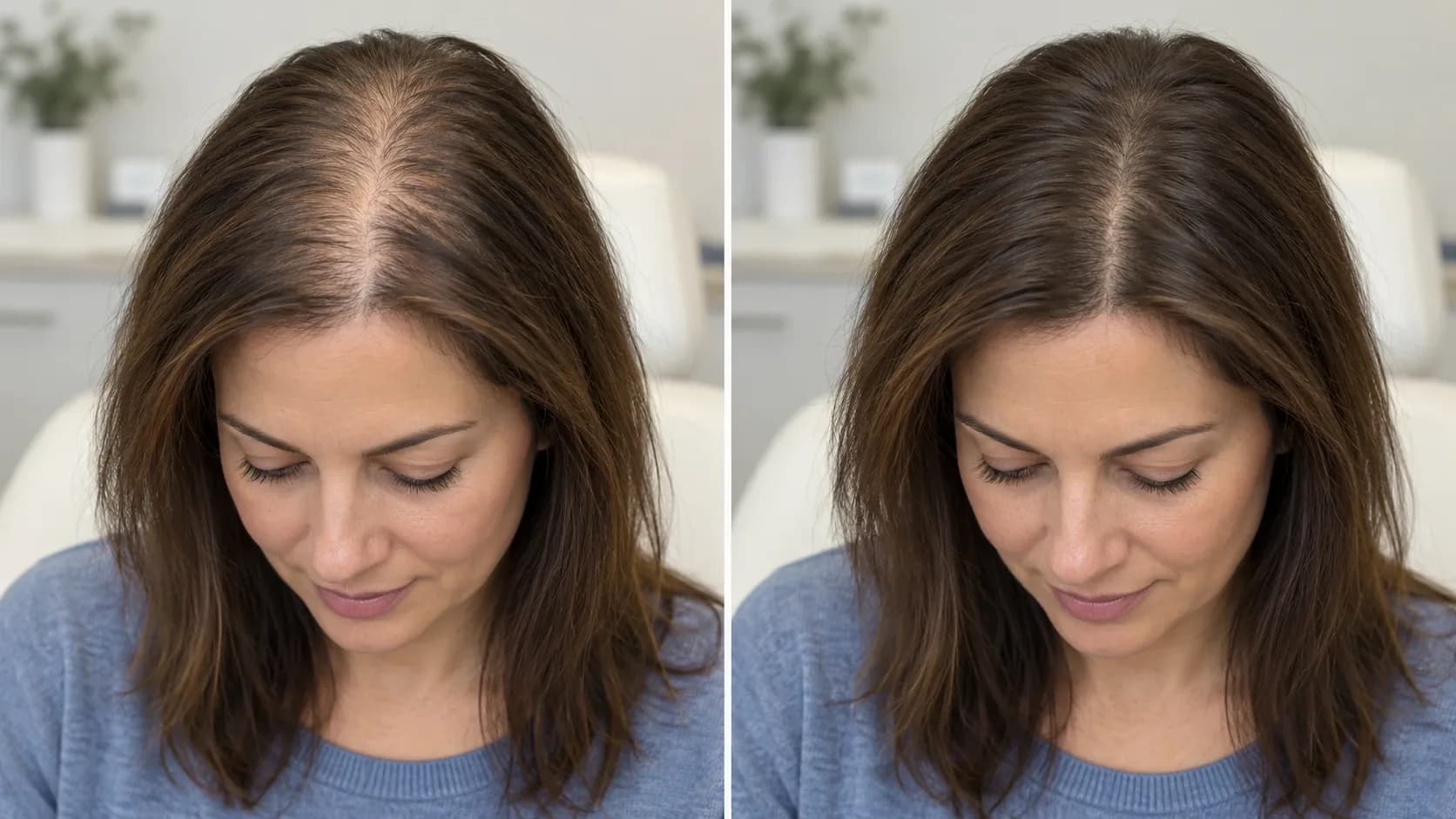
Hair Mesotherapy Before and After: What Results Can You Expect?
Hair mesotherapy before and after comparisons usually show gradual improvements in hair density, hair shaft thickness, and reduced shedding over 3 to 6 months, not overnight regrowth.
Hair mesotherapy before and after comparisons usually show gradual improvements in hair density, hair shaft thickness, and reduced shedding over 3 to 6 months, not overnight regrowth. Results depend on the diagnosis, the injected formula, follicle health, and the treatment protocol (Aledani 2024).
People search for hair mesotherapy before and after content for one reason: they want to know if the treatment works before they spend money on it. This article answers that question with evidence. Hair mesotherapy is an injectable therapy for hair loss. A clinician delivers vitamins, amino acids, peptides, minoxidil, dutasteride, or nutrient blends directly into the scalp through microinjections. The goal is to support follicles that still function but have started to shrink. That detail matters, because mesotherapy supports existing follicles. It does not create new ones.
What Can Hair Mesotherapy Before and After Results Show?
Before and after comparisons document changes in hair density, hair shaft diameter, scalp visibility, shedding, and overall hair appearance.
Before and after documentation serves one scientific purpose: it measures treatment response against a fixed baseline. Clinicians use it to decide whether mesotherapy for hair loss is working for a specific patient. The most common hair mesotherapy results include four changes. First, some patients show increased hair density in treated areas. Second, individual hairs may grow thicker, which reduces scalp visibility. Third, daily shedding may decrease. Fourth, the overall hair appearance may look fuller even when the follicle count stays stable. Outcomes vary because the underlying condition matters. Androgenetic alopecia, telogen effluvium, and alopecia areata respond differently, and each protocol uses different active ingredients (Aledani 2024).
What Does Hair Look Like Before Mesotherapy?
Before treatment, patients typically show a widening part line, reduced crown density, increased scalp visibility, finer hairs, or diffuse thinning.
Which Signs of Hair Thinning Should Be Documented?
The key signs to document are a widening part line, lower crown density, more visible scalp, miniaturised hairs, and diffuse thinning across the top of the head.
A clinician should record the exact pattern of loss before the first session. In female pattern hair loss, the part line often widens first. In male pattern hair loss, the crown and temples usually thin first. Miniaturised hairs are shorter, finer strands that signal follicular miniaturisation, the gradual shrinkage of follicles under genetic and hormonal influence. Diffuse thinning spreads evenly across the scalp and often links to nutritional, hormonal, or stress-related shedding. Each pattern points to a different cause, and each cause sets a different ceiling for hair mesotherapy results.
Why Is the Baseline Important for Measuring Progress?
A baseline records starting density, identifies responsive follicles, and gives every later measurement a fixed point of comparison.
Progress only has meaning when it is measured against a documented starting point. A proper baseline includes standardized photographs and, when available, trichoscopy. Trichoscopy is a magnified scalp examination that reveals follicular units, hair shaft diameter, and the ratio of thick to thin hairs. This matters because the naked eye misses early regrowth. A dermoscopic study by Gajjar (2019) found that new fine hairs appeared under the dermatoscope before patients could see them, which makes objective monitoring more reliable than mirror checks alone.
What Happens to Hair Immediately After Mesotherapy?
Redness, mild swelling, tenderness, small injection marks, and occasional bruising are normal and temporary after scalp injections.
Which Temporary Changes Are Normal After Injection?
Expect redness, mild swelling, tenderness, small puncture marks, and temporary bruising at the injection sites for hours to a few days.
These reactions come from the microinjury itself, not from hair growth. Multiple tiny injections trigger a short inflammatory response. In one randomized trial, 88 percent of patients developed transient redness that resolved within one to two hours (Gajjar 2019). This response is expected and usually mild.
Why Should Immediate Changes Not Be Mistaken for Hair Growth?
Post-injection swelling plumps the scalp and can mimic fullness in photographs, so immediate images distort the apparent result.
Swelling flattens the hair against the scalp and changes how light reflects off it. A photo taken the same day can look fuller or thinner than reality. Genuine follicular changes take weeks to months. Any honest hair mesotherapy before and after comparison must exclude the first days after each session.
When Do Hair Mesotherapy Before and After Changes Become Visible?
Most visible changes appear after 3 to 6 months of consistent treatment, because hair follows a biological growth cycle.
What May Happen During the Early Follow-Up Period?
Shedding may temporarily fluctuate and visible change stays limited in the first 4 to 8 weeks.
Early fluctuations are common. Follicles entering a new growth phase often push out old hairs first, so shedding can briefly increase. Patients who judge hair mesotherapy effectiveness at week two usually draw the wrong conclusion. Clinicians advise waiting through at least one full hair growth cycle before evaluating response.
What Changes May Appear Over the Following Months?
Reduced shedding, thicker hair shafts, and improved visible density may emerge between months two and six in responding patients.
The typical hair mesotherapy results timeline moves in stages. Shedding often stabilizes first. Then hair shaft diameter increases, which makes hair feel and look denser. Finally, some responders show measurable density gains. In a randomized trial of intradermal minoxidil, treated patients reported better improvement than placebo patients, although the density difference at six weeks after the final injection did not reach statistical significance (P = .054) (Uzel 2022). This shows why modest, gradual change defines realistic expectations.
Why Does Hair Growth Require a Longer Observation Period?
The hair growth cycle runs in phases, and follicles need months to move from resting phase into active growth.
Each follicle cycles through anagen (growth), catagen (transition), and telogen (rest). A follicle that enters anagen today will not produce a visible hair for weeks. Cosmetic fullness also changes faster than biology. A styled, freshly washed head of hair can look improved before a single new hair has grown, which is why measurable parameters matter more than appearance alone.
Can Hair Mesotherapy Increase Hair Density?
Some studies report measurable density improvements, but results vary by protocol and patient, and no outcome can be guaranteed.
Hair density means the number of hairs per square centimeter of scalp. Mesotherapy may raise density in two ways: it can thicken existing hairs and it can revive miniaturised follicles so they produce visible strands again. It cannot raise the follicle count itself. A 2024 systematic review identified 11 relevant studies and found promising signals, but it also highlighted major differences in protocols, doses, injection techniques, and schedules, which limits firm conclusions (Aledani 2024). The honest position: density gains are possible, especially in early-stage thinning, but the evidence base remains small.
Can Mesotherapy Make Individual Hairs Thicker?
Yes, increased hair shaft diameter is one of the most consistent reported changes, and thicker hairs reduce scalp visibility without any new follicles forming.
Hair shaft diameter and follicle count are separate measures. A follicle that miniaturises produces a finer hair. When treatment revives that follicle, the same follicle produces a thicker hair. The scalp then looks fuller because thicker hairs block more light and cover more surface. In the Gajjar (2019) trial, variation in hair shaft diameter increased significantly within the mesotherapy group (P = .01), which indicates thicker and newly growing hairs. Visual fullness, however, does not prove new follicles have formed. Only trichoscopic counting can confirm that.
How Should You Compare Hair Mesotherapy Before and After Photos?
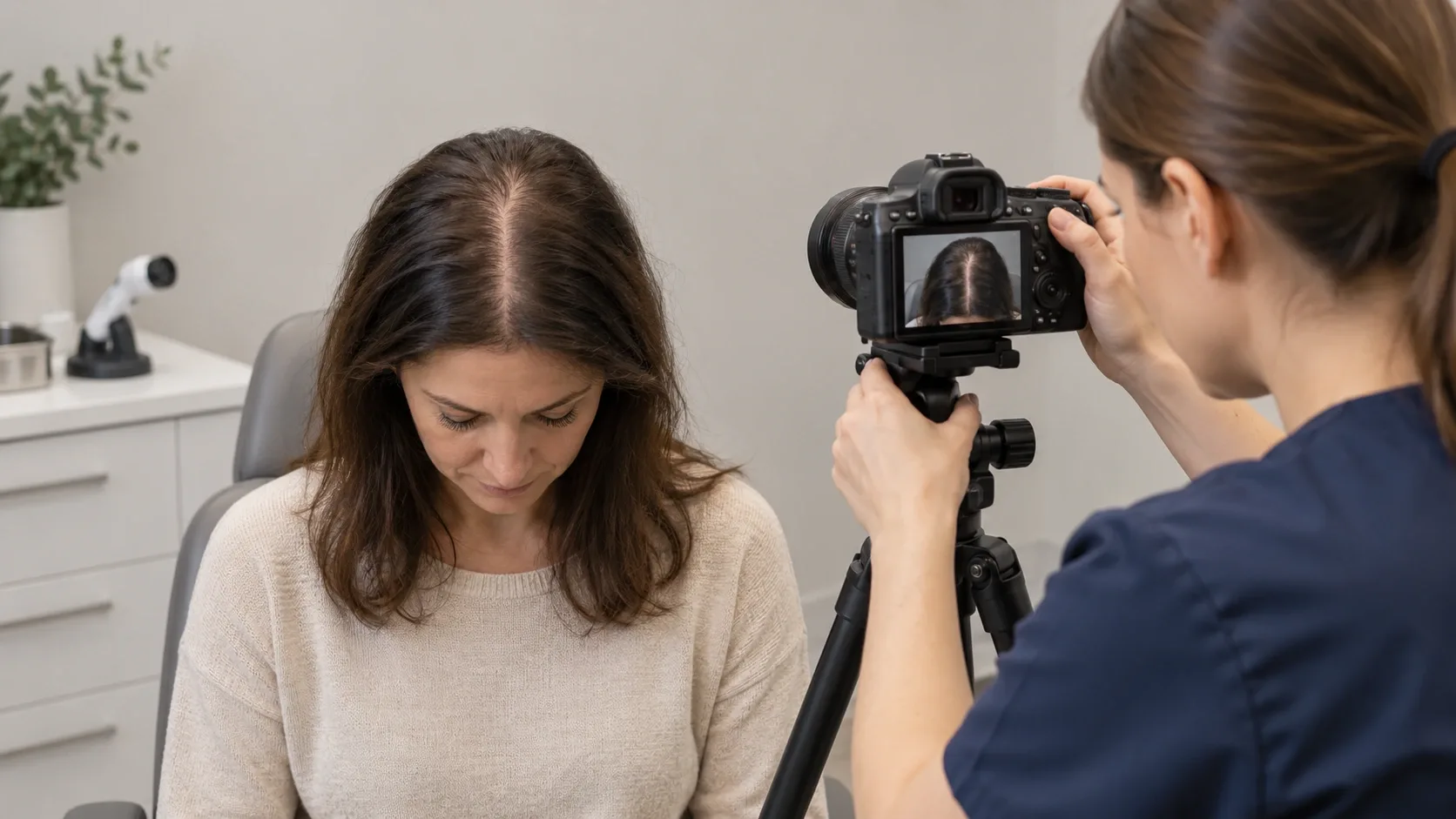
Only compare photos taken under identical lighting, angle, distance, hair length, and styling conditions, ideally backed by trichoscopy.
Which Photography Conditions Should Remain Consistent?
Keep the same lighting, camera, distance, angle, head position, hair state, and hairstyle in every session.
Condition | Why it matters |
Same lighting | Light direction changes how much scalp shows through hair |
Same camera and distance | Zoom flattens or exaggerates density differences |
Same angle and head position | A tilted head hides or exposes the crown |
Clean, dry hair | Wet hair clumps and reveals the scalp |
Consistent parting and style | A new parting can fake an improvement |
How Can Trichoscopy Improve Before-and-After Assessment?
Trichoscopy measures hair shaft diameter, follicular units, miniaturisation, and density objectively, which photographs cannot do.
Trichoscopy turns a subjective impression into data. It counts hairs, classifies them by thickness, and tracks follicular units over time. Standardized photography shows the cosmetic result. Trichoscopy shows the biological result. Both together give the clearest picture of hair mesotherapy treatment results.
Which Visual Factors Can Make Results Look Better or Worse?
Lighting, hair length, wet hair, styling, products, camera angle, and scalp concealers can all distort a comparison.
A tan, longer hair, strategic styling, or a concealer spray can make a weak result look strong. Harsh overhead light can make a good result look poor. This is why clinically documented results deserve more trust than promotional imagery alone.
What Factors Influence Hair Mesotherapy Before and After Results?
The cause of hair loss, the injected formula, and the stage of loss together determine the ceiling of possible results.
Does the Cause of Hair Loss Affect the Outcome?
Yes, androgenetic alopecia in its early stages responds best, while scarring and autoimmune disorders respond poorly or not at all.
Cause of loss | Expected response to mesotherapy |
Early androgenetic alopecia | Favorable, follicles remain viable |
Temporary shedding (telogen effluvium) | Often resolves with or without treatment |
Nutritional deficiency | Depends on correcting the deficiency |
Alopecia areata | Unpredictable, needs targeted medical therapy |
Scarring (cicatricial) alopecia | Very poor, follicles are destroyed |
Does the Injected Formula Change the Expected Result?
Yes, because mesotherapy is a delivery technique, not one standardized drug, and each formula works through a different mechanism.
Published studies use vitamins and minerals, amino acids, peptides, minoxidil-containing protocols, and dutasteride-based protocols. Injectable minoxidil aims to extend the anagen phase. Dutasteride blocks the hormone pathway that drives follicular miniaturisation. Nutrient blends support the follicle environment. A clinician should explain the intended mechanism of the chosen formula before the first session (Aledani 2024).
Does the Stage of Hair Loss Affect Treatment Potential?
Yes, early and moderate thinning with miniaturised but viable follicles offers the best potential, while long-standing bald areas do not respond.
A miniaturised follicle still lives. A destroyed follicle does not. This single biological fact explains why two patients with the same diagnosis can see completely different results.
Can Hair Mesotherapy Restore Completely Bald Areas?
No, mesotherapy cannot regrow hair where follicles have been permanently destroyed, so it should never be presented as a cure for advanced baldness.
Completely bald, shiny scalp usually means the follicles are gone. Mesotherapy may support follicles that still function, but it cannot build new ones. Patients with advanced loss should discuss hair transplantation instead. Setting this expectation honestly protects patients from disappointment and from wasting money on ineffective packages.
How Many Hair Mesotherapy Sessions May Be Needed Before Results Appear?
There is no universal schedule, but protocols in published studies typically use 6 to 12 sessions spaced one to four weeks apart, followed by clinical reassessment.
Published protocols differ widely. One trial used eight sessions over four months (Gajjar 2019). Another used weekly injections for ten weeks (Uzel 2022). Treatment intervals depend on the formula and the response. A fixed, automatically renewed package ignores individual biology. A responsible plan sets a predefined number of sessions, then measures the result against the baseline before continuing.
How Long Can Hair Mesotherapy Results Last?
Durability is difficult to predict, and many patients need maintenance treatment because the underlying hair loss keeps progressing.
Why Is Long-Term Durability Difficult to Predict?
Published studies rarely follow patients beyond a few months, and androgenetic alopecia continues to progress after treatment stops.
Short follow-up periods are a known weakness of the current evidence (Aledani 2024). Without long-term data, no honest clinician can promise a specific duration for hair mesotherapy results.
Could Maintenance Treatment Be Necessary?
Yes, maintenance sessions every few months are common in clinical practice to sustain the initial gain.
Maintenance works like upkeep on any chronic condition. If the cause of loss remains active, the result fades without continued support. Follow-up assessments should track shedding and density and adjust the schedule accordingly.
How Does Hair Mesotherapy Compare With Minoxidil?
Evidence suggests mesotherapy can match or slightly exceed topical minoxidil for some patients, but study sizes are small and results are mixed.
What Does the Research Say About Their Relative Results?
Comparative studies show similar outcomes overall, with mesotherapy showing an edge in hair shaft diameter and vertex response in some trials.
The 2024 systematic review found high satisfaction rates across 576 included patients but flagged small samples, short follow-up, and protocol differences as serious limitations (Aledani 2024). One randomized trial found no overall superiority of mesotherapy over minoxidil, though hair shaft diameter improved more in the mesotherapy group (Gajjar 2019).
How Do the Treatment Approaches Differ?
Minoxidil is a daily topical application, while mesotherapy is a periodic in-clinic injection procedure with different adherence demands and side effect profiles.
Factor | Topical minoxidil | Hair mesotherapy |
Administration | Daily self-application | In-clinic sessions every 1 to 4 weeks |
Adherence | Requires daily discipline | Requires clinic attendance |
Common reactions | Scalp itching, initial shedding | Injection pain, redness, swelling |
Systemic exposure | Low but present | Lower, due to local delivery |
Evidence strength | Large, long-term trials | Small, short-term trials |
Local delivery is the theoretical advantage of mesotherapy: it raises drug concentration at the follicle while limiting systemic exposure (Aledani 2024).
What Are the Possible Side Effects That Can Affect the Final Result?
Most reactions are mild and local, but uncommon complications like infection or persistent inflammation need prompt medical assessment.
Which Short-Term Reactions Can Occur After Treatment?
Pain, stinging, redness, swelling, bruising, itching, and occasional folliculitis are the most common short-term reactions.
Reaction | Typical course |
Pain or stinging | Hours, resolves on its own |
Redness | Hours to 1 to 2 days |
Swelling | 1 to 3 days |
Bruising | Several days |
Folliculitis | May need topical treatment |
Which Uncommon Complications Require Medical Assessment?
Persistent inflammation, infection, unexpected hair loss, scarring, or any worsening reaction requires medical review.
The systematic review reports local adverse effects such as bruising, pain, headache, frontal swelling, and rare infection, and it calls for further safety research (Aledani 2024). Any reaction that does not follow the expected short course deserves evaluation before further sessions.
What Should a Realistic Hair Mesotherapy Before and After Result Look Like?
A realistic result is gradual: less shedding, somewhat thicker hairs, and modestly improved visible density, not a dramatic transformation.
Responders typically report less hair on the pillow and in the shower first. Then their hair feels stronger. Then, in some cases, density visibly improves. Individual variation is large, and the difference between modest improvement and dramatic change usually reflects the stage of loss at the start. Patients should judge results on clinically documented measurements, not on clinic marketing photos.
How Can You Tell Whether Hair Mesotherapy Has Worked?
Rely on measured changes in density, hair shaft diameter, trichoscopic findings, and standardized photos compared against the original baseline.
Which Changes Can Be Measured Objectively?
Hair density, hair shaft diameter, trichoscopic parameters, standardized photography, and shedding patterns can all be measured objectively.
Objective tools remove guesswork. A trichoscan or manual trichoscopic count quantifies density. Shedding logs track daily hair fall. Together they answer the question with data instead of mirrors.
When Should Treatment Success Be Evaluated?
Evaluate after a predefined period, usually 3 to 6 months, never immediately after injections, and always against the baseline.
If improvement stays limited after a fair trial, the plan should change. That may mean adjusting the formula, adding combination therapy, or reconsidering the diagnosis.
What Should You Ask Before Choosing Hair Mesotherapy?
Ask what will be injected, what result the treatment targets, and how your progress will be documented.
What Exactly Will Be Injected?
Request the active ingredients, their concentrations, the intended mechanism, and the evidence behind the specific formulation.
What Result Is the Treatment Intended to Achieve?
Clarify whether the goal is reduced shedding, improved thickness, increased visible density, or general hair-quality improvement.
A defined target makes success measurable. A vague promise of "fuller hair" is not a treatment plan.
How Will My Progress Be Documented?
Insist on standardized photographs, trichoscopy, density measurements, and scheduled clinical reviews.
Documentation protects you. It shows whether the treatment earned its cost and when to stop.
Hair Mesotherapy Before and After: Frequently Asked Questions
How soon can you see hair mesotherapy results?
Most patients need 3 to 6 months to see visible changes, because the hair growth cycle moves slowly.
Does hair mesotherapy increase hair density?
Some studies report density gains, but results vary and no increase in follicle number occurs (Aledani 2024).
Can hair mesotherapy make thinning hair thicker?
Yes, increased hair shaft diameter is among the most consistent reported changes (Gajjar 2019).
Can hair mesotherapy regrow hair in bald areas?
No, it cannot revive permanently destroyed follicles.
How many mesotherapy sessions are usually required?
Most protocols use 6 to 12 sessions, then reassess against the baseline before continuing.
How long do hair mesotherapy results last?
Durability is unpredictable, and maintenance sessions are often necessary.
Is hair mesotherapy painful?
Patients describe mild stinging or pinching. Tolerability is generally high, and topical anesthesia can help.
What should you avoid immediately after hair mesotherapy?
Avoid washing the scalp, heavy sweating, sun exposure, and harsh products for the first 24 to 72 hours, as advised by your clinician.
Are hair mesotherapy before-and-after photos reliable?
Only when lighting, angle, and styling stay consistent and clinical measurements support them.
Is hair mesotherapy more effective than minoxidil?
Evidence shows comparable results overall, with advantages in specific parameters for some patients, but larger trials are still needed (Aledani 2024).
What Is the Bottom Line on Hair Mesotherapy Before and After Results?
Hair mesotherapy offers gradual, modest, and individual results for people with active follicles, and it works best when a clinician documents progress objectively and sets realistic expectations.
The expected progression runs from stabilized shedding to thicker hairs to possible density gains over months, not days. Results depend on five factors: an accurate diagnosis, the injected formulation, follicular status, the treatment protocol, and individual response. The current evidence is promising but limited, and it does not support guaranteed outcomes. Anyone considering mesotherapy for hair loss should start with a professional assessment, demand standardized documentation, and treat dramatic before-and-after marketing images with healthy skepticism.
References
Aledani, Eman M., et al. "Mesotherapy as a Promising Alternative to Minoxidil for Androgenetic Alopecia: A Systematic Review." Skin Health and Disease, 2024.
Dhurat, Rachita, and Preeti Sharma. "A Randomized Evaluator Blinded Study of Effect of Microneedling in Androgenetic Alopecia: A Pilot Study." International Journal of Trichology, vol. 5, no. 1, 2013, pp. 6-11.
Gajjar, Payal C., et al. "Comparative Study between Mesotherapy and Topical 5% Minoxidil by Dermoscopic Evaluation for Androgenic Alopecia in Male: A Randomized Controlled Trial." International Journal of Trichology, vol. 11, no. 3, 2019, pp. 103-110.
Uzel, N., et al. "Efficacy and Safety of Mesotherapy with 0.5% Minoxidil versus Placebo for Female Androgenetic Alopecia: A Randomized Controlled Trial." Dermatology and Therapy, 2022.