

Exosome for Male Hair Loss
Exosome therapy is a cell-free regenerative approach that uses extracellular vesicles to support hair follicle activity in men with androgenetic alopecia
Exosome therapy is a cell-free regenerative approach that uses extracellular vesicles to support hair follicle activity in men with androgenetic alopecia. Early clinical studies report gains in hair density and hair thickness, but researchers still consider the evidence preliminary because studies use different exosome sources, doses, and protocols (Al Ameer 2025).
This article explains how exosomes work, what clinical research shows, how the treatment compares with minoxidil, finasteride, PRP, and hair transplantation, and what men should check before they choose a provider.
What Is Exosome Therapy for Male Hair Loss?
Exosome therapy delivers nano-sized extracellular vesicles into the scalp to influence cell signaling around hair follicles. It is a cell-free regenerative treatment, not a stem cell transplant.
Exosomes are membrane-bound extracellular vesicles, typically 50 to 200 nanometers wide. Cells release them to carry proteins, lipids, and microRNA between tissues. In regenerative hair medicine, researchers value exosomes because they transport bioactive signaling molecules without transplanting living cells (Kost 2022).
This distinction matters. Stem cell therapy introduces cells that engraft and divide. Exosome therapy introduces only the vesicles those cells secrete. The vesicles act as biological messengers. They can influence dermal papilla cells, follicular stem cells, and nearby immune cells, which is why scientists study them in male pattern hair loss and androgenetic alopecia (AGA).
Their appeal also comes from practical advantages. Vesicles are small, stable enough to store, and easier to standardize than whole cells. These properties explain the rapid growth of clinical research since 2022 (Al Ameer 2025).
Why Does Male Pattern Hair Loss Develop?
Male pattern hair loss develops when genetically susceptible follicles shrink under the influence of dihydrotestosterone (DHT), which shortens the growth phase and produces progressively thinner hairs.
How Does DHT Affect Hair Follicles?
DHT binds to receptors in susceptible follicles and drives follicular miniaturization, which slowly converts thick terminal hairs into fine vellus hairs.
Dihydrotestosterone forms when the enzyme 5-alpha reductase converts testosterone. Men with a genetic susceptibility inherit follicles whose dermal papilla cells express androgen receptors at higher sensitivity. DHT binding alters gene expression in these cells and reduces the support they provide to the hair matrix. The follicle then produces a thinner hair shaft with each cycle (Nestor 2021).
How Does the Hair Growth Cycle Change in Androgenetic Alopecia?
AGA shortens the anagen phase and extends the proportion of follicles resting in telogen, so hairs shed before they grow long.
A healthy follicle cycles through anagen (active growth), catagen (regression), and telogen (rest). In AGA, anagen shrinks from several years to months. The hair shaft diameter falls as the follicle miniaturizes, and the progressive reduction in hair shaft diameter makes the scalp look thinner even before follicles die (Nestor 2021). This biology explains why treatments that prolong anagen or enlarge the follicle can restore visible density.
Which Biological Processes Could Exosomes Influence?
Exosomes may act on four processes central to AGA: dermal papilla cell activity, follicular stem-cell signaling, angiogenesis, and scalp inflammation.
Preclinical work shows that exosomes can carry Wnt/β-catenin signals that activate follicle stem cells, VEGF that supports blood vessel formation, and regulators of TGF-β that influence the catagen phase (Kost 2022). A 2025 systematic review identified follicular miniaturization, dermal papilla signaling, inflammation, and a shortened anagen phase as the key AGA features that exosome activity could plausibly modify (Al Ameer 2025). These findings are biologically plausible but not yet fully established in large trials.
How Could Exosomes Support Hair Growth in Men?
Exosomes may push resting follicles toward the growth phase, thicken existing hairs, calm scalp inflammation, and improve blood supply around follicles.
Can Exosomes Stimulate Hair Follicle Activity?
Laboratory studies show that dermal papilla cell-derived exosomes can promote hair growth in cultured human follicles and enhance the hair-inductive capacity of dermal papilla cells (Kwack 2019).
Kwack and colleagues demonstrated that exosomes from human dermal papilla cells stimulated growth in cultured follicles. Animal data extend this finding: adipose-derived stem cell exosomes increased PDGF and VEGF expression and lowered TGF-β1 in grafted tissue, which favors a shift from telogen toward anagen. These results suggest that exosomes can act directly on follicular cells rather than only on surrounding tissue (Kost 2022).
Can Exosomes Improve Hair Density and Thickness?
Clinical studies report increases in both hair count per square centimeter and hair shaft diameter, and these are separate outcomes.
Hair density counts follicles per area. Hair thickness measures shaft diameter. A treatment can raise one without the other. In the reviewed trials, density gains ranged from about 9.5 to 35 hairs per cm², and thickness gains reached 13.01 micrometers (Al Ameer 2025). Both changes matter visually. More follicles fill gaps, and thicker shafts improve coverage per follicle.
Can Exosomes Influence Scalp Inflammation?
Exosomes carry immunomodulatory molecules that can quiet inflammatory signaling around follicles.
Chronic low-grade inflammation contributes to the follicular microenvironment in AGA. Mesenchymal stem cell-derived exosomes carry anti-inflammatory cargo, including regulatory microRNAs, that can shift local immune activity toward repair (Kost 2022). No clinical trial has proven that this anti-inflammatory action drives regrowth on its own, but it remains a plausible supporting mechanism.
Could Exosomes Promote Angiogenesis Around Hair Follicles?
Exosome cargo includes VEGF and related signals that can stimulate blood-vessel formation and improve nutrient delivery to follicular tissue.
Follicles are metabolically demanding. Animal studies show higher VEGF expression after exosome exposure, which supports neovascularization (Kost 2022). Improved perfusion could sustain larger follicles during anagen. Researchers classify these mechanisms as plausible rather than proven, because current clinical evidence is promising but heterogeneous across protocols (Al Ameer 2025).
Which Types of Exosomes Are Used for Hair Restoration?
Clinics use exosomes from several biological sources, and each source delivers a different signaling profile, so "exosome therapy" is not one standardized treatment.
Source | Key signaling content | Evidence snapshot |
Adipose-derived | VEGF, PDGF, regenerative microRNA | Strongest volume of clinical data, including RCTs (Nadeem 2024) |
Placenta-derived | Immunomodulatory and pro-angiogenic factors | Phase I/II trial reported large density gains (Dehghani 2024) |
Hair follicle-derived | Follicle-specific inductive signals | Multicentric study over 12 months (Gentile 2025) |
Bone marrow-derived | Broad regenerative cargo | Retrospective safety and efficacy study (Sasaki 2022) |
Umbilical cord-derived | Growth factors, anti-inflammatory cargo | Early prospective data (Al Ameer 2025) |
What Are Mesenchymal Stem Cell-Derived Exosomes?
MSC-derived exosomes are the most studied class. They carry growth factors and microRNAs that support tissue repair and follicle signaling.
Mesenchymal stem cells from adipose tissue, bone marrow, placenta, and umbilical cord all release exosomes. Their regenerative signaling molecules include VEGF, hepatocyte growth factor, and regulatory microRNAs (Kost 2022). Most clinical trials in AGA use MSC-derived vesicles.
What Are Adipose-Derived Exosomes?
Adipose-derived exosomes come from fat tissue and currently hold the strongest clinical evidence base.
Adipose tissue is an abundant, accessible source. An RCT of 85 patients reported a 35 hairs/cm² density increase and a 13.01 micrometer thickness increase with adipose-derived MSC exosomes combined with microneedling (Nadeem 2024). A retrospective series of 39 patients found a 24.9 hairs/cm² gain after weekly microneedle application (Park 2022).
What Are Placenta-Derived Exosomes?
Placenta-derived exosomes come from placental mesenchymal stem cells and show potent regenerative activity in early trials.
In a phase I/II single-arm trial, intradermal placenta-derived exosomes raised hair density from 96.5 to 163.5 hairs/cm² within six weeks (Dehghani 2024). Researchers link this effect to the strong immunomodulatory and pro-angiogenic profile of placental vesicles.
What Are Hair Follicle-Derived Exosomes?
Follicle-derived exosomes carry the most follicle-specific signaling cargo and aim to restore the follicle's own inductive environment.
Dermal papilla cell exosomes promoted growth in cultured follicles in laboratory work (Kwack 2019). Clinically, autologous micrografts containing follicle mesenchymal stem cells and exosomes raised male pattern hair loss density by about 30 hairs/cm² at 12 months (Gentile 2025).
Are Umbilical Cord and Bone Marrow Sources Also Studied?
Yes, and both show early positive results, but their evidence strength remains lower than adipose sources.
A retrospective study of bone marrow-derived extracellular vesicles found that 88.9% of male participants reported satisfaction, with density gains of 11.1 to 24.2% at six months (Sasaki 2022). A 2025 systematic review concluded that the differing evidence strength across sources prevents any direct comparison (Al Ameer 2025).
Who May Be a Candidate for Exosome Therapy for Male Hair Loss?
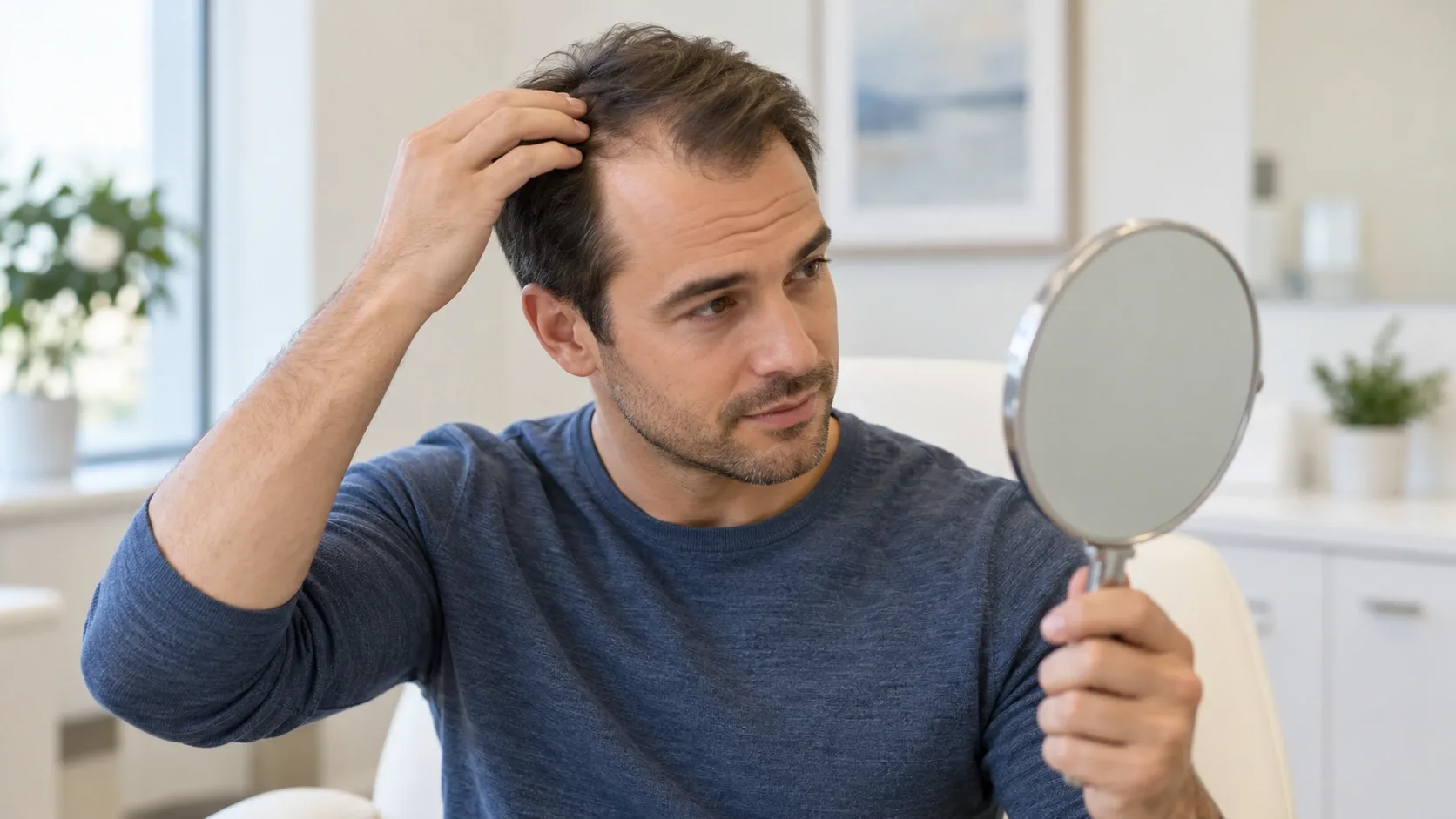
Men in the early to moderate stages of androgenetic alopecia are the best candidates, while advanced loss usually requires surgery.
Is Exosome Therapy Suitable for Early-Stage Male Pattern Hair Loss?
Yes. Early-stage loss responds best because miniaturized follicles remain alive and can re-enter anagen.
Can Men With a Receding Hairline Consider Exosome Treatment?
Yes, if the frontal zone still holds miniaturized follicles. Fully bald, shiny skin usually lacks viable follicles.
Can It Be Used for Diffuse Hair Thinning?
Yes. Diffuse thinning in AGA often reflects widespread miniaturization, which exosomes may help reverse partially.
When Might Advanced Hair Loss Require Another Approach?
When follicles have miniaturized beyond recovery or large areas are bare, hair transplantation becomes the more reliable option.
Exosomes cannot recreate follicles that no longer exist. A physician assesses follicular miniaturization with trichoscopy before recommending any regenerative plan (Nestor 2021).
How Is Exosome Therapy Administered to the Scalp?
Most protocols use intradermal injections, often combined with microneedling, across several sessions spaced weeks apart.
What Happens During the Initial Hair Loss Assessment?
The specialist reviews medical history, examines the scalp, measures hair density, and confirms the alopecia type before treatment.
Accurate diagnosis matters because telogen effluvium, alopecia areata, and AGA need different plans. The reviewed studies used different administration methods and schedules, which is one reason results vary between clinics (Al Ameer 2025).
How Are Exosomes Delivered to Hair-Bearing Areas?
Clinicians use intradermal injections, microneedling-assisted delivery, or topical application after microneedling.
Injection places vesicles directly into the dermis. Microneedling creates channels that improve uptake. Trials combining both methods reported some of the largest density gains (Nadeem 2024).
How Long Does an Exosome Hair Treatment Session Take?
Most sessions take 30 to 60 minutes, depending on the treatment area and delivery method.
What Can Men Expect After Exosome Treatment?
Recovery is usually quick, with mild scalp reactions for a few days and visible density changes typically appearing within 8 to 16 weeks.
Is There Downtime After the Procedure?
Most men return to normal activity the same day or the next day.
What Scalp Reactions Can Occur Immediately After Treatment?
Redness, swelling, itching, and injection-site tenderness are the most common reactions, and they usually resolve within days.
When Might Changes in Hair Density Become Noticeable?
Studies measured improvements as early as four weeks, with clearer gains at 12 weeks and beyond (Dehghani 2024; Ersan 2024).
How Long Should Results Be Monitored?
Men should track results for at least 6 to 12 months, using standardized photos and trichoscopy at consistent intervals.
What Does Clinical Research Say About Exosomes for Male Hair Loss?
The 2025 systematic review included 11 clinical studies, two of them randomized controlled trials, and all reported improvement in at least one hair parameter, but small samples and protocol differences limit firm conclusions (Al Ameer 2025).
What Have Clinical Studies Reported About Hair Density?
Reported gains range from 9.5 to 35 hairs/cm² across studies, but the heterogeneity in design prevents direct comparison.
Different exosome concentrations, delivery routes, and measurement tools explain the wide range (Al Ameer 2025).
What Have Researchers Found About Hair Thickness?
Studies measured hair diameter increases up to 13.01 micrometers, and thicker shafts improve perceived coverage even at stable follicle counts (Nadeem 2024).
What Do Randomized Controlled Trials Show?
The two RCTs reported meaningful advantages over placebo, which gives the strongest current evidence for efficacy (Amini 2025; Nadeem 2024).
Control groups matter because AGA fluctuates and placebo response is real. A plant-extract exosome formulation raised hair counts significantly versus placebo in a pilot RCT (Amini 2025).
How Strong Is the Current Evidence for Exosome Hair Therapy?
The evidence is promising but low to moderate in certainty, limited by small samples, short follow-up, and heterogeneous formulations (Al Ameer 2025).
Is Exosome Therapy Safe for Men With Hair Loss?
Short-term safety data are reassuring. Studies report only mild, transient local reactions, but long-term safety data do not yet exist (Al Ameer 2025).
What Are the Common Short-Term Side Effects?
Redness, swelling, itching, scalp irritation, and injection-site discomfort are the most frequent effects, and they resolve quickly.
Have Serious Adverse Events Been Reported in Clinical Studies?
No serious adverse events appeared in the reviewed studies, but absence of reports is not proof of long-term safety.
Why Does Product Source and Preparation Matter?
Biological source, purification, sterility, and characterization determine whether a product is safe and consistent.
The systematic review stresses that standardized treatment protocols and long-term safety still require investigation (Al Ameer 2025). Men should ask whether the product underwent validated particle counting and sterility testing.
How Does Exosome Therapy Compare With Established Male Hair Loss Treatments?
Exosomes act through regenerative signaling, while established drugs act on hormonal or vascular pathways, and surgery redistributes follicles. A 2025 systematic review compared exosomes directly with PRP and minoxidil and found each option holds a different evidence profile and role (Al Ameer 2025).
Treatment | Mechanism | Evidence strength | Administration |
Exosomes | Regenerative cell signaling | Early, growing | Injections or microneedling, several sessions |
Minoxidil | Potassium channel opening, prolongs anagen | Strong, decades of data | Daily topical |
Finasteride | Blocks DHT production | Strong | Daily oral |
PRP | Autologous growth factors | Moderate | Repeated injections |
Microneedling | Mechanical injury signaling | Moderate as adjunct | Repeated sessions |
Hair transplant | Surgical follicle redistribution | Strong for eligible candidates | Single surgery |
Exosomes vs Minoxidil
Minoxidil prolongs anagen through potassium channel opening, while exosomes aim to restore follicle signaling directly.
Minoxidil carries a large evidence base but requires daily lifelong use (Nestor 2021). Exosome protocols use fewer sessions but lack long-term data.
Exosomes vs Finasteride
Finasteride blocks the DHT pathway systemically, while exosomes use local regenerative signaling, so they pursue different objectives.
Finasteride can cause sexual side effects in a minority of men. Exosomes show no systemic hormonal effect in studies so far, but their long-term profile is unknown (Al Ameer 2025).
Exosomes vs PRP
PRP uses the patient's own platelet growth factors, while exosomes use donor or cultured cell vesicles with a broader cargo.
PRP requires repeated sessions and shows variable preparation quality. Exosome RCTs reported larger short-term density gains, but PRP holds longer follow-up data (Gentile 2025).
Exosomes vs Microneedling
Microneedling alone creates injury signals, while exosome-assisted microneedling adds biological messengers to that stimulus.
Trials pairing both methods reported some of the strongest results, which suggests a synergistic rationale (Wan 2025).
Exosomes vs Hair Transplantation
Transplants permanently redistribute healthy follicles, while exosomes try to rehabilitate existing ones.
These treatments suit different stages. Transplants work where follicles are gone. Exosomes work where follicles survive (Nestor 2021).
Can Exosome Therapy Be Combined With Other Hair Restoration Treatments?
Yes, and combination strategies are common, but a physician must confirm the plan fits the diagnosis.
Can Exosomes Be Used With Microneedling?
Yes. Microneedling channels improve exosome uptake, and trials using both reported strong density gains (Wan 2025).
Can Exosomes Be Combined With PRP?
Yes, some protocols alternate sessions, though direct comparative evidence for the combination remains limited.
Can They Be Used Alongside Medical Hair Loss Treatments?
Yes. Men often continue minoxidil or finasteride while receiving exosomes, since each targets a different pathway.
What Factors Determine Whether Combination Therapy Is Appropriate?
Diagnosis, treatment history, scalp condition, and physician assessment decide the plan.
What Are the Limitations of Exosome Therapy for Male Hair Loss?
The field lacks standardized formulations, large trials, and long-term data.
Available evidence varies in exosome source, preparation, dosage, delivery route, outcome measurement, and follow-up duration (Al Ameer 2025). Commercial preparations differ widely, and small studies cannot predict durability of results.
What Should Men Check Before Choosing an Exosome Hair Treatment?
Verify the diagnosis, the exosome source, product characterization, delivery method, supporting evidence, and follow-up plan.
Has the Cause of Hair Loss Been Properly Diagnosed?
A confirmed AGA diagnosis must precede treatment, because other alopecias need different care.
What Is the Source of the Exosomes?
Ask whether the vesicles come from adipose, placenta, follicle, bone marrow, or umbilical cord tissue, since source shapes the effect.
How Is the Product Prepared and Characterized?
Reputable products report particle counts, sterility, and validated isolation methods.
What Delivery Method Will Be Used?
Ask whether the plan uses injections, microneedling, or both, and how many sessions it includes.
What Evidence Supports the Specific Product?
Ask for published data on that exact formulation, not on exosomes in general.
What Follow-Up Will Be Provided?
Standardized photography and trichoscopy at set intervals allow objective monitoring.
What Questions Should You Ask a Hair Restoration Specialist?
Bring questions about diagnosis, candidacy, product source, processing, administration, measured outcomes, risks, and alternatives.
Ask what type of hair loss you have, whether exosomes fit your stage, where the exosomes come from, how the product is processed, how treatment is delivered, which outcomes will be measured, what risks to expect, and which alternatives exist. A specialist who answers clearly and cites evidence supports informed consent.
What Is the Current Outlook for Exosome Therapy in Male Hair Loss?
Research interest is growing quickly, and regenerative dermatology may gain a new tool, but larger randomized trials and standardized protocols must come first (Al Ameer 2025).
Current studies point to real biological activity and encouraging short-term results. The field needs longer follow-up, uniform formulations, and bigger RCTs before exosome therapy can take a firm place beside established treatments.
Frequently Asked Questions About Exosome for Male Hair Loss
Does exosome therapy regrow hair in men?
Studies show increased density and thickness, but "regrowth" in fully bald areas is not supported.
Can exosomes help with male pattern baldness?
Yes, early clinical data support benefit in AGA, mainly in men with miniaturized but living follicles (Al Ameer 2025).
How long does exosome hair treatment take to work?
Visible changes typically appear between 8 and 16 weeks after the first session.
How many exosome treatments are needed for hair loss?
Most protocols use 3 to 6 sessions spaced 2 to 4 weeks apart, but no standard schedule exists yet.
Are exosomes better than PRP for male hair loss?
Exosomes show larger short-term gains in trials, but PRP has longer follow-up data, so neither is clearly superior (Gentile 2025).
Are exosomes FDA-approved for treating male pattern hair loss?
No. Exosome products do not hold FDA approval for hair loss, and many are marketed under unapproved uses.
Can exosome therapy replace a hair transplant?
No. Exosomes cannot restore follicles that no longer exist, so advanced baldness still needs surgery.
What are the side effects of exosome treatment for hair loss?
Redness, swelling, itching, and injection-site discomfort are the common effects, and they are usually mild and temporary (Al Ameer 2025).
How long do exosome hair treatment results last?
The longest published follow-up is 12 months, and durability beyond that remains unknown (Gentile 2025).
References
Al Ameer, Mohammad A., et al. "Exosomes and Hair Regeneration: A Systematic Review of Clinical Evidence Across Alopecia Types and Exosome Sources." Cureus, 2025.
Amini, Faiz, et al. "A Pilot Randomized Controlled Trial (RCT) Evaluating the Efficacy of an Exosome-Containing Plant Extract Formulation for Treating Male Alopecia." Life, vol. 15, no. 3, 2025, p. 500.
Dehghani, Leila, et al. "Efficacy of Placental-Derived Mesenchymal Stem Cell Exosome Therapy in Treating Androgenetic Alopecia: A Clinical Trial Study." Research Square, 2024.
Ersan, Merve, et al. "Effectiveness of Exosome Treatment in Androgenetic Alopecia: Outcomes of a Prospective Study." Aesthetic Plastic Surgery, vol. 48, 2024, pp. 4262-4271.
Gentile, Pietro, et al. "Autologous Micrografts Containing Nanovesicles, Exosomes, and Follicle Stem Cells in Androgenetic Alopecia: In Vitro and In Vivo Analysis Through a Multicentric, Observational, Evaluator-Blinded Study." Aesthetic Plastic Surgery, vol. 49, 2025, pp. 43-58.
Kost, Yael, et al. "Exosome Therapy in Hair Regeneration: A Literature Review of the Evidence, Challenges, and Future Opportunities." Journal of Cosmetic Dermatology, vol. 21, no. 8, 2022, pp. 3226-3231.
Kwack, Mi Hee, et al. "Exosomes Derived from Human Dermal Papilla Cells Promote Hair Growth in Cultured Human Hair Follicles and Augment the Hair-Inductive Capacity of Cultured Dermal Papilla Spheres." Experimental Dermatology, vol. 28, 2019, pp. 854-857.
Nadeem, Hafsa, et al. "Exploring the Efficacy and Therapeutic Potential of Mesenchymal Stem Cell-Derived Exosomes for the Treatment of Androgenic Alopecia." Journal of Population Therapeutics and Clinical Pharmacology, vol. 31, no. 8, 2024, pp. 1752-1760.
Nestor, Mark S., et al. "Treatment Options for Androgenetic Alopecia: Efficacy, Side Effects, Compliance, Financial Considerations, and Ethics." Journal of Cosmetic Dermatology, vol. 20, no. 12, 2021, pp. 3759-3781.
Park, B. S., et al. "Effects of Exosome from Adipose-Derived Stem Cell on Hair Loss: A Retrospective Analysis of 39 Patients." Journal of Cosmetic Dermatology, vol. 21, no. 5, 2022, pp. 2282-2284.
Sasaki, Gordon H. "Clinical Use of Extracellular Vesicles in the Management of Male and Female Pattern Hair Loss: A Preliminary Retrospective Institutional Review Board Safety and Efficacy Study." Aesthetic Surgery Journal Open Forum, vol. 4, 2022, ojac045.
Wan, Jin, et al. "A Prospective Study of Exosome Therapy for Androgenetic Alopecia." Aesthetic Plastic Surgery, vol. 49, 2025, pp. 3151-3156.