
Exosome Before and After: What Results Can You Expect From Hair Restoration?
Exosome before and after comparisons give patients their first real sense of what regenerative hair therapy can and cannot achieve.

Exosome before and after comparisons give patients their first real sense of what regenerative hair therapy can and cannot achieve. Exosome hair treatment is an emerging, non-surgical approach that aims to influence follicle activity through cell-derived signaling vesicles. Patients search for before-and-after photos because they want evidence, not promises. They want to see changes in hair density, thickness, shedding, and scalp coverage. Results vary widely. The cause of hair loss, the condition of existing follicles, the treatment protocol, and individual biology all shape the outcome (Kanti et al. 2018). One patient's photographs can never guarantee another patient's result.
What Changes Can You See in Exosome Before-and-After Photos?
Real exosome before-and-after photos typically show gradual changes in density, shaft thickness, scalp coverage, and reduced shedding over months, not days.
How Does Hair Density Change in Photographs?
Density refers to the number of hairs per unit area of scalp. In genuine follow-up images, thinning zones such as the part line, temples, and crown appear gradually fuller. However, photo lighting and hairstyle heavily influence how density reads on camera. Standardized trichoscopy, not photography alone, measures true density changes (Lee et al. 2024).
How Can You Tell Thicker Hair From New Hair Growth?
Thickening of existing miniaturized hair and brand-new growth look similar in photos. Thickened shafts indicate follicle revitalization. New hairs suggest follicles re-entered the growth phase. Kwack et al. (2019) showed that dermal papilla-derived exosomes increased hair shaft elongation in cultured human follicles, which supports the biological basis for both effects. A photograph alone rarely distinguishes one from the other.
Why Does Scalp Visibility Change?
As coverage improves, less scalp shows through. Consistent lighting matters here. Direct light exaggerates scalp contrast. Diffused light softens it. Compare photos only when angle, distance, and lighting match.
What About Hair Texture and Shedding?
Some patients report fuller-feeling hair and reduced shedding in the first weeks. Reduced shedding is a plausible early observation because exosomes may shift follicles from the resting phase toward the growth phase (Rajendran et al. 2017). Texture improvements are subjective and should not be promised as a standard outcome.
Change | Objective (measurable) | Subjective (impression) |
Hair density | Count via trichoscopy | Fuller look in photos |
Shaft thickness | Micrometer measurement | Coarser feel |
Shedding | Hair count tests | Fewer hairs on pillow |
Scalp coverage | Standardized imaging | Less scalp visible |
How Does Exosome Treatment Work for Hair Restoration?
Exosomes deliver biological signals that may stimulate follicle cells and improve the scalp environment, but researchers have not yet proven them as a cure for hair loss.
What Exactly Are Exosomes?
Exosomes are extracellular vesicles, roughly 30 to 150 nanometers wide, that cells release to communicate. They carry proteins, lipids, and microRNAs. Dermal papilla cells use these vesicles to regulate hair follicle cycling (Rajendran et al. 2017).
How Might Exosomes Influence Hair Follicles?
Studies show that exosome cargo activates the Wnt/β-catenin pathway, a core signal for follicle growth. Zhou et al. (2018) found that dermal papilla exosomes increased β-catenin expression and prolonged the anagen, or growth, phase in mice. le Riche et al. (2019) demonstrated that extracellular vesicles from activated fibroblasts stimulated human follicle growth ex vivo through the Norrin signaling axis. These are laboratory findings, not established clinical outcomes.
How Do Clinics Administer Exosomes?
Providers deliver exosome preparations through microneedling or intradermal injections, depending on the protocol. Delivery method affects retention. Yang et al. (2019) showed that microneedle patch delivery retained exosomes longer than subcutaneous injection in animal models.
What Should You Expect Before Your First Exosome Session?
Expect a diagnostic scalp assessment, baseline photographs, a review of your medical history, and a frank discussion about evidence and product sourcing.
Why Does Diagnosis Come First?
Androgenetic alopecia, telogen effluvium, and alopecia areata require different strategies. Treating the wrong condition wastes time and money. A qualified clinician should confirm the cause of hair loss before any cosmetic procedure (Kanti et al. 2018).
What Happens During the Assessment?
The clinician examines scalp density, shaft caliber, and thinning patterns. Baseline photographs establish a reliable comparison point. You should also document previous treatments and medical history, because hormonal, nutritional, and medical factors drive many cases of shedding.
What Should You Ask the Provider?
Ask which exosome product they use, where it comes from, how it is manufactured, what regulatory status it holds, and what evidence supports its use for your specific condition. The FDA has warned companies that market unapproved exosome products for hair and other uses (FDA 2019). A transparent provider answers these questions directly.
What Happens During and Immediately After Exosome Treatment?
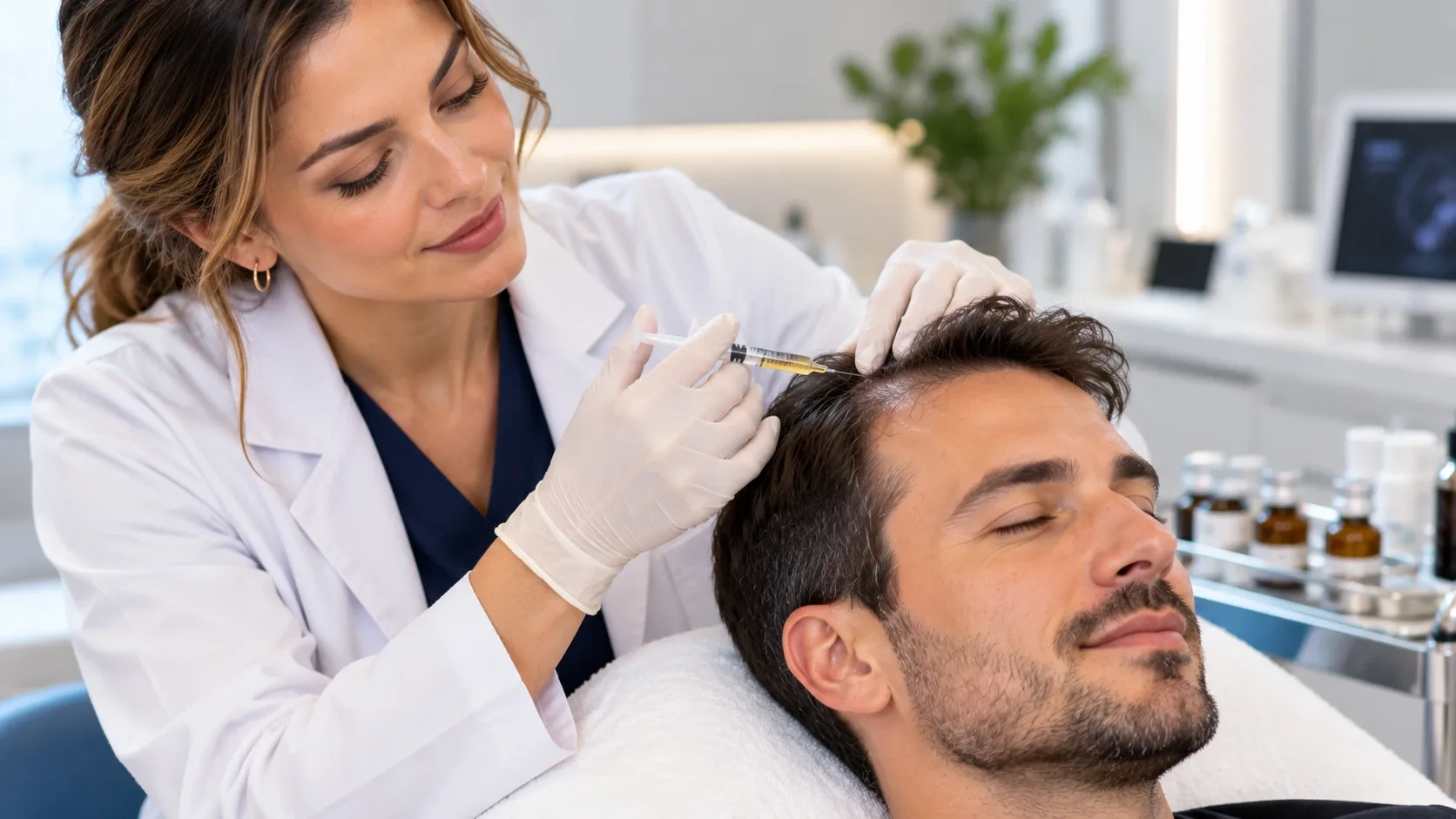
The session involves scalp preparation and delivery via microneedling or injection, followed by temporary redness or tenderness that resolves within days.
What Does the Procedure Involve?
The provider cleans the scalp and applies the exosome preparation through the chosen delivery method. Sessions typically last under an hour.
What Short-Term Reactions Are Normal?
Redness, swelling, tenderness, and mild discomfort commonly occur. These reactions reflect the delivery technique more than the exosomes themselves. Any immediate change in scalp appearance after treatment is a treatment response, not regrowth.
Why Does Aftercare Matter?
Follow the treating professional's instructions on washing, sun exposure, and activity. Recovery periods differ by protocol and product, so no single timeline applies to everyone.
What Does Exosome Before and After Look Like at Different Stages?
Nothing visible in the first days, possible early changes in weeks two to four, and evaluable density or thickness changes between months two and six, with longer follow-up needed for stability.
What Should You Expect in the First Few Days?
Temporary treatment reactions dominate this window. Do not confuse redness or post-procedure styling with growth.
What Might Change Between Weeks Two and Four?
Some patients notice reduced shedding or improved scalp condition. Early change is not guaranteed, and improvement at this stage is usually subtle.
Why Do Clinicians Evaluate at Months Two and Three?
Follicles that respond to signaling typically need weeks to shift cycle and produce visible shafts. Clinicians may begin measuring early thickness changes at follow-up visits around this point.
What Do Months Four to Six Reveal?
This window allows assessment of hair coverage, shaft caliber, and measured density. In a prospective study of 30 men with androgenetic alopecia, Ghalaut et al. (2023) observed a statistically significant increase in hair density at the fourth and twelfth weeks after exosome injection, measured by digital imaging analysis. Note that this was a single-arm study without a control group.
Why Does Follow-Up Extend to Months Six to Twelve?
Hair cycles run in months, not weeks. Longer observation reveals whether improvements stabilize or fade. Clinic-reported timelines are not universal benchmarks, because published clinical evidence remains limited (Lee et al. 2024).
Stage | What may occur | What it means |
Days 1–7 | Redness, swelling | Procedural reaction |
Weeks 2–4 | Reduced shedding (possible) | Early signal, not proof |
Months 2–3 | Early thickness changes | First evaluable window |
Months 4–6 | Density and coverage assessment | Core evaluation period |
Months 6–12 | Stability check | Durability unknown |
How Can You Compare Exosome Before-and-After Results Accurately?
Compare photos with identical lighting, angle, distance, hair length, and styling, and prefer objective tools such as trichoscopy over single images.
Why Does Photography Technique Matter So Much?
Wet hair clumps and exposes scalp. Dry, styled hair conceals it. Warm side lighting exaggerates thinning. A two-minute photo session can manufacture or erase apparent improvement without any editing at all.
Which Scalp Areas Should You Compare?
Track the same zones every time: the hairline, temples, mid-scalp, and crown. Consistent zones turn a photo series into usable data.
How Does Trichoscopy Improve Assessment?
Trichoscopy magnifies the scalp and counts hairs and shaft diameters per area. Lee et al. (2024) used such standardized measurements to document density changes over 24 weeks in a clinical exosome study. Objective measurement separates real improvement from photographic illusion.
Which Factors Influence Exosome Hair Restoration Results?
Diagnosis, follicle viability, severity, protocol, individual health, and concurrent treatments all shape the outcome, which is why results differ so much between patients.
How Does the Cause of Hair Loss Change the Prognosis?
Androgenetic alopecia involves progressive follicle miniaturization driven by dihydrotestosterone. Exosome therapy attempts to revitalize existing follicles. It cannot recreate follicles that are gone.
Why Does Follicle Condition Matter?
Areas with miniaturized but living follicles respond better than smooth bald skin where follicles no longer exist. This single factor explains most of the variation in before-and-after photos.
How Do Protocol and Health Factors Play a Role?
Product formulation, source cells, particle concentration, delivery method, and session schedule all vary between providers (Chen et al. 2020). Meanwhile, iron deficiency, thyroid disorders, and hormonal shifts can continue to drive loss during treatment, masking any benefit.
Why Do Concurrent Treatments Complicate Interpretation?
Patients often combine exosomes with minoxidil, finasteride, or microneedling. Dhurat et al. (2013) showed that microneedling alone significantly improves androgenetic alopecia outcomes. Any observed improvement in a combined regimen cannot be credited to exosomes specifically.
Who Is Most Likely to Benefit From Exosome Hair Treatment?
Patients with early or moderate thinning and viable follicles appear most likely to respond, while advanced baldness and unexplained hair loss require different strategies.
Which Patients Show the Most Promise?
Current clinical research focuses on androgenetic alopecia with existing miniaturized hair. Ghalaut et al. (2023) studied Norwood type III to VI patients, while Lee et al. (2024) followed 30 patients over 24 weeks with measurable density gains.
Why Does Advanced Baldness Respond Poorly?
Once follicles disappear, no signaling therapy can restore them. Surgical hair transplantation remains the only option that relocates viable follicles.
What Should You Do About Sudden or Patchy Hair Loss?
Seek medical evaluation first. Patchy loss suggests alopecia areata or other conditions that need targeted medical care, not cosmetic therapy (Kanti et al. 2018).
How Does Exosome Therapy Compare With PRP and Other Hair Loss Treatments?
Exosomes use cell-derived vesicles, PRP uses your own concentrated platelets, minoxidil is an established medication, and transplantation is surgery. No head-to-head trial proves one superior.
Treatment | Material | Evidence status | Mechanism |
Exosomes | Cell-derived vesicles | Early clinical studies | Paracrine signaling |
PRP | Autologous platelets | Moderate, mixed trials | Growth factor release |
Minoxidil | Approved medication | Strong, decades of data | Prolongs anagen |
Microneedling | Mechanical stimulation | Supportive trials | Wound-healing signals |
Hair transplant | Relocated follicles | Established | Follicle redistribution |
What Is the Key Difference Between Exosomes and PRP?
PRP concentrates platelets from your own blood. Exosomes are manufactured vesicle products with variable composition. PRP has more published trials, though quality varies. Exosomes have fewer but growing human studies (Lee et al. 2024).
How Does Exosome Therapy Differ From Minoxidil?
Minoxidil is an approved drug with decades of safety data and known mechanism through potassium channel modulation and anagen prolongation (Suchonwanit et al. 2019). Exosome therapy remains investigational. Do not substitute one for the other without medical guidance.
Can You Combine Treatments?
Combination can be rational, but it requires individualized assessment. Never assume that adding exosomes to an existing regimen produces superior results, because comparative research does not exist yet.
Are Exosome Before-and-After Results Permanent?
No one can claim permanence. Androgenetic alopecia progresses, and long-term durability data for exosome therapy simply do not exist yet.
Why Does Short-Term Improvement Not Guarantee Lasting Change?
A follicle that re-enters anagen still faces the same hormonal and genetic pressures. Continued loss around treated areas can erase apparent gains.
What Does Long-Term Data Show?
The longest published clinical follow-ups run roughly six months (Lee et al. 2024). No study tracks patients for years. Any guarantee of permanent regrowth contradicts current evidence.
How Should You Think About Maintenance?
Maintenance schedules are protocol-dependent, not scientifically established. Discuss a monitoring plan with your clinician instead of assuming a fixed schedule.
What Are the Risks and Limitations of Exosome Hair Treatment?
Short-term reactions are common and mild, but product quality, regulatory status, and long-term safety remain unresolved questions.
What Short-Term Side Effects Occur?
Redness, swelling, tenderness, and irritation typically resolve within days. Report persistent or unusual symptoms to your clinician.
Why Does Product Quality Matter So Much?
Safety depends on manufacturing standards, sterility, and characterization of the vesicle product. The FDA has cautioned against unapproved exosome products marketed for therapeutic uses (FDA 2019). Ask for documentation of the specific product before you consent.
What Do We Still Not Know?
No large randomized controlled trial has tested exosome therapy against placebo for hair loss. Effect size, optimal dosing, durability, and rare adverse events all remain unmeasured. Small studies and patient reports cannot fill these gaps (Lee et al. 2024).
How Should You Interpret Patient Testimonials and Exosome Results Shared Online?
Treat online before-and-after content as marketing or anecdote, not evidence, unless it includes dated photos, transparent treatment history, and objective measurements.
Why Do Online Results Overstate Success?
Selection bias guarantees that satisfied patients post and dissatisfied patients stay silent. Photographs skip follow-up periods, hide concurrent treatments, and exploit lighting differences. Social media rewards the most dramatic image, not the most accurate one.
What Should Credible Documentation Include?
Look for consistent photo technique, exact dates, full treatment history, and ideally trichoscopy or density counts. Peer-reviewed studies, even small ones like Ghalaut et al. (2023), carry more weight than any testimonial.
What Questions Should You Ask Before Choosing Exosome Hair Restoration?
Ask about the product, the evidence, realistic outcomes, risks, session schedules, provider qualifications, and follow-up plans.
Bring this list to your consultation:
Which specific exosome product will you use, and where does it come from?
What clinical evidence supports it for my type of hair loss?
What results are realistic in my case, and how will you measure improvement?
What risks, uncertainties, and alternatives should I consider?
How many sessions do you propose, and what evidence supports that schedule?
Who performs the procedure, and what are their qualifications?
What follow-up will you provide if results fall short?
A provider who answers these questions clearly deserves your trust. One who guarantees outcomes or dodges product questions does not.
What Is the Final Verdict on Exosome Before and After Results?
Exosome before and after comparisons can show meaningful changes in shedding, thickness, density, and coverage for some patients, but results remain unpredictable, evidence remains preliminary, and no photograph replaces a correct diagnosis and objective follow-up.
The biology is genuinely promising. Exosomes influence follicle signaling, shift hair cycles, and stimulate dermal papilla cells in controlled studies (Rajendran et al. 2017; Kwack et al. 2019). Early human data show measurable density gains in small cohorts (Ghalaut et al. 2023; Lee et al. 2024). Yet the evidence base remains small, uncontrolled, and short. Approach every before-and-after image with disciplined skepticism. Prioritize a confirmed diagnosis, a transparent provider, standardized measurement, and expectations grounded in research rather than marketing.
References
Chen, Ping, et al. "Sustained Release of Dermal Papilla-Derived Extracellular Vesicles from Injectable Microgel Promotes Hair Growth." ACS Applied Materials & Interfaces, vol. 12, no. 15, 2020, pp. 17376–17387.
Dhurat, Rachita, et al. "A Randomized Evaluator Blinded Study of Effect of Microneedling in Androgenetic Alopecia: A Pilot Study." International Journal of Trichology, vol. 5, no. 1, 2013, pp. 6–11.
FDA. "Public Safety Notification on Exosome Products." U.S. Food and Drug Administration, 2019.
Ghalaut, Ram Chander, et al. "Effectiveness of Exosome Treatment in Androgenetic Alopecia: A Prospective Study." Cureus, 2023.
Kanti, Varvara, et al. "Evidence-Based (S3) Guideline for the Treatment of Androgenetic Alopecia." Journal of the European Academy of Dermatology and Venereology, vol. 32, no. 1, 2018, pp. 11–22.
Kwack, Mi Hee, et al. "Exosomes Derived from Human Dermal Papilla Cells Promote Hair Growth in Cultured Human Hair Follicles and Augment the Hair-Inductive Capacity of Cultured Dermal Papilla Spheres." Experimental Dermatology, vol. 28, no. 7, 2019, pp. 854–857.
le Riche, Antoine, et al. "Extracellular Vesicles from Activated Dermal Fibroblasts Stimulate Hair Follicle Growth Through Dermal Papilla-Secreted Norrin." Stem Cells, vol. 37, no. 9, 2019, pp. 1166–1175.
Lee, Sangju, et al. "The Efficacy of Adipose Stem Cell-Derived Exosomes in Hair Regeneration Based on a Preclinical and Clinical Study." Stem Cell Research & Therapy, vol. 15, 2024.
Rajendran, Roshini L., et al. "Extracellular Vesicles Derived from MSCs Activate Dermal Papilla Cells In Vitro and Promote Hair Follicle Conversion from Telogen to Anagen in Mice." Scientific Reports, vol. 7, 2017, article 15560.
Suchonwanit, Poonkiat, et al. "Minoxidil and Its Use in Hair Disorders: A Review." Drug Design, Development and Therapy, vol. 13, 2019, pp. 2777–2786.
Yang, Ruey-Bin, et al. "Exosome-Carried miRNA21-5p Induces Cell Proliferation and Promotes Hair Growth by Targeting CMTM4." Stem Cell Research & Therapy, vol. 10, 2019.
Zhou, Lijuan, et al. "Exosomes Derived from Human Dermal Papilla Cells Promote Hair Growth in Mice by Activating Wnt/β-Catenin Signaling." Experimental Dermatology, vol. 27, no. 10, 2018, pp. 1125–1132.